“In the middle of one of the world's most chaotic cities, 500-year-old royal tombs serve as the backdrop for morning yoga and political power walks.”
About Lodi Gardens
The Lodi period was the final chapter of the Delhi Sultanate, and their architectural style was defined by a rugged, masculine simplicity compared to the later Mughal opulence. The gardens were once part of a much larger necropolis that stretched across the southern plains of the city. The British intervention in the 1930s was controversial at the time as it displaced local residents, but it ultimately preserved the ruins from being swallowed by urban sprawl. Today, the park is a protected monument under the Archaeological Survey of India, serving as a vital green corridor that supports hundreds of bird species and ancient plant life.
What Lodi Gardens actually is
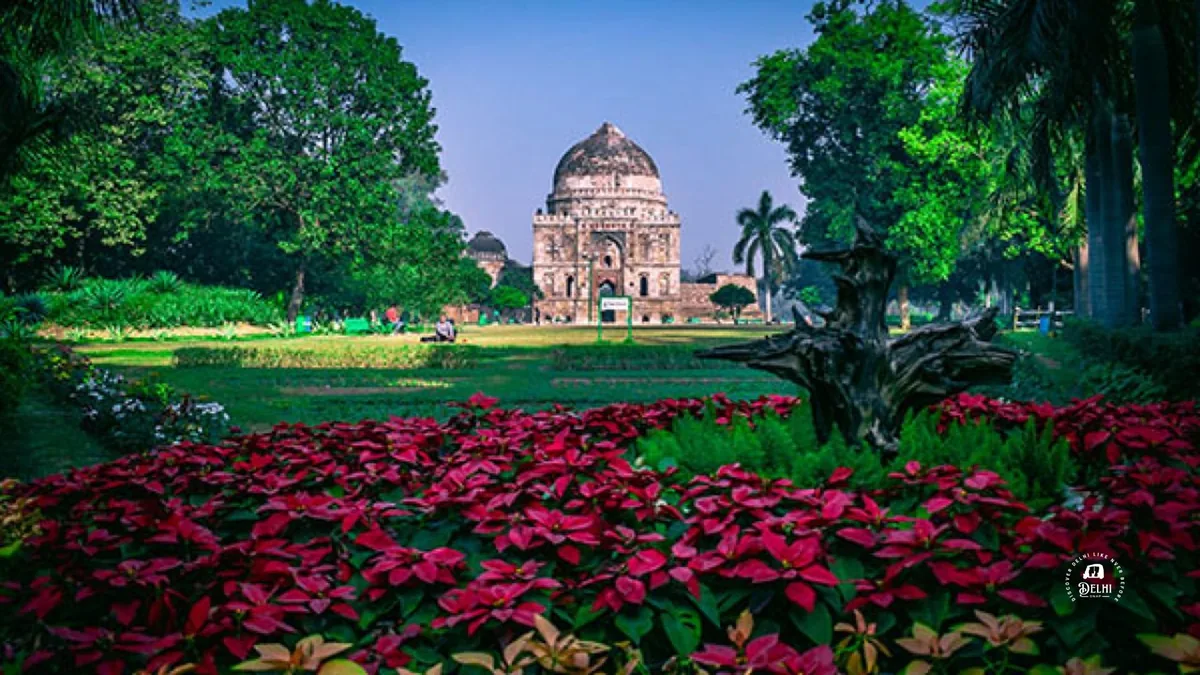
Lodi Gardens is the refined lungs of New Delhi, a place where 15th-century stone tombs sit amidst a lush ninety-acre landscape of manicured lawns and ancient banyan trees. This is not a static monument but a living public space where power-walking politicians, yoga practitioners, and young lovers mingle under the gaze of Sayyid and Lodi architecture. The surroundings here is noticeably cooler and cleaner than the surrounding city, smelling of cut grass and blooming bougainvillea. The sound is a mix of the sharp calls of rose-ringed parakeets and the distant, muffled roar of Delhi’s traffic. The grit of the modern capital feels miles away as you wander through the massive stone arches of the Bara Gumbad, whose dark, weathered surfaces tell the story of a pre-Mughal Delhi.
Lodi Gardens is the refined lungs of New Delhi, a place where 15th-century stone tombs sit amidst a lush ninety-acre landscape of manicured lawns and ancient banyan trees.
The gardens house the tombs of the Sayyid
The gardens house the tombs of the Sayyid and Lodi dynasties, who ruled Delhi from 1414 to 1526 before being ousted by the Mughals. These structures represent a transition in Indian architecture, moving toward the octagonal shapes and grand domes that would later reach their peak with the Taj Mahal. The most significant tombs belong to Mohammed Shah and Sikandar Lodi. In the 1930s, the British landscape architect Lady Willingdon cleared the surrounding villages and designed the park as 'Willingdon Park.' After independence, it was renamed Lodi Gardens and redesigned in 1968 by American landscape architect Garrett Eckbo and local architect Joseph Allen Stein, who integrated the medieval ruins with the modern needs of a growing city.
Walking the paved paths in the early morning , The quiet energy of a city at rest. the rough, cool texture of the ancient stone stepping into the Sheesh Gumbad, where the remnants of blue glazed tiles still catch the morning sun. At first, the massive trunks of the trees, their roots wrapping around the masonry like giant wooden fingers. The light at sunset is particularly dramatic, casting long shadows of the tombs across the grass and turning the grey stone a warm, dusty orange. The mass of the democratic spirit of the place; it is one of the few spots in Delhi where the elite and the ordinary coexist in a shared space of beauty. The sound of dogs barking and children playing near the pond adds a layer of contemporary life to the historical solemnity. Located deep in South Delhi, the gardens are easily reached by the Delhi Metro via the Jor Bagh or Khan Market stations. The entrances are free and open from dawn to dusk. Almost all visitors combine a walk through the gardens with a visit to the nearby Khan Market for coffee or shopping. The park is most vibrant during the winter months when the flowerbeds are in full bloom and the weather is perfect for a picnic. Arriving just after sunrise is the best way to see the ruins in their most peaceful state before the joggers and the professional photographers take over the landscape.
The Experience
Within Lodi Gardens has a soft, earthy quality that settles your nerves. The thing you pick up on is the tiny, vibrant green parakeets that nest in the cracks of the stone domes, their screeching a constant part of the garden's atmosphere. The immense thickness of the walls in the Bara Gumbad, which keep the interior cool even on the hottest days. The most poignant moment is standing on the 16th-century Athpula bridge over the central pond; you see the reflection of the tombs in the water, framed by the modern skyline in the distance, a perfect encapsulation of Delhi's layered history.
Within Lodi Gardens has a soft, earthy quality that settles your nerves.
Why It Matters
Lodi Gardens is the premier example of pre-Mughal Islamic architecture in India and a masterclass in urban landscape design. It represents a successful fusion of historical preservation and public utility. Culturally, it is the intellectual and social heart of the capital, serving as an unofficial 'parliament' for the city’s thinkers, artists, and leaders.
Why Visit
This matters because is where Delhi is at its most civil and beautiful. While the Red Fort is a museum and India Gate is a spectacle, Lodi Gardens is an experience. It is the only place where you can touch 15th-century history while having a casual Sunday picnic. It is the city's most gracious host.
✦ Insider Tips
- 1
Enter through the gate near Khan Market and grab a takeaway coffee to enjoy while you walk.
- 2
Look for the blue glazed tiles on the Sheesh Gumbad; they are rare surviving examples of 15th-century Persian influence.
- 3
Visit the Bonsai Garden located within the complex for a quiet, miniature escape from the larger park.
- 4
If you are a birdwatcher, bring your binoculars to the central pond; it is a hotspot for migratory species in the winter.
- 5
Avoid the park on Sunday afternoons if you want peace; it becomes the city’s favorite spot for large, loud family gatherings.