Over thirty-three thousand stone sculptures inhabit the fourteen towers of this temple, creating a vivid, multi-colored encyclopedia of Hindu mythology that dominates the skyline of Madurai.
About Meenakshi Amman Temple
The temple was the center of the Tamil Sangam, the ancient academy of literature, making it as much a site of intellectual history as religious devotion. Following the Nayak reconstruction, the temple became a masterpiece of Dravidian architecture, characterized by its geometric precision and massive scale. The outer walls and gateways were designed to be so imposing that they functioned as a secondary defense for the city during times of war. Today, it remains one of the few ancient temples in India that continues to manage its own vast estates and charitable institutions, operating with a level of autonomy that has lasted for hundreds of years.
What Meenakshi Amman Temple actually is
Fourteen towering gopurams rise above the city of Madurai, their surfaces a dizzying riot of thousands of brightly painted stone deities, demons, and celestial dancers. The Meenakshi Amman Temple is a city within a city, a sprawling granite fortress that has was the heartbeat of Tamil culture for over two millennia. Within, the space the complex smells of crushed jasmine, camphor, and the damp, cool smell of ancient stone. Here, the rhythm of life is dictated by the ringing of temple bells and the constant shuffle of pilgrims moving through the labyrinthine corridors. The sun catches the gold-plated shrines of the inner sanctums, creating a brilliant contrast with the deep shadows of the pillared halls where thousands of stone sculptures keep watch.
“Fourteen towering gopurams rise above the city of Madurai, their surfaces a dizzying riot of thousands of brightly painted stone deities, demons, and celestial dancers.”
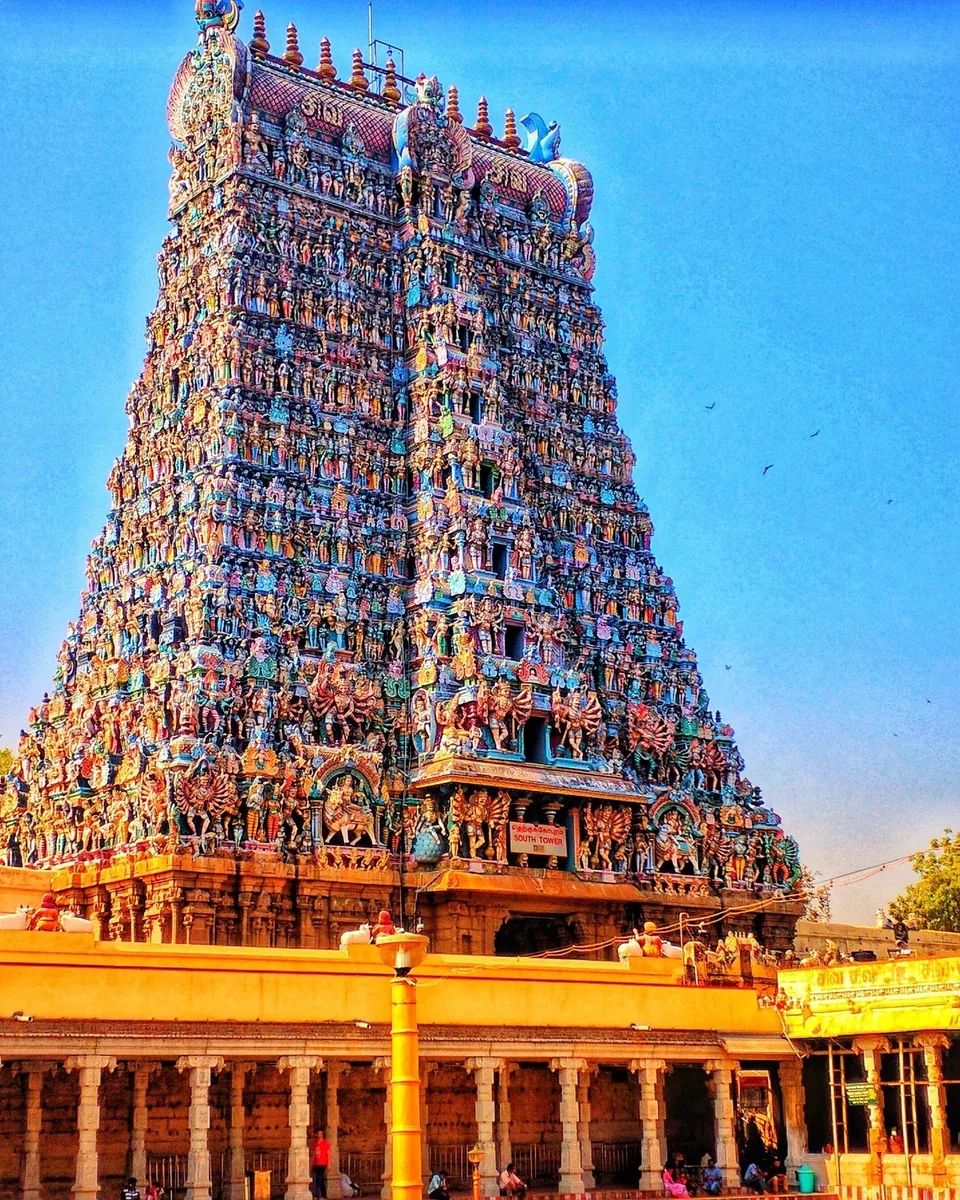
Meenakshi Amman Temple, India
History
Legend says the temple was founded by Indra, but the historical core was expanded significantly during the Pandyan dynasty. In the 14th century, the temple was nearly razed during the raids of Malik Kafur, only to be rebuilt with even greater grandeur by the Nayak rulers in the 1600s. King Tirumala Nayak was responsible for the Hall of a Thousand Pillars, an architectural marvel where every column is carved from a single block of granite. The temple is dedicated to Meenakshi, a form of Parvati, and her consort Sundareshwar. Unusually for a major Indian temple, the goddess takes center stage, reflecting the ancient matriarchal traditions of the region. Every night, the priests carry a statue of the god to the goddess's chamber in a ceremonial procession that has been performed for centuries.
Passing through the massive southern gateway,
Passing through the massive southern gateway, the immediate transition from the modern chaos of Madurai to a space governed by ancient ritual. You get a cold, polished granite under your bare feet and notice the vibrant colors of the ceiling murals depicting celestial myths. In the Thousand Pillar Hall, the acoustics are so precise that the sound of a single flute can travel to the farthest corner without a microphone. Right off, the Golden Lily Tank, where pilgrims perform ritual ablutions while the reflections of the gopurams dance on the water's surface. The sound is a constant wall of chanting and the soft lowing of the temple elephant. At night, the atmosphere turns electric as the oil lamps are lit, casting long, dramatic shadows against the prehistoric carvings.
Madurai is well-connected by air and rail
Madurai is well-connected by air and rail to Chennai, Bangalore, and Kochi. The temple sits at the exact center of the city’s grid-like streets. Almost all visitors arrive via auto-rickshaw at the perimeter of the pedestrian-only zone. To appreciate the scale of the gopurams, you must walk the narrow streets of the surrounding bazaar, where the towers suddenly appear between the gaps in the buildings. Entering through the East Tower allows you to follow the traditional path of the pilgrims, though the West Tower often offers the shortest security lines during the busy midday hours.
“Madurai is well-connected by air and rail to Chennai, Bangalore, and Kochi.”
The Experience
The morning light in the outer courtyards is soft and hazy, filtered through the smoke of a thousand incense sticks. The feel of the stone, smoothed by millions of hands over the centuries, and the way the paint on the gopurams looks almost neon against the blue South Indian sky. You discover a vibration of the nadaswaram, a traditional reed instrument, piercing through the quiet of the inner halls. The most moving moment occurs during the 'Palliyarai' ceremony at 9:00 PM, when the temple is filled with the rhythmic chanting of priests and the heavy, sweet aroma of sandalwood as the deities are put to rest for the night.
Why It Matters
Meenakshi Amman is the spiritual and cultural anchor of the Tamil people, representing the pinnacle of the Nayak architectural style. It is a living museum of South Indian history, art, and philosophy. Humanly, it demonstrates to the resilience of a culture that rebuilt its holiest site from the ashes of invasion to create something even more magnificent.
Why Visit
This place pulls because this is not a museum; it is a functioning spiritual powerhouse. While the temples of the north are often ruins, Meenakshi is a riot of contemporary life. You go to witness a 2,000-year-old tradition that hasn't lost a shred of its intensity or its color in the modern age.
Insider Tips
- 1
Hire a licensed temple guide at the entrance; the iconography is too complex to decode without expert help.
- 2
Check your electronics at the locker rooms, as cameras and mobile phones are strictly prohibited inside the inner temple complex.
- 3
Look for the 'Musical Pillars' in the outer corridors that produce different notes when tapped with a thumb.
- 4
Visit the Art Museum inside the Thousand Pillar Hall to see bronze icons that date back over a thousand years.
- 5
Avoid the midday heat by visiting at dawn, when the rituals are most authentic and the stone is still cool to the touch.