“Among the two hundred thousand treasures here is a tiny bronze girl who has been captured in mid-dance for over four and a half thousand years.”
About National Museum
The museum’s collection was bolstered in its early years by the visionary leadership of its first curators, who sought to bridge the gap between ancient ritual and modern art. It survived the bureaucratic hurdles of early independence to become a world-class institution. The Buddhist section is particularly significant, housing sacred relics of the Buddha found in Piprahwa, which draw pilgrims from across Asia. In recent years, the museum has embraced digital technology, creating interactive displays that allow visitors to see the microscopic details of its miniature painting collection, one of the largest and finest in the world.
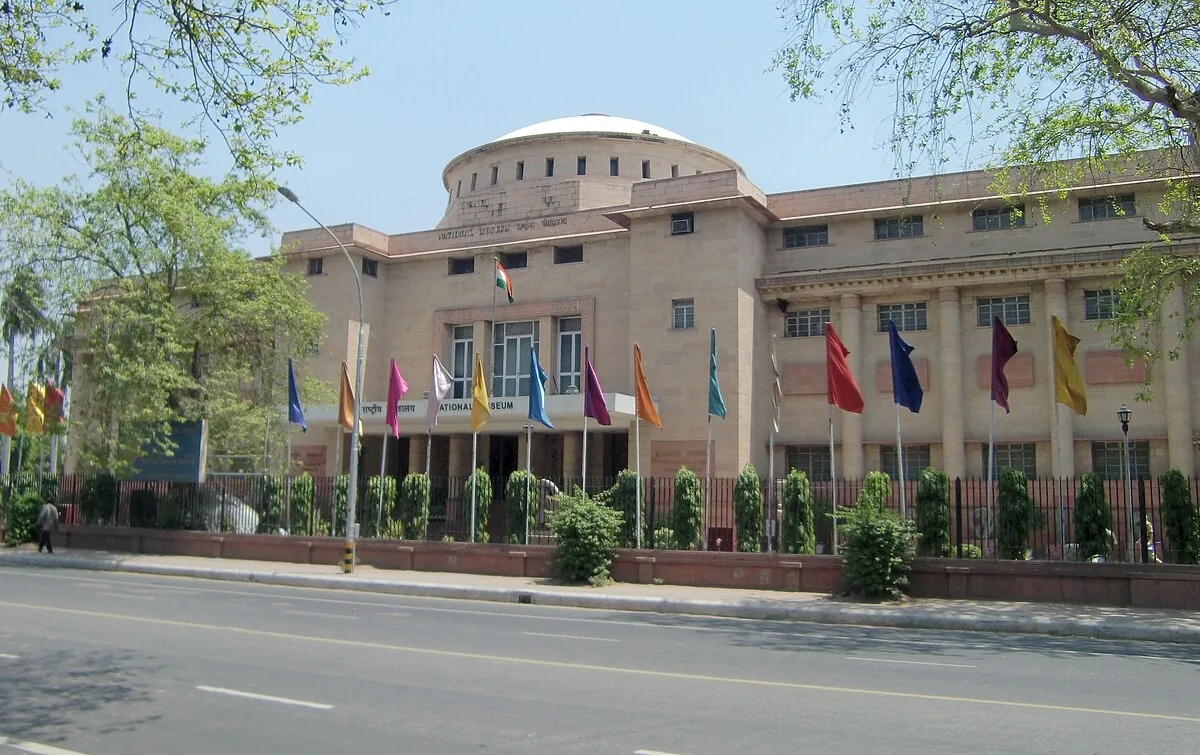
New Delhi’s National Museum
New Delhi’s National Museum is a sprawling, multi-story repository that attempts to do the impossible: condense five thousand years of Indian civilization into a single building. Located on Janpath, the museum is a sober, sand-colored structure that houses over two hundred thousand artifacts. Within, the space is hushed and temperature-controlled, a sharp contrast to the humid, honking chaos of the capital outside. From the terracotta toys of the Harappan era to the jewel-encrusted swords of the Mughals, the museum offers a tactile timeline of the human spirit on the subcontinent. It is a place that demands a slow pace, where the light is kept dim to protect the silk paintings and the ancient wood carvings smell faintly of aged cedar and polish.
New Delhi’s National Museum is a sprawling, multi-story repository that attempts to do the impossible: condense five thousand years of Indian civilization into a single building.
The roots of the museum lie in a 1947 exhibition of Indian art held at the Royal Academy in London. Upon its return to India, the collection was so significant that the government decided to establish a permanent home for it in the new capital. The first prime minister, Jawaharlal Nehru, laid the foundation stone in 1955, envisioning it as a temple to the nation's newfound post-colonial identity. Over the decades, it has grown through archaeological finds and generous private donations. The building itself is designed in a style that echoes the red sandstone architecture of Lutyens’ Delhi, creating a seamless aesthetic link with the nearby Parliament and India Gate. It remains the premier institution for the study and preservation of South Asian heritage.
Walking through the Harappan gallery, There
Walking through the Harappan gallery, There is a jolt of recognition at the sight of the 'Dancing Girl,' a tiny bronze figure from 2500 BCE whose posture feels startlingly modern. The precision of the stone-carved Buddha from the Kushan period, his expression one of absolute, unshakeable peace. The museum is organized chronologically and by theme, allowing you to move from the early stone age to the elaborate decorative arts of the 19th century. The presence of the silence in the manuscript room, where the tiny, perfect calligraphy of ancient palm leaves requires you to lean in close. The most evocative section is often the jewelry gallery, where the sheer density of gold and diamonds from the Nizam of Hyderabad's collection reveals the staggering wealth of India’s princely past.
The museum sits at the core
The museum sits at the core of Lutyens' Delhi at the intersection of Janpath and Maulana Azad Road. It is easily accessible by the Delhi Metro, Central Secretariat station is the closest, followed by a short walk or rickshaw ride. Given the scale of the collection, many visitors find it helpful to hire one of the audio guides at the entrance. The museum is closed on Mondays and national holidays. Because it is a favorite destination for local school groups, arriving right when it opens at 10:00 AM allows for a more solitary experience in the more popular galleries like the bronze and Buddhist sections.
The museum sits at the core of Lutyens' Delhi at the intersection of Janpath and Maulana Azad Road.
The Experience
The museum is the muffled shuffle of shoes on heavy rugs and the occasional chime of a guard's bell. The standout is the cool, dry air that seems to strip the Delhi humidity from your skin the moment you enter. The immense span of time in the stone sculpture galleries, where the granite and sandstone figures have survived the rise and fall of dozens of empires. The most intimate moment is found in the textile gallery, where the intricate patterns of ancient pashminas and silks reflect a level of patience that is almost unimaginable in the modern age. It is a place that makes the history of the world feel personal and immediate.
Why It Matters
The National Museum is the primary guardian of India’s material history and a vital center for archaeological research. It houses the world's most significant collection of Harappan artifacts and a peerless assembly of Central Asian antiquities. Culturally, it serves as the foundational text for understanding the diverse and complex layers that make up the modern Indian identity.
Why Visit
Worth it because you cannot understand the present of India without seeing the ghosts of its past. While a fort tells you about power, this museum tells you about people, what they wore, how they played, and what they worshipped. It is the most efficient and moving way to grasp the staggering depth of Indian civilization in a single afternoon.
✦ Insider Tips
- 1
The 'Dancing Girl' from Mohenjo-daro is much smaller than you expect, only ten centimeters tall, so look carefully in the Harappan section.
- 2
Don't miss the museum cafe; it serves surprisingly good traditional Indian snacks and offers a quiet place to process what you've seen.
- 3
The Central Asian gallery contains murals and artifacts recovered by the explorer Aurel Stein that are unique in the world.
- 4
Wear comfortable walking shoes, as you will likely cover several kilometers of gallery space if you try to see everything.
- 5
Check the schedule for the free guided tours; the staff experts often share stories about the artifacts that aren't on the labels.