“Designed as a celestial chariot with wheels that function as accurate sundials, this 13th-century stone masterpiece was once used by sailors to navigate the Bay of Bengal.”
About Sun Temple
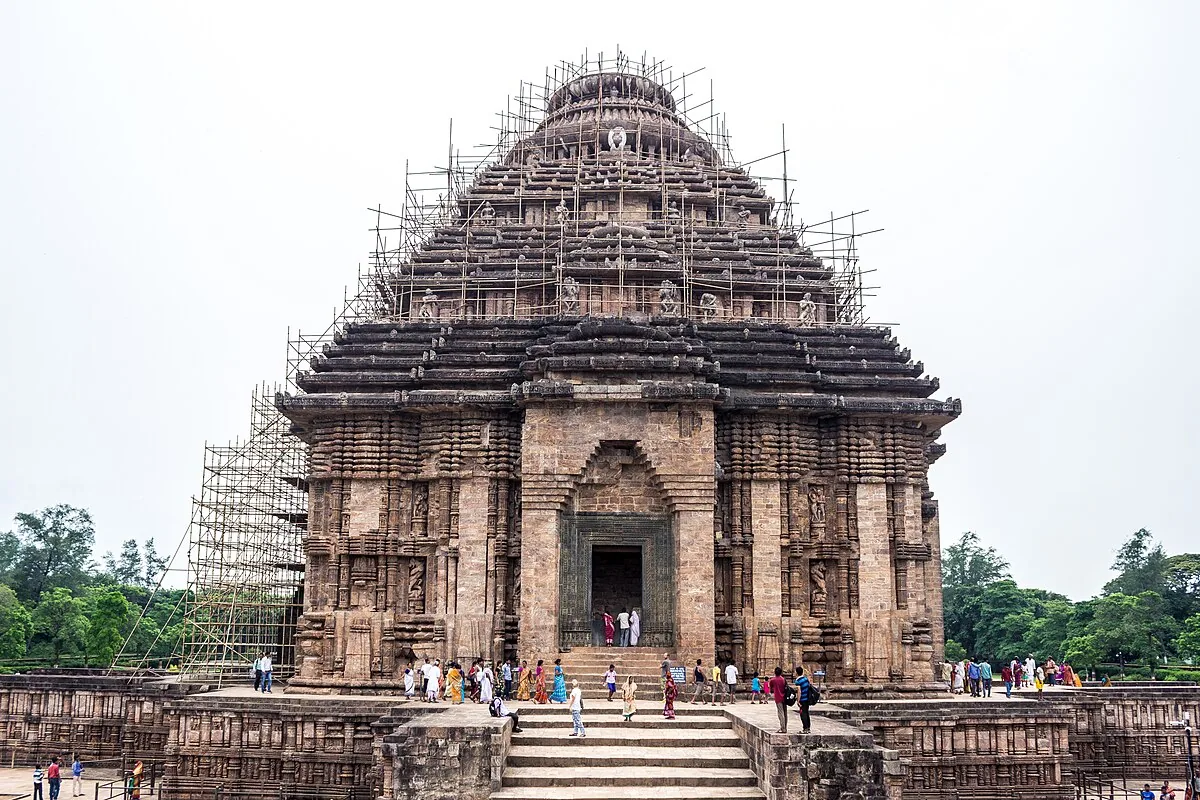
The temple's collapse remains a subject of intense debate among historians; theories range from the removal of a massive magnetic cap that held the structure together to the gradual shifting of the sandy foundations. Despite the loss of the main tower, the remaining structures were declared a UNESCO World Heritage site in 1984. The carvings are a social encyclopedia of the time, documenting the military, domestic, and religious life of the Ganga Empire. The preservation efforts continue to this day, with the interior of the main hall filled with sand to prevent further collapse, a controversial but necessary measure to save the remaining architecture for future generations.
Sun Temple in short
Konark’s Sun Temple is a gargantuan stone chariot, its twenty-four massive wheels carved with such precision they could almost be mistaken for clockwork. Rising from the coastal sands of Odisha, the temple is a monument to the sun god Surya, designed to appear as if he is being pulled across the sky by seven galloping horses. On all sides, The air is thick with the salt of the Bay of Bengal, and the sound of the ocean is a constant, distant roar. The dark khondalite stone of the temple has weathered into a deep, earthy grey, creating a dramatic silhouette against the bright, tropical sky. Every square inch of the structure is covered in carvings, ranging from celestial dancers to erotic scenes, that capture the vitality and complexity of 13th-century Indian life.
Konark’s Sun Temple is a gargantuan stone chariot, its twenty-four massive wheels carved with such precision they could almost be mistaken for clockwork.
commissioned the temple, 1250
King Narasimhadeva I of the Eastern Ganga Dynasty commissioned the temple around 1250 CE to celebrate his military victories and the glory of the sun. Legend says twelve hundred architects worked for twelve years to complete the structure, which was originally much taller and was a landmark for sailors, who called it the 'Black Pagoda' to distinguish it from the white-washed temple at Puri. The main sanctuary tower collapsed centuries ago, but the surviving audience hall and the chariot base remain one of the pinnacles of Kalinga architecture. The site was eventually reclaimed from the encroaching jungle and sand by British archaeologists in the late 19th century, revealing a masterpiece of engineering where massive iron beams were used to support the stone lintels.
Approaching the temple, the immense scale
Approaching the temple, The immense scale of the wheels, each nearly ten feet in diameter and functioning as an accurate sundial. There is a rough, sandy texture of the stone and notice the intricate details of the jewelry on the stone dancers. In the Natya Mandap, or dancing hall, the pillars are so densely carved that they seem to move as the sun shifts. The smell of the sea breeze mixing with the dry scent of sun-heated stone. The volume is a mix of the wind whistling through the hollow chambers and the murmurs of visitors trying to decipher the complex carvings. The light at dawn is particularly special; the temple was oriented so that the first rays of the sun would pass through the main entrance and strike the diamond in the center of the presiding deity's crown.
Konark is a smooth sixty-kilometer drive
Konark is a smooth sixty-kilometer drive from the state capital, Bhubaneswar, which has a major airport and railway station. Many visitors stay in the nearby temple town of Puri and take a day trip along the scenic Marine Drive road. The site is a UNESCO World Heritage monument and is well-maintained with paved walkways and information boards. Arriving early in the morning allows you to beat the intense humidity and the busloads of day-trippers. The government-run light and sound show in the evening provides a dramatic retelling of the temple's myths and history under the stars.
Konark is a smooth sixty-kilometer drive from the state capital, Bhubaneswar, which has a major airport and railway station.
The Experience
Up at Konark feels heavy with the weight of time and the proximity of the sea. The tiny, repetitive patterns in the stone wheels that represent the seasons and the times of day, a level of detail that is almost hypnotic. You come across a heat of the stone radiating through your shoes as the midday sun climbs. The most moving moment is looking up at the seven stone horses, only a few of which remain intact, straining at their harness, forever frozen in their race across the sky. It is a place that makes you feel the sheer ambition of the human imagination when it seeks to honor the cosmic.
Why It Matters
The Sun Temple is the supreme achievement of Kalinga architecture and one of the world's most important sites of solar worship. It is a unique example of a religious structure designed as a kinetic object, a chariot in motion. Culturally, it remains the defining symbol of Odisha, appearing on the national currency and representing the state's historical maritime power.
Why Visit
Visit Konark because it is a mathematical and artistic miracle. While other temples are houses for the gods, this is a vehicle for one. The precision of the sundials and the sheer density of the carvings offer a level of sophistication that challenges our modern assumptions about medieval technology. It is stone-work at its most audacious.
✦ Insider Tips
- 1
Hire a licensed guide to show you how to tell the exact time using the shadows cast by the spokes of the chariot wheels.
- 2
Visit the small archaeological museum nearby to see the original sculptures that were removed from the temple for preservation.
- 3
Check the dates for the Konark Dance Festival in December, where India’s best classical dancers perform with the illuminated temple as a backdrop.
- 4
Stop at the Chandrabhaga beach just three kilometers away to see the sun rise over the same ocean that inspired the temple's builders.