“While an entire empire was burned to the ground in 1565, this temple remained standing, its sacred fires never once extinguished in over a thousand years.”
About Virupaksha Temple Complex
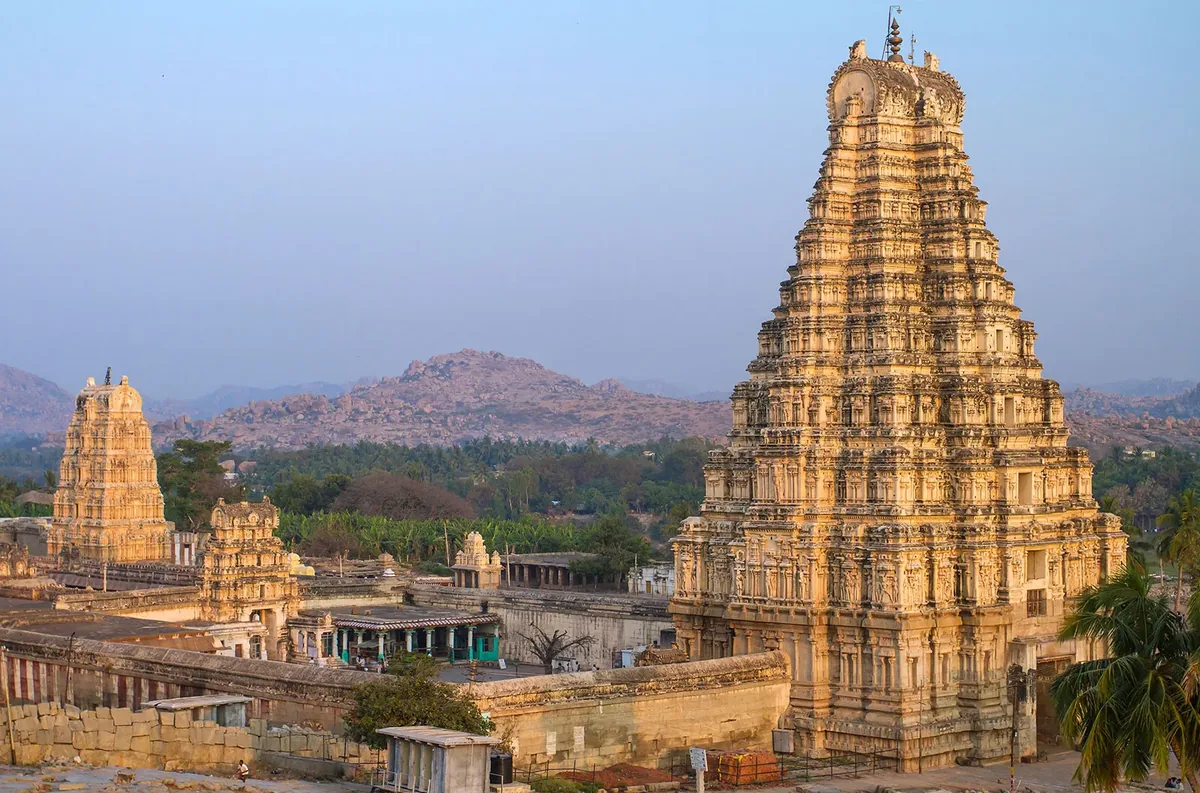
The temple began as a small shrine to the river goddess Pampa and Shiva long before the Vijayanagara Empire was founded in 1336. As the empire flourished, rulers like Krishnadevaraya added the grandest features, including the central pillared hall to celebrate his coronation. The intricate ceiling paintings, which depict scenes from the Ramayana, date back to the 16th century and are some of the best-preserved examples of Vijayanagara art. Despite the ruins surrounding it, the temple has undergone continuous maintenance, with the main gopuram being renovated in the early 19th century to its current, towering height.
What Virupaksha Temple Complex is
Virupaksha Temple is the living heart of Hampi, a jagged, ochre-colored skyline of granite boulders and ancient ruins in the state of Karnataka. While the rest of the vast Vijayanagara Empire fell to ruin in 1565, this temple remained active, its worship uninterrupted for over a millennium. The central gopuram, a fifty-meter-high tiered tower, looms over a landscape that looks like it was designed by a giant playing with pebbles. The space smells of camphor, jasmine, and the ancient dust of the Deccan plateau. The Tungabhadra River flows just behind the complex, its dark waters providing a cool contrast to the sun-scorched stone of the temple courtyards.
Virupaksha Temple is the living heart of Hampi, a jagged, ochre-colored skyline of granite boulders and ancient ruins in the state of Karnataka.
The temple’s roots extend
The temple’s roots extend to the 7th century, making it one of the oldest functioning shrines in India. It grew from a modest collection of shrines into a massive complex under the patronage of the Vijayanagara kings, who saw themselves as the earthly representatives of the god Virupaksha, a form of Shiva. In the 14th century, the city of Hampi was one of the largest and wealthiest in the world, a global hub for the diamond and spice trades. When the city was sacked and burned by a coalition of sultanates, the invaders systematically destroyed the surrounding palaces and temples, but the Virupaksha complex was spared, perhaps due to its extreme sanctity. Today, it is the lone survivor of a golden age, a stone bridge between the medieval past and the devotional present.
Walking through the towering entrance,
Walking through the towering entrance, The heat of the sun-baked stone through your feet. The standout is the resident temple elephant, Lakshmi, who blesses pilgrims with a gentle trunk-tap in exchange for a coin or a banana. Inside the pillared halls, the carvings are so dense they appear to vibrate, gods, dancers, and mythical beasts frozen in granite. You get a cool darkness of the inner sanctum, where the air is heavy with the smoke of oil lamps. A highlight is the 'pinhole camera' effect in a small dark room at the rear of the complex, where a tiny opening in the wall projects an inverted shadow of the massive main gopuram onto the floor, a medieval engineering marvel that still baffles and delights. Hampi is a day’s journey from either Bangalore or Goa. The nearest railhead is Hospet, from where a short rickshaw ride brings you to the Hampi Bazaar. The temple is the undisputed center of the village. The best way to experience it is by staying in a guesthouse on the opposite side of the river and crossing by a small coracle boat at dawn. This allows you to climb Hemakuta Hill just before sunrise, watching the morning light slowly illuminate the towers of Virupaksha while the call to prayer and the temple bells echo across the boulder-strewn valley.
The Experience
The soundscape of Virupaksha is a mix of chanting, the rhythmic ringing of bells, and the chatter of monkeys that scale the temple towers with ease. First, the smell of the river mud mixing with the sweet scent of temple offerings. The immense age of the place in the way the stone floors have been polished to a mirror-finish by centuries of bare feet. The most serene moment is at dusk, when the lamps are lit and the shadows of the pillars stretch across the courtyard, making the carvings seem to come alive in the flickering light. It is a place that feels heavy with the prayers of thirty generations.
The soundscape of Virupaksha is a mix of chanting, the rhythmic ringing of bells, and the chatter of monkeys that scale the temple towers with ease.
Why It Matters
Virupaksha is the primary religious anchor of the UNESCO World Heritage site of Hampi and a masterpiece of Dravidian architecture. It represents the resilience of South Indian cultural traditions in the face of total imperial collapse. Culturally, it remains a major pilgrimage site, keeping the ancient myths of the Tungabhadra Valley active in the modern world.
Why Visit
Visit Virupaksha because it provides the soul to Hampi’s stone skeleton. While the nearby palaces and stables are fascinating ruins, Virupaksha is a living continuity. It is the only place where you can see the rituals of the 14th century performed in their original setting, surrounded by the ghosts of a fallen empire.
✦ Insider Tips
- 1
Climb Hemakuta Hill at sunset for a view of the temple complex silhouetted against the river; it is far less crowded than the sunrise climb.
- 2
Bring plenty of bananas for Lakshmi the elephant, but keep your bags tightly closed near the monkeys on the upper tiers.
- 3
Look for the 'inverted shadow' room; ask a local priest or guide to point it out, as it is easily missed behind a small wooden door.
- 4
Wear socks if you have sensitive feet; the granite courtyards become searingly hot by 11:00 AM.
- 5
The riverside path behind the temple leads to the 'Achyutaraya Temple,' which is often completely deserted and offers a hauntingly beautiful ruin experience.