While the rest of the world was charting the oceans, a civilization of tens of thousands lived in a hidden mountain basin, completely unknown to mapmakers until a pilot spotted their gardens in 1938.
About Baliem Valley
Richard Archbold’s 1938 expedition turned the scientific world upside down by discovering a thriving agricultural society in what was thought to be an empty mountain range. The Dani people had spent thousands of years perfecting irrigation and stone tool technology in total seclusion. During World War II, the valley became the site of a famous rescue mission after a U.S. Army plane crashed in a 'Shangri-La' that the survivors realized was actually home to a sophisticated tribal culture. By the 1950s, Christian missionaries began replacing stone axes with steel ones, and the traditional tribal wars were slowly discouraged. Today, the valley exists in a delicate balance, where ancient agricultural rituals continue alongside the creeping arrival of cellular towers and modern medicine.
What Baliem Valley actually is
High within the Jayawijaya Mountains of Papua, a massive emerald basin remains shielded by limestone peaks that pierce the clouds at four thousand meters. Baliem Valley is a geological sanctuary where time operates on a different axis. The landscape is a patchwork of sweet potato gardens and thatched 'honai' dwellings, crisscrossed by the silty, serpentine curves of the Baliem River. Walking through the valley, you encounter a silence so profound it feels physical, broken only by the rush of mountain streams or the distant call of a tribal elder. The setting is thin, crisp, and carries the faint, omnipresent scent of peat fire. This is not the tropical Indonesia of palm trees and white sand; it is a rugged highland world where the stone age and the digital age collide in the mud of a mountain trail.
“High within the Jayawijaya Mountains of Papua, a massive emerald basin remains shielded by limestone peaks that pierce the clouds at four thousand meters.”
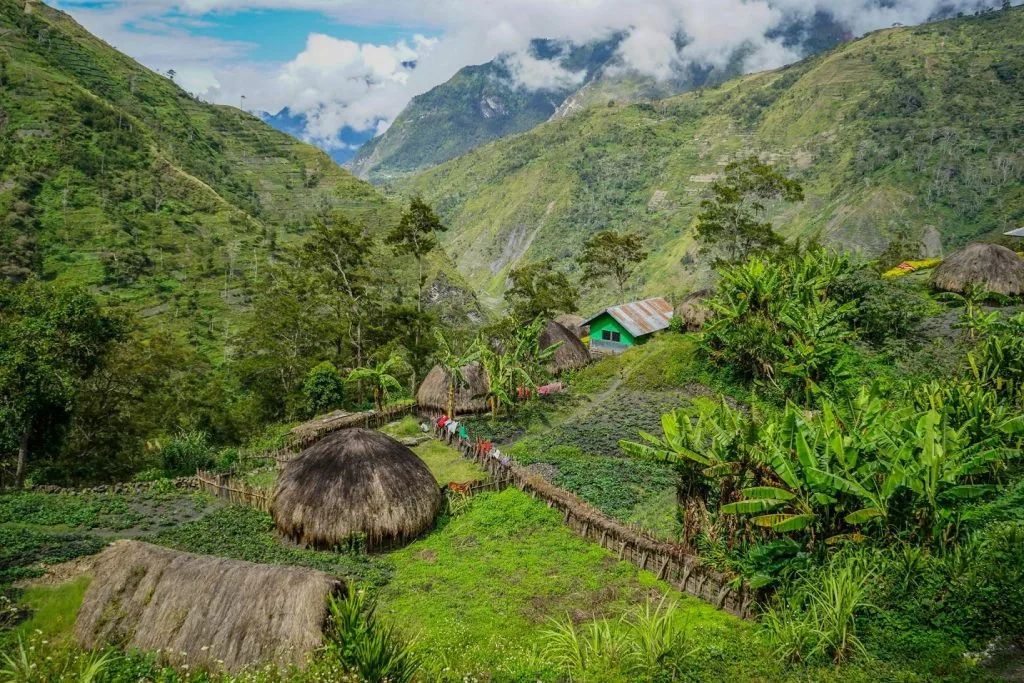
Baliem Valley, Indonesia
External maps ignored this entire civilization until 1938, when Richard Archbold peered through the window of a Guba flying boat and spotted a vast, cultivated valley where the charts indicated only uninhabited jungle. This discovery revealed the Dani people, an agrarian society that had flourished in total isolation for millennia. The arrival of the outside world was a jarring sequence of Dutch missionaries, American paratroopers during World War II, and eventually Indonesian administration. Despite these shifts, the Dani maintained their complex social structures and traditional agriculture. The valley floor is still dotted with smoked mummies of ancestors, preserved for centuries as guardians of the clan. Every August, the tribal tensions that once fueled real warfare are channeled into the Baliem Valley Festival, a massive gathering of the Dani, Lani, and Yali tribes that is a vibrant, rhythmic act of cultural preservation.
Trekking through the southern reaches of the valley requires a steady pace and an appetite for steep, slippery terrain. A hint of the spongy texture of the earth beneath your boots moving between villages that have no road access. Inside a traditional honai, the atmosphere is dark and thick with smoke, a necessary warmth against the high-altitude chill that settles after dark. Leading with the intricate details of the 'koteka' or gourd coverings worn by the men, and the rhythmic clicking of shells against bone jewelry. Sunlight here has a sharp, crystalline quality that makes the green of the valley walls look almost artificial. Travelers usually find that the greatest impact comes from the casual hospitality of the Dani people, who might share a meal of roasted 'hipere' or sweet potato while discussing the mountain spirits. You catch of the wind through the casuarina trees becomes a constant companion, a lonely and beautiful melody that defines the Papua highlands. Wamena is the sole way into this mountain realm, accessible only by air. Most journeys begin with a flight to Jayapura, followed by a smaller turboprop hop over the impenetrable mountain spine to Wamena’s high-altitude runway. Because all supplies, from fuel to salt, must be flown in, the town has a frontier energy like a gold-rush settlement. From Wamena, the valley opens up into various trekking circuits. Hiring a local guide is not just a recommendation but a necessity for navigating the tribal territories and the shifting muddy paths that lead to the remote outposts of the Yali and Lani tribes.
The Experience
The morning mist in the Baliem Valley doesn't just sit on the ground; it swallows the horizon, leaving you standing in a white void until the sun burns through to reveal towering limestone walls. The mass of the cool dampness of the mountain air on your face, a stark contrast to the stifling heat of the coast. Walking over a swaying suspension bridge made of vines and cables, you notice the incredible strength of the Baliem River churning below, a record of the raw power of the Papuan wilderness. The highlight for many is the sound of a hundred voices rising in a war chant during a mock battle, a deep, guttural vibration that you feel in your chest. It is a place that strips away your modern certainties, leaving you with a profound respect for a people who have mastered a beautiful, unforgiving landscape.
Why It Matters
Baliem Valley is one of the few places on the planet where a prehistoric lifestyle hasn't been entirely commodified. It matters as a living archive of human resilience and agricultural genius. Culturally, it represents the heart of the Papuan identity, a stronghold of tradition that continues to resist the homogenizing forces of the outside world while navigating its own complex path toward the future.
Why Visit
If you are tired of destinations that feel like a stage set for tourists, Baliem Valley offers a dose of reality. You come here to see a way of life that hasn't changed its fundamental rhythm in five thousand years. It is a grueling, magnificent, and deeply moving journey that rewards those who want to see the world before it was finished being discovered.
Insider Tips
- 1
Carry a waterproof bag for your electronics, as the mountain weather can shift from clear sun to a torrential downpour in less than ten minutes.
- 2
Stock up on tobacco or salt in the Wamena market before trekking, as these small gifts are still highly valued by elders in the more remote villages.
- 3
Obtain your 'Surat Keterangan Jalan' or travel permit at the Jayapura or Wamena police station immediately upon arrival to avoid being turned back at village checkpoints.
- 4
Bring several pairs of thick wool socks; the valley mud is relentless and foot rot is a real risk for those who don't keep their skin dry at night.
- 5
Request to see the smoked mummies in Jiwika or Akima, but always negotiate the 'photography fee' with the village head before taking your camera out.