“Four modest oil palm seedlings planted here in 1848 would eventually escape these fences to rewrite the entire economic and ecological history of Southeast Asia.”
About Bogor Botanical Gardens
Founded on the orders of King Willem I of the Netherlands, the gardens began as a laboratory for the Dutch East India Company’s agricultural ambitions. Reinwardt started with just forty-seven hectares, but his successor, Johannes Elias Teijsmann, spent thirty years expanding the collection and meticulously labeling the flora of the spice islands. In 1860, the gardens welcomed the first cinchona trees, which would produce the quinine needed to battle malaria across the globe. Throughout the twentieth century, the site survived the Japanese occupation and the turbulence of the Indonesian revolution, emerging as a world-class center for tropical biology. Today, it serves as a genetic vault for thousands of endangered species, maintained by generations of Indonesian botanists who view the park as a sacred national treasure.
What Bogor Botanical Gardens actually is
Rain falls in Bogor with a clockwork intensity that has earned it the title of the City of Rain, yet this constant deluge is the lifeblood of the oldest botanical sanctuary in Southeast Asia. Kebun Raya Bogor feels like a deliberate pause in the frantic expansion of West Java, a eighty-seven hectare lung where the air is noticeably cooler and smelling of damp bark. Massive buttress roots of centuries-old dipterocarps snake across the manicured lawns, looking more like sleeping prehistoric beasts than timber. The gardens wrap around the Istana Bogor, one of Indonesia's six presidential palaces, where a herd of spotted deer grazes peacefully behind white fences. Through these gates, you leave behind the roar of 'angkot' minibuses for a cathedral of canopy that has been carefully curated since the early nineteenth century.
Rain falls in Bogor with a clockwork intensity that has earned it the title of the City of Rain, yet this constant deluge is the lifeblood of the oldest botanical sanctuary in Southeast Asia.
brief British interregnum, 1811
Sir Stamford Raffles first planted the seeds of this sanctuary during the brief British interregnum in 1811, but the formal establishment fell to Caspar Georg Carl Reinwardt, a German-born Dutch botanist, in 1817. He sought to consolidate the botanical wealth of the archipelago into a single research hub. The gardens played a pivotal role in global history that many visitors forget; it was here that the first oil palm seedlings were planted in 1848, an event that eventually transformed the economy and landscape of the entire region. Scientists used these grounds to study cinchona for quinine and rubber for industrialization, making this quiet park a quiet engine of the colonial era. Despite world wars and the shift to Indonesian sovereignty, the institution remained a global titan of plant science, preserving species that have long since vanished from their original wild habitats.
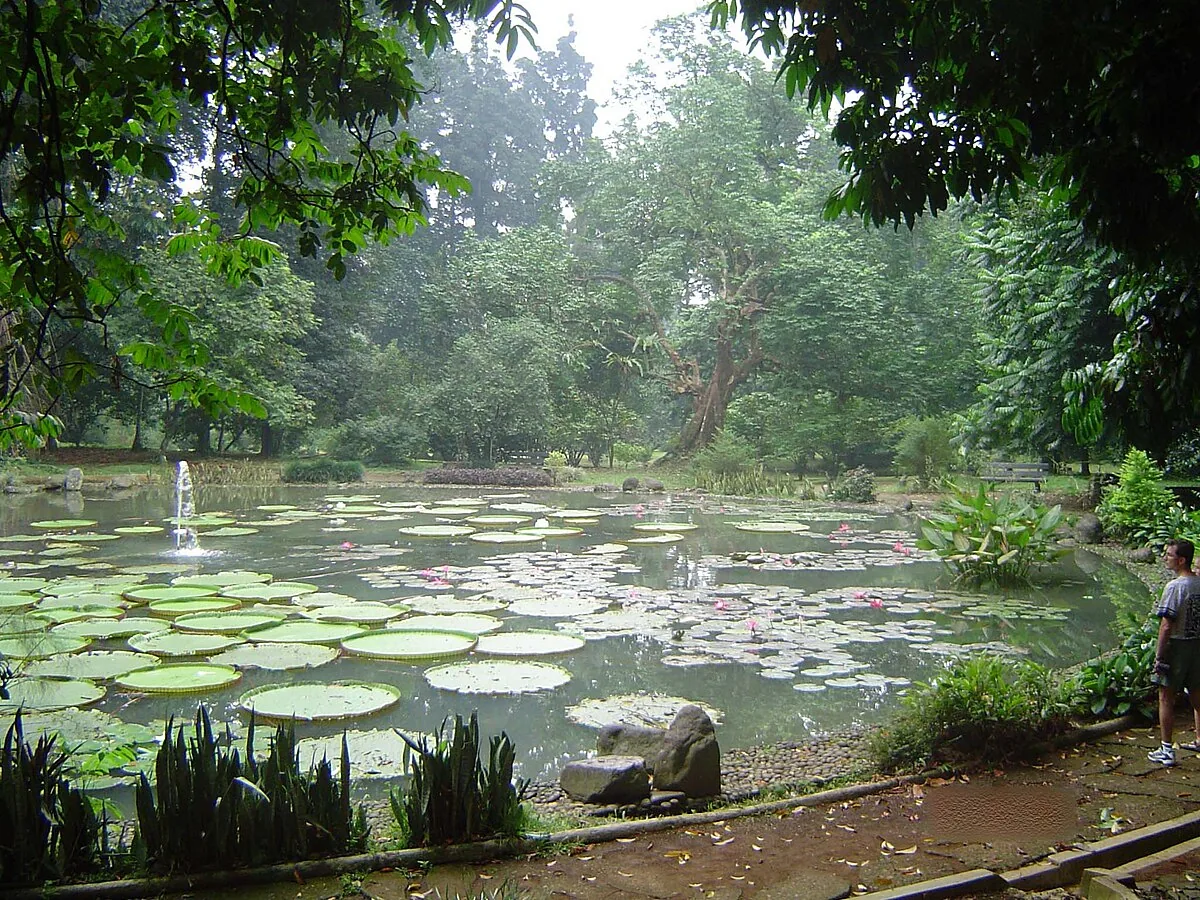
Stepping onto the gravel paths during a light morning mist, The rhythmic tapping of raindrops hitting the broad leaves of the Victoria amazonica lilies. These gargantuan pads, floating in the central pond near the palace, are strong enough to support the weight of a small child and look entirely otherworldly. Overhead, the space is a layered blend of screeching cicadas and the distant, low boom of thunder that inevitably rolls in by three in the afternoon. Deep within the Mexican Garden, the heat feels dry and prickling, while the fernery offers a subterranean chill and ancient moss. You might find yourself wandering through the Orchid House, where thousands of delicate, alien-looking blooms hang in a humid silence. The true magic occurs when there is a solitary bench under a massive Banyan tree, watching the local families picnic with a sense of quiet reverence for the greenery that surrounds them.
Reaching Bogor from Jakarta
Reaching Bogor from Jakarta is a rite of passage involving the Commuter Line train, a sixty-minute journey that snakes through the sprawling suburbs of the capital. Once you arrive at the historic Bogor Station, a ten-minute walk or a short 'becak' ride through the active street markets leads you to the main garden gates. For those arriving by car, the Jagorawi Toll Road provides a direct link, though the weekend traffic can turn a sixty-kilometer drive into a three-hour test of patience. The gardens are best explored on foot, but electric carts are available near the entrance for those who want to cover the sprawling acreage without battling the equatorial humidity.
Reaching Bogor from Jakarta is a rite of passage involving the Commuter Line train, a sixty-minute journey that snakes through the sprawling suburbs of the capital.
The Experience
Within, the gardens feels weighted with moisture and the oxygen-rich exhale of millions of leaves. A temperature drop by several degrees as you move from the sun-drenched lotus ponds into the deep shadow of the Great Canarium Avenue. Sunlight struggles to reach the forest floor, creating a dappled, cinematic light that highlights the vibrant red dragonflies skimming the water. The contrast between the rigid, formal Dutch landscaping near the palace and the wild, overgrown tangles of the research sectors. One of the most striking sights is the Titan Arum when it occasionally blooms; it is a giant, stinking flower that commands a crowd with its sheer biological audacity. Before the afternoon storm arrives, the entire park seems to hold its breath, a brief window of absolute tranquility before the sky opens up.
Why It Matters
Bogor Botanical Gardens represents the intersection of colonial ambition and modern conservation. It is the spiritual home of Indonesian biology and a living museum of the planet’s botanical diversity. Beyond the science, it serves as a crucial social space where the rigid boundaries of Indonesian urban life dissolve into the shared shade of ancient trees.
Why Visit
Jakarta can feel like a labyrinth of steel and exhaust, but Bogor offers the antidote just an hour away. You come here to stand under trees that were saplings when Napoleon was in power and to see the rarest orchids on earth. It is a rare chance to experience the primal, untamed greenery of Indonesia within a safe, historical frame.
✦ Insider Tips
- 1
Enter through Gate 3 near the Pajajaran street for the quickest access to the most dramatic Banyan trees and the Mexican Garden.
- 2
Time your visit for a Tuesday or Wednesday morning to have the sprawling avenues almost entirely to yourself before the weekend crowds arrive from Jakarta.
- 3
Carry a lightweight poncho rather than an umbrella; when the Bogor rains start, they often come with winds that make umbrellas useless.
- 4
Look for the small, weathered Dutch cemetery hidden in a bamboo grove near the palace for a quiet lesson in the garden's colonial human history.
- 5
Check the official website for rare sightings of the Rafflesia or Titan Arum blooms, which only happen every few years and last for just a few days.