“A seventeenth-century Dutch fortress, built in the shape of a perfect pentagon, still keeps watch over a tiny island that once traded its independence for the weight of a handful of nutmeg.”
About Fort Belgica
Fort Belgica was not the first fortress on this hill, but it was undoubtedly the most formidable. Following the bloody conquest of the Banda Islands in 1621, the Dutch realized they needed a high-altitude stronghold to protect the harbor from the English and the Spanish. In 1667, after years of structural failures, the current five-pointed design was commissioned. It was built using a mixture of coral, limestone, and volcanic sand, hauled up the hill by enslaved locals and soldiers. The fort successfully repelled several naval incursions before the English eventually captured it in 1796 with a daring land-based night assault. After the Dutch regained control via the Treaty of Amiens, the fort gradually became an administrative relic. It stood abandoned for much of the early twentieth century until the Indonesian government recognized its peerless historical value and began a comprehensive restoration program in the 1990s.
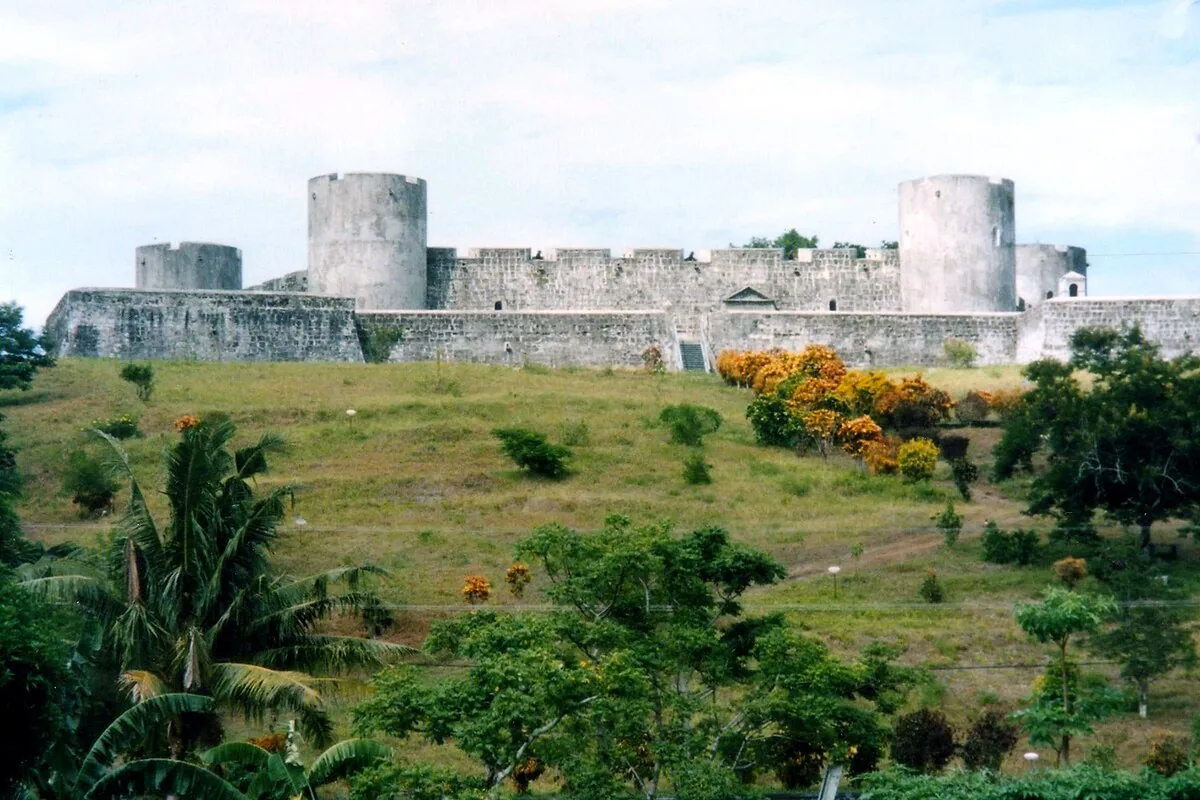
About Fort Belgica
High above the sleepy, nutmeg-scented lanes of Banda Neira, a massive stone pentagon rises against the backdrop of an emerald volcano. Fort Belgica feels like a misplaced piece of a European chess set dropped into the middle of the Maluku sea. Constructed with a mathematical precision that defies its remote location, this seventeenth-century bastion was once the most feared structure in the Dutch East Indies. Today, the moss-slicked walls and silent cannons overlook a harbor so calm it reflects the clouds like a mirror. Here, There is a faint, spicy tang of drying mace and the heavy humidity of the Banda Islands. To stand on its upper ramparts is to witness the physical remains of a global obsession with spices that once made these tiny islands the most valuable real estate on earth.
High above the sleepy, nutmeg-scented lanes of Banda Neira, a massive stone pentagon rises against the backdrop of an emerald volcano.
of this fortress, 1611
The Dutch East India Company, or VOC, ordered the construction of this fortress in 1611 to solidify their monopoly over the world's only source of nutmeg. Governor-General Pieter Both initially oversaw a smaller fortification, but the version that looms over the island today was a total redesign completed in 1672 by Cornelis Speelman. Its unique nested pentagonal shape was a marvel of military engineering, designed to provide overlapping fields of fire against both invading European armadas and local uprisings. Across centuries, the fort was the iron fist of the spice trade, ensuring every nut harvested in the surrounding groves passed through Dutch hands. After the British eventually managed to transplant nutmeg seedlings to other colonies, the fort’s strategic importance withered. It survived earthquakes and the slow erosion of the tropical salt air before being meticulously restored to its current state in the late twentieth century.
Visiting Fort Belgica
Climbing the narrow, circular stone stairs within the corner towers feels like ascending through a cold, lightless chimney before suddenly bursting into the blinding equatorial sun. The presence of the rough, porous texture of the volcanic rock used in the masonry, a material that has absorbed four hundred years of heat. From the highest parapet, the view is dominated by the near-perfect cone of Gunung Api, the volcano across the water whose dark slopes provide a stark contrast to the turquoise bay. First, the absolute silence of the interior courtyard, where the grass is kept short by the wind and the occasional local goat. The sound of a distant boat engine in the harbor below is the only thing that anchors you to the present century. Visitors often find that the most poignant moment is watching the sunset from the western wall, when the stone turns a deep ochre and the shadows of the cannons stretch toward the nutmeg groves that started it all. Reaching Banda Neira is an adventure that requires patience and a willingness to follow the whims of the sea. Those visiting fly from Jakarta or Bali to Ambon, where they must wait for either a twice-weekly small plane or the more reliable overnight Pelni ferry. The sea crossing from Ambon takes about eight hours, delivering you to the harbor directly at the foot of the fort’s hill. From the center of Neira village, a short ten-minute walk up a series of stone steps leads you to the entrance. Because the islands are so compact, no motorized transport is necessary; the walk itself provides an essential context of the colonial ruins and vibrant gardens that surround the fortress walls.
The Experience
Moving from the humid, leafy shade of the nutmeg forests to the open stone expanse of the fort is jarring. The way the wind whistles through the arrow slits, a lonely sound that emphasizes the isolation of the garrison that once lived here. Looking down into the central well, the depth of the cisterns reminds you how vital water was during a siege. The thing most visitors miss is the small, hand-etched graffiti from eighteenth-century soldiers carved into the softer stones near the guardhouse. You get a sense of vertigo not from the height, but from the historical weight of the place. It is a moment of profound stillness where the geopolitical struggles of the seventeenth century feel incredibly close, yet entirely silenced by the beauty of the Maluku archipelago.
Moving from the humid, leafy shade of the nutmeg forests to the open stone expanse of the fort is jarring.
Why It Matters
Fort Belgica is a haunting monument to the Age of Discovery and the brutal costs of the spice trade. It stands as one of the best-preserved examples of VOC military architecture in the world. Humanly, it represents the intersection of European engineering and the indigenous Bandanese landscape, a site where the struggle for global trade changed the course of world history forever.
Why Visit
While the more famous temples of Java offer spiritual grandeur, Fort Belgica offers a raw, tactile connection to the era of sail and spice. It is the only place in the world where you can stand on a Dutch bastion and look directly into the mouth of a tropical volcano. You come here to experience the end of the world as it was once mapped.
✦ Insider Tips
- 1
Ask the caretaker for the key to the underground tunnels that once connected the fort to the lower coastal defenses of Fort Nassau.
- 2
Visit just after dawn to see the volcano's peak clear of clouds, before the morning heat creates the daily mist.
- 3
Look for the original iron rings in the walls where cannons were lashed down during the monsoon storms.
- 4
Bring a local guide from Neira village who can point out the specific nutmeg groves that were once the exclusive property of the VOC 'perkeniers'.
- 5
Check the lighthouse schedule in the harbor; its light sweeping across the fort's walls at night creates a specter-like atmosphere worth seeing from the village.