Six stone spheres pierced by a central rod top this colonial palace, giving a grand administrative masterpiece the whimsical nickname of a skewered street-food snack.
About Gedung Sate
Conceived during the height of the Dutch 'Ethical Policy' in 1920, Gedung Sate was intended to be the first of a massive complex of government buildings in the cool highlands of Bandung. Designer J. Gerber opted for a daring mix of styles, incorporating Moorish elements, Italian Renaissance windows, and tiered roofs inspired by Javanese 'meru' shrines. The project cost six million guilders, an astronomical sum that halted further construction during the global economic downturn of the late 1920s. During the chaotic transition of 1945, the building became a literal fortress. A group of Indonesian youths, now known as the 'Pemuda Pekerjaan Umum,' fought a desperate last stand against Dutch-allied troops here. This conflict transformed the building from a symbol of colonial bureaucracy into a sacred site of nationalist pride, eventually becoming the permanent seat of the West Java provincial government.
What Gedung Sate actually is
Bandung sits cradled by volcanic peaks, a city that once aspired to be the 'Paris of Java,' and at its heart stands a building topped with what looks like a skewer of stone-carved meat. Gedung Sate remains the most recognizable silhouette in West Java, a grand neoclassical palace that successfully marries European architectural rigor with the soul of the tropics. The limestone walls, bright and pristine against the frequently overcast mountain sky, house the administrative engine of the province. Yet, the atmosphere around the grounds is surprisingly communal. On any given afternoon, the roar of the city fades into the background as the manicured lawns and fountains create a pocket of colonial-era grandeur that still feels relevant to the modern Indonesian identity. To stand before its symmetry is to see the exact moment when Dutch engineering stopped trying to dominate the landscape and started listening to it instead.
“Bandung sits cradled by volcanic peaks, a city that once aspired to be the 'Paris of Java,' and at its heart stands a building topped with what looks like a skewer of stone-carved meat.”
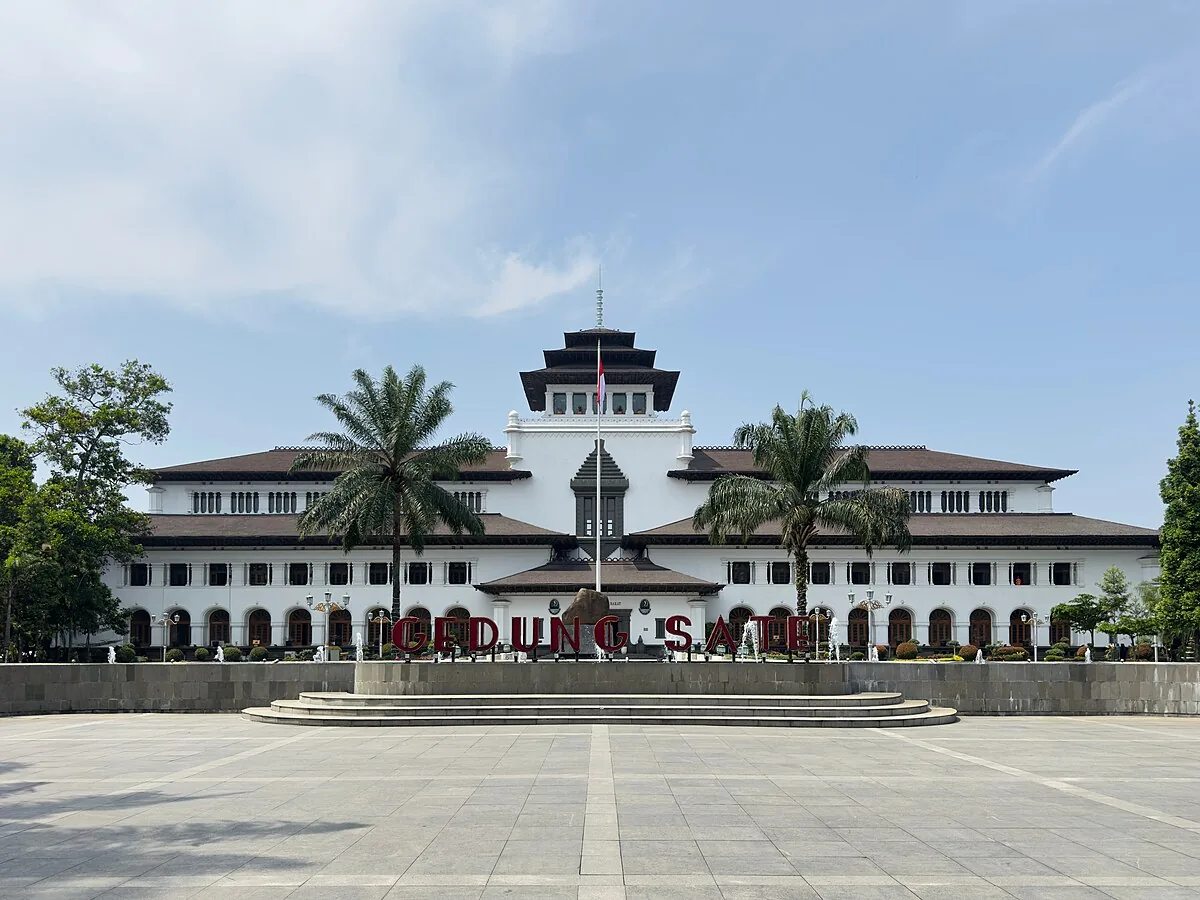
Gedung Sate, Indonesia
Commissioned by Architect J
Architect J. Gerber began the ambitious project in 1920, commissioned by the Dutch East Indies government to create a seat of power for the Department of Government Enterprises. At the time, there were serious plans to move the colonial capital from the sweltering, swampy marshes of Batavia to the cooler altitudes of Bandung. Construction took four years and involved a workforce of thousands, including specialized stonemasons from China who carved the intricate details of the facade. The building’s nickname, Gedung Sate, arose from the six stone spheres skewered on its central pinnacle, which locals famously compared to 'sate' or satay. While Gerber used Italian Renaissance proportions for the windows and wings, he looked to Hindu-Buddhist temple silhouettes for the rooflines. This Indo-European hybrid style became a precursor to modern Indonesian architecture. Following independence, the building witnessed a fierce battle in December 1945, when seven young Indonesians died defending the site against returning Allied forces, a sacrifice commemorated by a modest stone monument in the front garden.
Walking toward the main entrance feels like approaching a silent, watchful sentinel. The environment in Bandung is thinner and sharper than on the coast, smelling of damp earth and blooming jasmine from the surrounding parks. The interior museum uses high-tech projections to tell the story of the building, but the real magic lies in the tactile details of the architecture itself, the cool touch of the thick masonry and the way the long, airy corridors are designed to catch the mountain breeze. Climbing to the top floor provides a panoramic view that explains why the Dutch chose this spot. From the upper balcony, the city sprawls out toward the Tangkuban Perahu volcano, its jagged crater visible on clear mornings. A trace of the weight of history in the heavy timber doors, yet the space is filled with the youthful energy of students and office workers who treat the monument like a living, breathing part of their daily commute.
Reaching this landmark involves navigating
Reaching this landmark involves navigating the leafier districts of northern Bandung. Travelers usually arrive via the Husein Sastranegara Airport or the central train station, both of which are a quick taxi or 'Angkot' ride away from the Diponegoro area. If you are staying in the heritage district of Braga, a twenty-minute walk through the tree-lined avenues of the city’s colonial core offers a perfect introduction to the local aesthetic. Public buses frequent the Jalan Diponegoro route, dropping passengers directly in front of the ornate gates. While the exterior is visible daily, the interior museum requires a small entry fee and adheres to strict government office hours.
“Reaching this landmark involves navigating the leafier districts of northern Bandung.”
The Experience
The light in Bandung has a soft, filtered quality that makes the white walls of Gedung Sate glow with a pearlescent hue during the late afternoon. The rhythmic splash of the fountains and the low murmur of local families who gather on the sidewalk to eat spicy 'cilok' from street vendors. Inside the museum, the smell of polished wood and old stone replaces the city's exhaust. The most evocative moment occurs on the top-floor terrace, where the wind whistles through the stone 'satay' ornament. From here, you notice how the building’s north-south axis perfectly aligns with the distant volcanic peaks, a deliberate nod to ancient Javanese cosmology that links the mountains to the sea. It is a rare place where you can feel the ambition of two different empires simultaneously.
Why It Matters
Gedung Sate matters because it was the first truly successful experiment in 'Indo-European' architecture. It proved that Western structural demands could be softened by Eastern aesthetics, creating a design language that belonged specifically to the Indonesian archipelago. Humanly, it serves as the heart of Bandung, representing the city's transition from a mountain outpost to a sophisticated cultural capital.
Why Visit
While Jakarta has its skyscrapers and Yogyakarta has its ancient stones, Bandung offers Gedung Sate as a masterclass in early 20th-century elegance. You visit to see a building that doesn't just house government officials but holds the aesthetic DNA of the city. It is the perfect starting point for anyone trying to understand why Bandung remains the intellectual and artistic soul of West Java.
Insider Tips
- 1
Book your museum tickets online at least a day in advance, as they strictly limit the number of visitors to preserve the original floorboards.
- 2
Look for the 'secret' air-conditioning system, a series of tunnels beneath the building designed by Gerber to use the natural mountain air to cool the offices.
- 3
Visit the rear garden to find the monument dedicated to the seven fallen heroes of 1945; it is far more moving and quiet than the lively front entrance.
- 4
Ask the museum guards if the top-floor balcony is open; it offers the only 360-degree view of the Bandung basin that isn't from a skyscraper.