Seventeen years of construction and millions of tons of East Javanese marble culminated in a sanctuary so vast that its internal echoes take several seconds to find a wall to rest upon.
About Istiqlal Mosque
Following the end of Dutch colonial rule, Indonesian leaders envisioned a grand structure to celebrate their hard-won sovereignty. President Sukarno insisted the site occupy the former Dutch Citadel Frederick Hendrik, literally replacing a colonial fortress with a house of worship. He chose Friedrich Silaban for the task, whose Christian background underscored the state’s 'Bhinneka Tunggal Ika' or 'Unity in Diversity' motto. The project faced immense hurdles, including the 1965 attempted coup and severe inflation, which paused work for years. When President Suharto finally inaugurated the mosque in February 1978, it stood as the largest in Southeast Asia, a title it holds with quiet dignity to this day.
Standing in the humid heart of Jakarta
Standing in the humid heart of Jakarta, a city often defined by its chaotic pulse, Istiqlal Mosque offers a cavernous silence that feels almost impossible given its surroundings. This limestone-clad behemoth is a physical manifestation of Indonesian identity, positioned intentionally across from the neo-gothic Jakarta Cathedral to symbolize a philosophy of religious harmony. The scale here is difficult to grasp until you are small against its courtyard floor. Covering nine hectares, the complex can house over 120,000 worshippers, yet it never feels like a mere stadium for prayer. Instead, the architecture uses shadow and airflow to create a micro-climate that defies the equatorial heat.
“Standing in the humid heart of Jakarta, a city often defined by its chaotic pulse, Istiqlal Mosque offers a cavernous silence that feels almost impossible given its surroundings.”
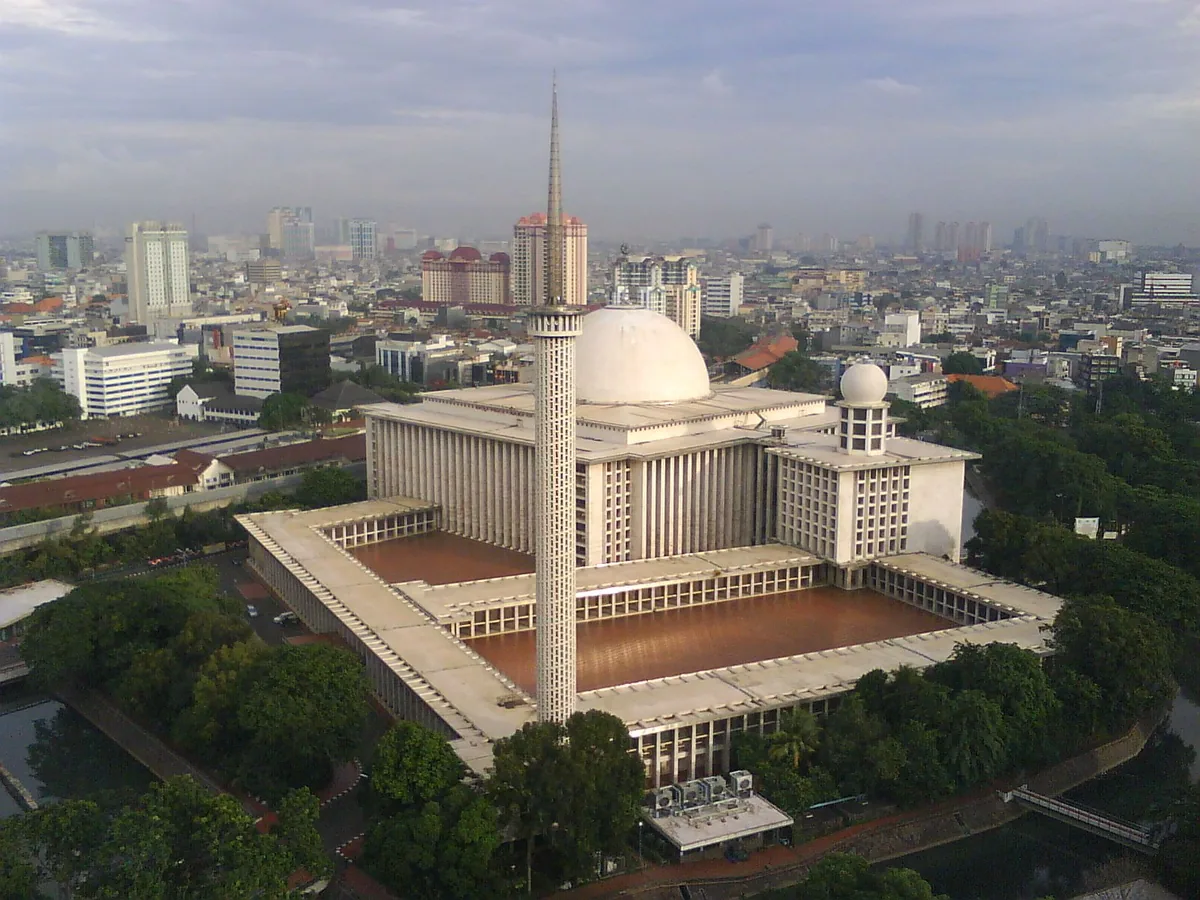
Istiqlal Mosque, Indonesia
Design choices for this national icon fell to Friedrich Silaban, a Christian architect who won a competition judged by Sukarno, Indonesia’s first president. Silaban spent decades refining a vision that would eschew traditional Javanese tiered roofs in favor of a modernist, international aesthetic. Construction began in 1961, though political upheaval and economic shifts meant the doors didn't officially open until 1978. Every measurement within the walls carries a secret meaning. The central dome spans 45 meters to honor the year of independence, while the twelve massive pillars supporting it represent the birthday of the Prophet Muhammad. Even the stainless steel accents throughout the interior speak to a desire for a future that remains polished and enduring.
Inside
Walking through the entrance requires a barefoot transition onto cool marble that seems to pull the fever from your skin. The interior the main prayer hall moves in slow, deliberate currents, filtered through geometric lattices that break the harsh sunlight into soft, repetitive patterns on the floor. You catch is the distant hum of traffic outside, but it sounds like waves hitting a far-off shore. During the late afternoon, the calls to prayer from the single minaret vibrate through your chest, a deep resonance that fills the void of the 17-story high ceiling. Visitors often find themselves sitting against the polished columns, watching children chase shadows or elders resting between prayers. The sheer volume of the space creates a psychological shift, making your own presence feel both insignificant and deeply peaceful.
Navigating to Central Jakarta usually involves
Navigating to Central Jakarta usually involves a battle with the city's notorious 'macet' or traffic jams. The most reliable approach involves using the TransJakarta busway, which has a dedicated stop right at the mosque gates. If you are coming from the Gambir train station, a short walk or a quick ride in a blue Bluebird taxi will deposit you at the visitor entrance. Foreign guests are directed to a specific welcome center where guides provide robes for modesty and offer a brief orientation before leading you onto the upper balconies for the best views of the prayer hall's geometry.
“Navigating to Central Jakarta usually involves a battle with the city's notorious 'macet' or traffic jams.”
The Experience
Shifting from the sun-scorched pavement of Jakarta to the shaded corridors of Istiqlal feels like diving into deep water. The rhythmic slapping of bare feet on stone and the low, melodic murmur of students reciting verses in the corner of the hall. Sunlight pierces the stainless steel lattice work, casting long, sharp shadows that crawl across the prayer mats as the day wanes. Looking up into the stainless steel dome, the geometry feels mathematical and celestial all at once. The smell of sandalwood occasionally drifts through the air, mingling with the scent of rain-washed stone. Most people miss the small tunnel connecting the mosque grounds to the cathedral across the street, a literal underground bridge for the two communities.
Why It Matters
Istiqlal represents more than religious devotion; it is a monument to the fragile, beautiful experiment of Indonesian pluralism. By placing a Christian architect at the helm and positioning the minaret within sight of a cathedral’s spires, the nation declared that its strength lies in coexistence. The mosque functions as the spiritual lungs of the capital, providing a space where the boundaries between the sacred and the civic are blurred by daily life and communal gathering.
Why Visit
Ignore the malls and the high-rises for a morning to witness how a city of ten million people finds its center of gravity. Istiqlal provides a sense of scale that most modern buildings fail to achieve, offering a brutalist beauty softened by the devotion of those who fill it. You come here to see how Indonesia sees itself: modern, massive, and deeply rooted in a tradition of welcoming the world.
Insider Tips
- 1
Head to the second-floor balcony near the southeast corner for a photograph that captures the symmetry of the twelve main pillars.
- 2
Look for the massive 'bedug', a traditional Javanese drum made of cowhide and meranti wood, used to signal prayer times.
- 3
Borrow a free batik sarong from the visitor center even if you think your clothes are long enough; the staff appreciate the gesture of respect.
- 4
Check the lunar calendar and avoid visiting during the Friday midday prayer unless you wish to navigate a crowd of a hundred thousand people.
- 5
Ask your guide to point out the specific vents in the floor designed to naturally circulate cool air from the basement levels.