“Ninety-two massive stained-glass panels from Delft filter the harsh Javanese sun into a soft European glow, masking the fact that this railway palace once doubled as a grim wartime prison.”
About Lawang Sewu
The Nederlandsch-Indische Spoorweg Maatschappij commissioned this masterpiece at the turn of the 20th century to manage their expanding rail networks. Between 1904 and 1919, the site evolved into a sprawling complex of three main buildings, showcasing the 'Indische' style that blended European masonry with tropical necessities. The transition of power in 1942 turned this center of logistics into a site of interrogation under the Japanese military. Following the brutal Five-Day Battle in Semarang in 1945, the building served various roles, from a military headquarters to a regional railway office, before falling into a haunting state of disrepair. Only in 2011 did the Indonesian railway company, PT KAI, complete the restoration that stripped away decades of grime to reveal the brilliant white facade seen today.
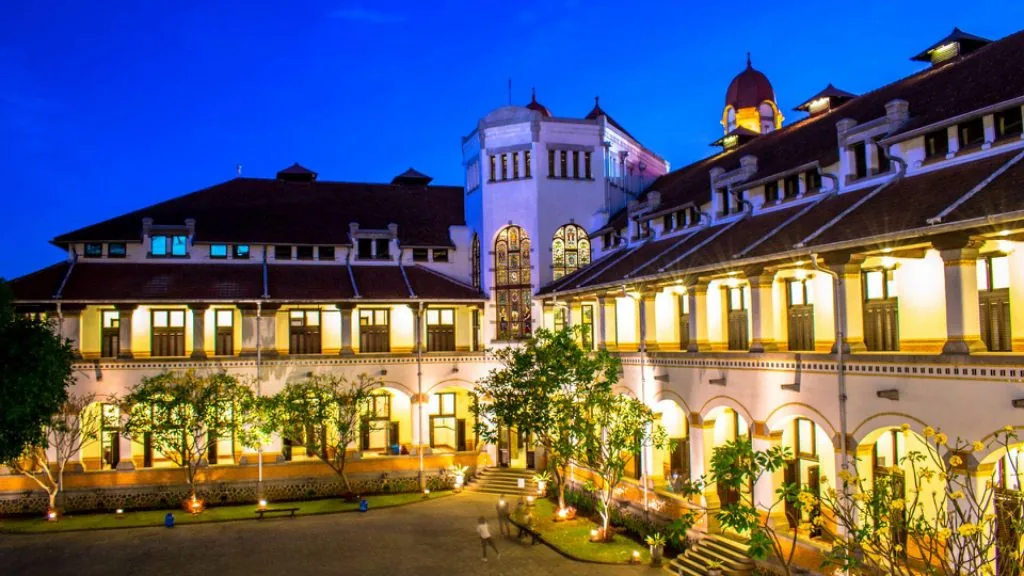
Lawang Sewu in Indonesia
Semarang pulses with a humid, coastal energy, but stepping through the gates of Lawang Sewu feels like a sudden immersion in cold water. The name translates to A Thousand Doors, an exaggeration of the hundreds of towering portals designed to funnel the Javanese breeze through a labyrinth of white stone and dark timber. This former headquarters of the Dutch East Indies Railway Company looms over Tugu Muda roundabout, its twin towers standing as stoic witnesses to a century of shifting regimes. To walk these corridors is to navigate a masterclass in colonial tropical architecture, where aesthetic grandeur was a secondary benefit to the desperate need for ventilation. The air air here carries a heavy, floral scent mixed with the dampness of aged limestone, creating an atmosphere that feels suspended between the Victorian era and the modern Indonesian republic.
Semarang pulses with a humid, coastal energy, but stepping through the gates of Lawang Sewu feels like a sudden immersion in cold water.
Architects Cosman Citroen and J.F . Klinkhamer began drafting this behemoth in 1904, finishing the primary structure three years later. They sought to create a temple to industry, using materials shipped directly from Europe to ensure the railway company’s dominance was visible in every brick. Along the Dutch departure, the building took on a darker character during the Japanese occupation in World War II. The basement, originally designed as a cooling water reservoir, was repurposed into a makeshift prison and execution chamber. This violent pivot from administrative hub to site of suffering left an indelible mark on the local psyche. When Indonesian nationalist forces fought Japanese troops here in October 1945, the walls literally absorbed the conflict. Decades of neglect followed, allowing moss and local folklore to claim the halls before a major restoration in the late 2000s revived its former architectural luster.
Know before you go
Late afternoon brings a particular kind of magic to the main hall when sunlight hits the massive stained-glass windows. These glass panels depict a lush, idealized Holland, casting vibrant blues and yellows across the checkered floors. You get a temperature drop moving deeper into the interior, away from the roar of Semarang’s motorbikes. The silence is often interrupted by the distant, rhythmic clicking of a train on the nearby tracks, a ghost of the building’s original purpose. Almost all visitors find themselves drawn to the long, repetitive vistas of the arched corridors where doors align in infinite rows. While the basement stays closed during heavy rains, a visit to the upper floors reveals the intricate woodwork of the ceilings, where the craftsmanship remains sharp despite the relentless humidity. Immediately, the way the light dies out in the far corners, giving life to the local legends that keep the city’s residents talking long after the sun sets.
Reaching Lawang Sewu involves a simple
Reaching Lawang Sewu involves a simple journey to the heart of Semarang, the capital of Central Java. Those visiting arrive via Ahmad Yani International Airport or the Tawang Train Station, both of which are within a twenty-minute drive of the landmark. Taxis and ride-hailing apps provide the most seamless transit, though a walk through the colonial 'Old Town' or Kota Lama offers a broader context of the city’s history. The entrance is positioned directly across from the iconic Tugu Muda monument, making it impossible to miss. Visitors must purchase a ticket at the small kiosk near the gate, which grants access to the main grounds and the interior galleries.
Reaching Lawang Sewu involves a simple journey to the heart of Semarang, the capital of Central Java.
The Experience
A heavy stillness sits in the air as you cross the threshold, a sharp contrast to the chaotic traffic of the roundabout outside. First, the repetitive rhythm of the archways, an architectural trick that makes the hallways seem to stretch into another dimension entirely. In the central courtyard, a massive mango tree provides a canopy of shade where the heat of Semarang finally relents. The most haunting moment occurs in the stairwells, where the sound of your own footsteps echoes with a clarity that feels almost intrusive. Local guides often lower their voices when discussing the basement, and you feel a genuine chill even in thirty-degree weather. Before you leave, stand in the center of the main hall and look upward; the sheer scale of the joinery reveals a level of detail that modern construction rarely dares to replicate.
Why It Matters
Lawang Sewu serves as a physical bridge between Indonesia’s colonial past and its independent present. It stands not just as a relic of Dutch engineering, but as a memorial to the Indonesian youth who died within these walls during the revolution. Culturally, it occupies a unique space in the national imagination, representing both the peak of European architectural influence in Asia and a focal point for Java’s deep-seated love of the supernatural.
Why Visit
Most travelers rush to the temples of Yogyakarta, but skipping Semarang means missing the most atmospheric building in Java. Lawang Sewu offers a sensory experience that no museum can replicate: the feeling of a building that has breathed through three different eras. You come here for the architecture, but you stay for the heavy, palpable sense of history that lingers in every shadow and open doorway.
✦ Insider Tips
- 1
Engage a guide specifically to hear the 'Five-Day Battle' stories, as the signage focuses heavily on architecture rather than the dramatic human history.
- 2
Look closely at the door handles and hinges; they are original brass fixtures that have survived over a century of constant use.
- 3
Avoid the basement tours if you are claustrophobic, as the ceilings are low and the air can become exceptionally thin when groups gather.
- 4
Bring a small flashlight to illuminate the intricate carvings in the darker corners of the attic where the light rarely reaches.
- 5
Check the schedule for occasional evening jazz performances in the courtyard, which transform the atmosphere from haunting to sophisticated.