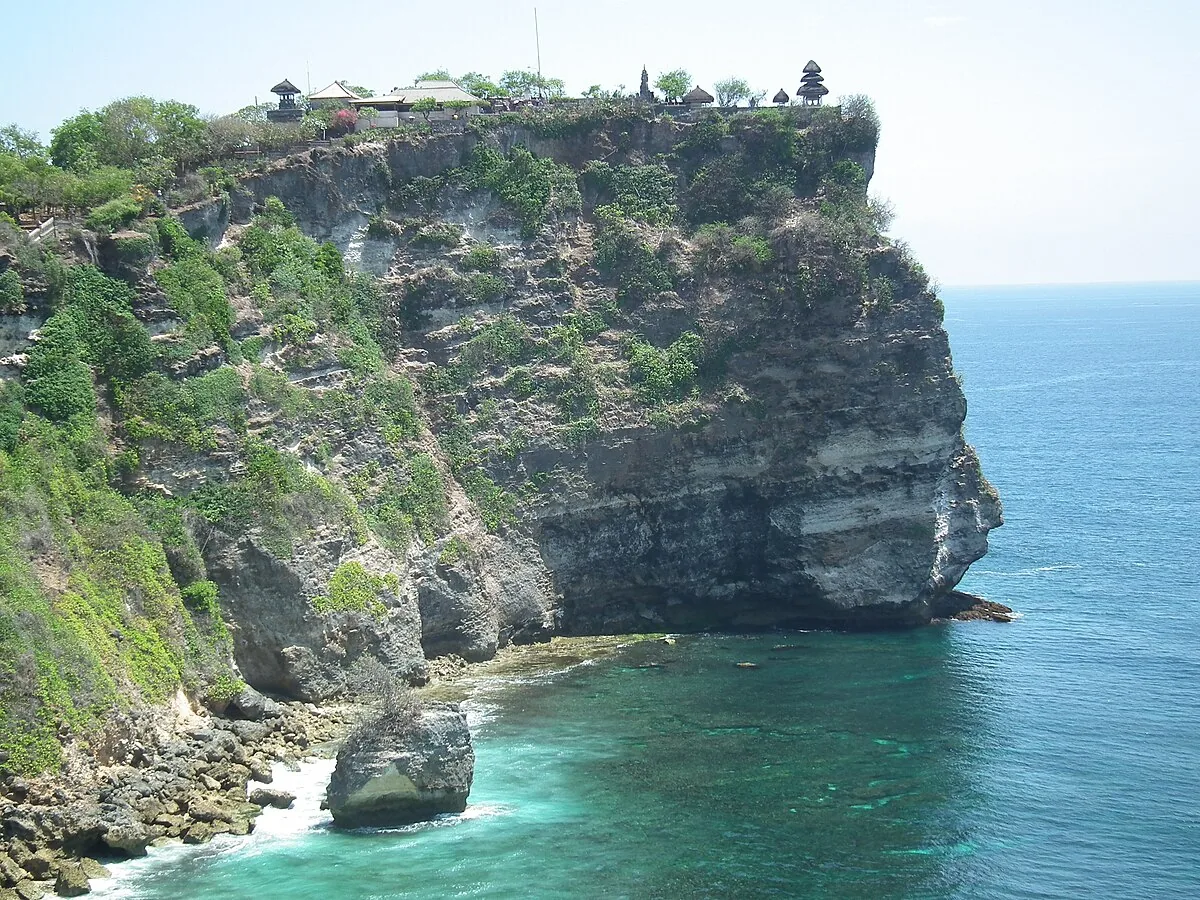
Seventy meters of sheer limestone are all that separate the sacred silence of the inner sanctum from the violent, turquoise fury of the Indian Ocean crashing below.
About Uluwatu Temple
Spiritual history in Bali is often etched in stone and seawater, and Uluwatu is the most dramatic example. The 11th-century sage Mpu Kuturan laid the first stones, but the site gained its true prestige in 1550 when the Javanese priest Dang Hyang Nirartha transformed it into a masterpiece of architectural devotion. He envisioned the temple as one of the six key sanctuaries that form a spiritual chain across the island. The most significant turning point occurred in the early 20th century when a massive lightning strike nearly leveled the structures; the subsequent rebuilding solidified the temple's role as a symbol of Balinese resilience. Today, the royal family of Gianyar still maintains a deep ancestral connection to the site, overseeing the major ceremonies that take place every six months during the Odalan festival.
What Uluwatu Temple actually is
Perched on the extreme edge of a limestone plateau that drops seventy meters straight into the churning Indian Ocean, Pura Luhur Uluwatu feels like the final outpost of the habitable world. The Balinese name literally translates to 'something divine at the end of a rock,' and standing on the narrow cliff-side path, the description feels less like a name and more like a warning. Salt spray hangs in the air as a permanent mist, softening the sharp edges of the black coral stone architecture. While many come for the sunset, the temple is a functioning spiritual site where the smell of incense frequently battles the briny wind. It remains one of the island's pillars of spiritual protection, guarding the southwest against evil sea spirits with nothing but sheer altitude and ancient masonry.
Its importance
Legend attributes the temple's expansion to Dhang Hyang Nirartha, a 16th-century priest who traveled from East Java to bring a new era of Hindu religious reform to Bali. Local lore suggests he chose this specific cliff as his point of spiritual ascension, or 'moksa,' disappearing into the ether from the temple's innermost sanctum. Before Nirartha, a smaller shrine likely stood here as early as the 11th century, established by the sage Empu Kuturan. The complex has survived centuries of tectonic shifts and lightning strikes, including a major fire in the early 1900s that required extensive restoration of its iconic tiered 'meru' roofs. Today, the grey volcanic stone walls are etched with intricate carvings of mythological beings, though the relentless ocean air gradually smooths their features back into the rock.
A visit here is a sensory gauntlet that begins with the mischievous chatter of long-tailed macaques who patrol the perimeter with an eye for loose spectacles. There is a vibration of the swell hitting the cliff base long before seeing the white foam far below. As evening approaches, the amphitheater fills with the rhythmic 'chak-chak-chak' of the Kecak fire dance, where seventy men create a percussive wall of sound using only their voices. The heat from the central fire pit mingles with the cooling sea breeze, creating a strange, flickering microclimate. Away from the performers, the temple’s inner courtyards remain off-limits to non-worshippers, but you can peer through the split-gate 'candi bentar' to see devotees in white lace carrying towering offerings of fruit. The true moment of clarity happens when the sun dips below the horizon, turning the ocean into a sheet of hammered gold and silhouettes the temple against a bruised purple sky.
Navigating to the southern tip
Navigating to the southern tip of the Bukit Peninsula requires a drive through winding limestone corridors and upscale villa estates. Those visiting hire a private driver from Seminyak or Nusa Dua, a journey that can take anywhere from forty minutes to two hours depending on the legendary Bali traffic. Bluebird taxis and ride-sharing apps like Grab are available, though securing a return ride after the sunset dance can be difficult without a pre-arranged driver. A paved walkway clings to the cliff edge for several hundred meters in both directions, providing ample space to find a vantage point away from the main theater entrance.
The Experience
Around the cliff’s edge tastes of salt and frangipani, a heavy, humid perfume that stays on your skin. The standout is the monkeys first, not as cute residents but as sharp-eyed sentinels waiting for the moment you look away from your sunglasses. As the Kecak dancers begin their chant, the sound bounces off the stone walls and seems to vibrate through the soles of your feet. You get a specific minute just after the sun disappears when the crowd goes silent, and all you can hear is the roar of the surf hundreds of feet below. It is a place that demands you look at the horizon and feel small, a rare sensation in a range of constant digital noise. The rough texture of the sun-warmed stone against your palm serves as a grounding reminder of the centuries this wall has stood against the Pacific.
Why It Matters
Uluwatu functions as a spiritual lightning rod for Bali, a place where the human, the natural, and the divine intersect at a literal breaking point. It serves as one of the Sad Kahyangan, the six directional temples meant to provide balance to the island’s soul. Its position guarding the sea reflects the Balinese belief that the ocean is both a source of life and a realm of powerful, unpredictable spirits that must be constantly appeased.
Why Visit
Plenty of places offer a sunset view, but only Uluwatu pairs that vista with a thousand years of theological weight and the hypnotic, primal energy of the Kecak dance. You come here to see the struggle between the elements, the wind, the fire of the dancers, and the relentless water. It provides a perspective on Bali that goes deeper than the beaches, touching the raw, volcanic heart of the island's identity.
✦ Photo Gallery
Best Season
🌤 Visit during the dry season from May to September when the skies are reliably clear and the sunset light is most intense. August offers the most consistent sea breezes to cut through the Bukit heat, though the crowds are at their peak.
Quick Facts
Best time to visit
Visit during the dry season from May to September when the skies are reliably clear and the sunset light is most intense. August offers the most consistent sea breezes to cut through the Bukit heat, though the crowds are at their peak.
Getting there
In Uluwatu, Indonesia; reach Uluwatu first, then continue to the site.
What's nearby
Museum Puri Lukisan is also close by.
Location
Uluwatu, Indonesia
Type
attraction
Coordinates
-8.8289°, 115.0853°
Insider Tips
- 1
Secure your glasses and loose jewelry in your bag before entering the forest path; the local monkeys have turned theft into a sophisticated trade for fruit.
- 2
Book your Kecak dance tickets online by mid-afternoon, as the on-site booth frequently sells out an hour before the performance begins.
- 3
Walk at least three hundred meters south along the cliff path away from the main temple to find a solitary view of the surf breaks without the tourist throng.
- 4
Wear a traditional sarong and sash, available for rent at the gate, even if your legs are covered, as it is a mandatory sign of respect for the temple's guardian spirits.
- 5
Arrive by 4:00 PM to explore the architectural carvings before the heavy evening shadows and the rush for sunset seating begin.