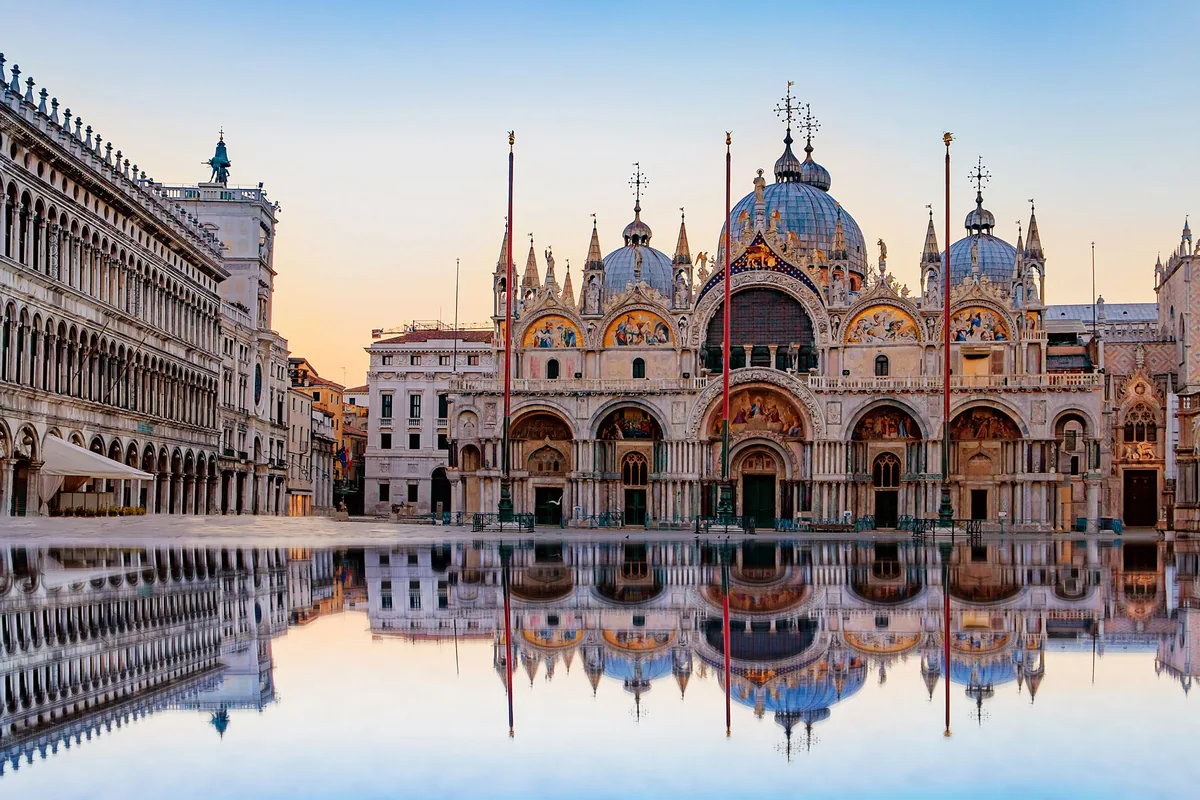
To build this golden cathedral, Venetian sailors spent centuries looting the finest marbles and gems from the dying ports of the Byzantine Empire.
About Basilica di San Marco
The first church on this site was burned down during a palace revolution, leading to the construction of the current, more fortified version. Its architecture is a rare blend of Western Romanesque and Eastern Byzantine styles, reflecting Venice's role as the hinge between two worlds. During the Napoleonic occupation, the bronze horses were taken to Paris, only to be returned after the Emperor's fall. Today, the basilica faces its greatest threat from 'Acqua Alta,' or high water, which increasingly infiltrates the narthex and threatens the ancient mosaics with salt erosion.
What Basilica di San Marco actually is
Golden mosaics cover every inch of the undulating domes, reflecting a soft, flickering light that seems to emanate from the stone itself. St. Mark's Basilica is the jewel of Venice, a structure that feels more like an Eastern treasure chest than a traditional European cathedral. The interior is cool and smelling of ancient incense and the salty dampness of the Venetian lagoon. Walking over uneven marble floors that rise and fall like the waves of the sea, a physical reminder of the city's precarious relationship with the water. The sound is a low hum of whispers and the distant chime of the clock tower in the piazza outside. It is a space where the wealth of Byzantium meets the mercantile ambition of the Venetian Republic.
“Golden mosaics cover every inch of the undulating domes, reflecting a soft, flickering light that seems to emanate from the stone itself.”
Basilica di San Marco, Italy
Origins
Venetian merchants famously stole the relics of St. Mark from Alexandria in 828, hiding the body under layers of pork to smuggle it past Muslim guards. The current basilica was built in the 11th century to house these remains, designed in a Greek cross plan with five massive domes. Much of the decorative splendor was literally looted; the columns, marbles, and the famous bronze horses were taken from Constantinople during the Fourth Crusade in 1204. Across centuries, the Doges of Venice used the basilica as their private chapel, pouring the city's immense wealth into its decoration until it became known as the 'Church of Gold.'
Stepping inside, the immediate transition
Stepping inside, the immediate transition from the bright, chaotic Piazza San Marco to a dim, amber-hued sanctuary. The way the light dances on the four thousand square meters of gold leaf mosaics, shifting moving through the nave. A smooth, worn texture of the balustrades and notice the intricate patterns of the mosaic floors, which contain marbles brought from across the Mediterranean. The Pala d'Oro, the golden altarpiece behind the main altar, sparkles with thousands of pearls and emeralds. The most powerful moment occurs climbing to the Loggia dei Cavalli, where the replica bronze horses stand guard and you can look out over the entire expanse of the piazza toward the Grand Canal.
The basilica is the focal point
The basilica is the focal point of the San Marco district, accessible by Vaporetto via the San Marco or San Zaccaria stops. Queues for entry are legendary, and because of the fragility of the structure, backpacks are strictly prohibited and must be left at a nearby luggage drop. Entering during a mass is discouraged for sightseers, but it is the only time to hear the organ fill the domed space. A pre-booked skip-the-line ticket is highly recommended, especially during the peak summer months when the piazza acts like a heat trap.
“The basilica is the focal point of the San Marco district, accessible by Vaporetto via the San Marco or San Zaccaria stops.”
The Experience
The atmosphere inside San Marco is heavy and mysterious, far removed from the airy cathedrals of Northern Europe. The mass of the age of the place in the dips and swells of the floor, which tell the story of a building slowly sinking into the mud of the lagoon. From the start, the smell of beeswax and the faint sound of water lapping against the stone foundations nearby. Standing under the central dome, the sheer volume of gold above you creates a sense of being suspended in a celestial cloud. It is a place that demands you look up until your neck aches.
Why It Matters
San Marco is the definitive monument of the Venetian Empire's maritime supremacy and its unique cultural identity. It houses the most extensive collection of Byzantine mosaics in the world and serves as a vital link to the lost splendor of Constantinople. Humanly, it is the spiritual anchor for a city that has defied geography for over a thousand years.
Why Visit
Visit to see what happens when a city has too much money and an obsession with the afterlife. San Marco is not just a church; it is a statement of power. The intensity of the gold mosaics is something that must be seen in person to be believed, as no photograph can capture the way they interact with the dim Venetian light.
Insider Tips
- 1
Visit the Museum (Museo di San Marco) on the upper floor to see the original bronze horses and get access to the exterior balcony.
- 2
The mosaics are only fully illuminated for a few hours each day (usually 11:30 am to 12:45 pm); time your visit to catch this glow.
- 3
Dress respectfully with shoulders and knees covered, as the 'dress code' guards are exceptionally strict and will deny entry.
- 4
Look for the 'Tetrarchs' sculpture on the exterior corner of the basilica; it is a rare 4th-century Egyptian porphyry masterpiece.
- 5
Check the 'Acqua Alta' forecasts before your visit, as the narthex of the basilica is one of the lowest points in the city and floods frequently.