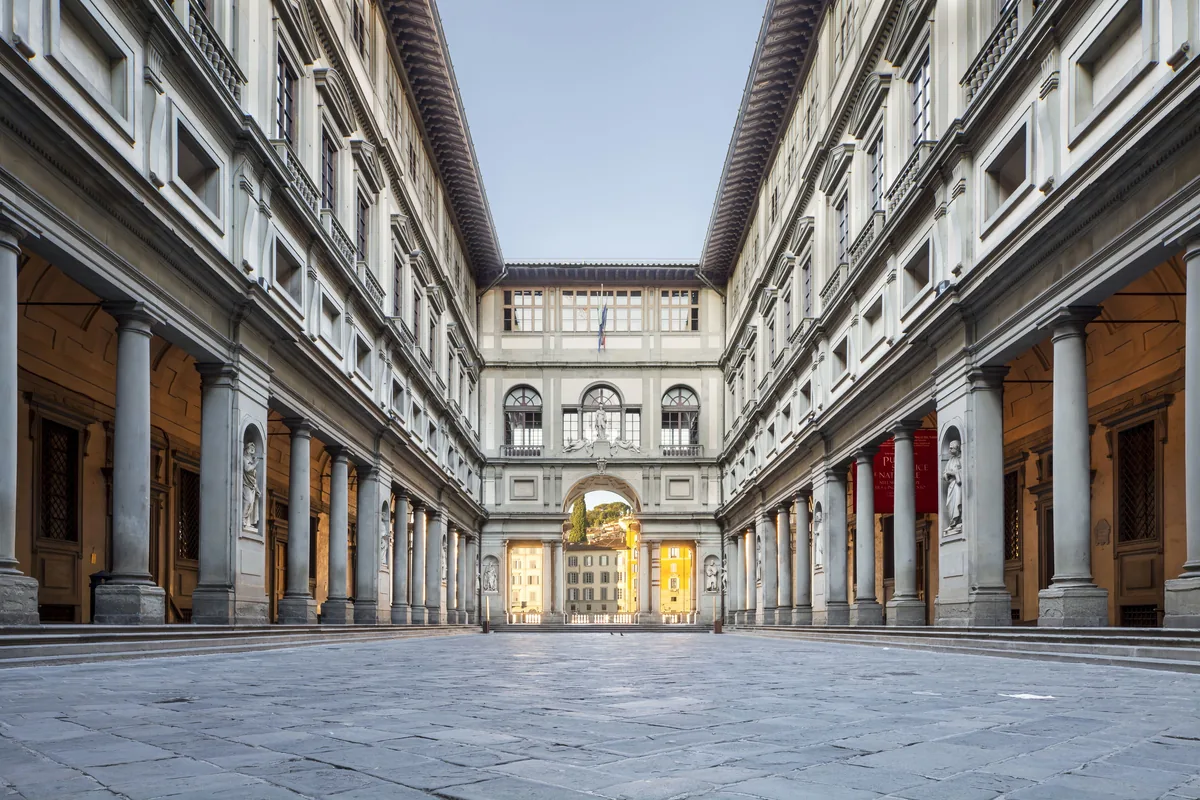
“Nearly five centuries ago, the world’s most famous paintings were hung in what was essentially a high-end office building for Florentine accountants and lawyers.”
About Galleria degli Uffizi
The construction required the demolition of a medieval neighborhood, a bold urban planning move that created the grand vista leading to the river. Vasari’s design was revolutionary for its time, utilizing iron reinforcements that allowed for the expansive window spaces. During World War II, the most precious works were hidden in villas across the countryside to protect them from Nazi looting. In 1993, a car bomb near the gallery caused significant damage, but the museum was restored with such care that the scars are nearly invisible to the untrained eye.
What Galleria degli Uffizi actually is
High ceilings and long, echoing corridors house the very soul of the Renaissance within this U-shaped masterpiece in Florence. The Galleria degli Uffizi, once the administrative offices of the Medici dukes, now functions as a sanctuary for the most significant collection of Western art in existence. Sunlight streams through the tall windows overlooking the Arno river, illuminating the intricate frescoes of the ceiling and the polished marble of the floors. The walk through rooms that feel like royal chapels, where the smell of old varnish and floor wax mingles with the cool air of the gallery. The museum is a chronological path through human thought, shifting from the flat gold of the Middle Ages to the breathing, fleshy reality of the High Renaissance.
High ceilings and long, echoing corridors house the very soul of the Renaissance within this U-shaped masterpiece in Florence.
commissioned Giorgio Vasari, 1560
Cosimo I de' Medici commissioned Giorgio Vasari in 1560 to design a building that would house the magistrates of Florence. Vasari created an architectural marvel that integrated the palace with the existing Loggia dei Lanzi and the Palazzo Vecchio. Gradually, the Medici family began to move their private art collections into the top floor, turning a workplace into a private museum. In 1737, the last Medici heir, Anna Maria Luisa, signed the 'Family Pact,' ensuring the art remained in Florence for the public to enjoy forever. This act of foresight preserved works by Botticelli, Leonardo, and Michelangelo that might otherwise have been scattered across the globe.
Standing before Botticelli's Birth of Venus,
Standing before Botticelli's Birth of Venus, There is a peculiar gravity pull you toward the canvas. First, the delicate transparency of the skin and the movement in the painted waves that seems almost rhythmic. The sound of the museum is a soft, reverent shuffling of feet and the occasional hushed gasp of a visitor seeing a textbook image in the flesh. Walking along the Corridoio Vasariano, The weight of history in the rows of Roman busts that line the path. The light in the 'Tribuna' room, with its deep red velvet walls and mother-of-pearl dome, feels like being inside a jewelry box. Those who come rush past the smaller corridors, but the views of the Ponte Vecchio from the end of the hall offer a perfect moment of Florentine calm.
The gallery sits in the middle
The gallery sits in the middle of Florence, a short walk from the Piazza della Signoria and the Duomo. It is essential to arrive with a timed entry ticket, as the standby lines can stretch for hours in the Tuscan heat. Entering via Door 3 to collect your booking and then Door 1 to enter is the standard ritual. Once inside, the path is largely linear, leading you through the upper floor before descending into the lower galleries. Staying until the final hour of the day often allows for a more intimate viewing of the larger rooms after the tour groups have retreated to the city's trattorias.
The gallery sits in the middle of Florence, a short walk from the Piazza della Signoria and the Duomo.
The Experience
The interior of the Uffizi is often remarkably cool, a welcome refuge from the humid Florentine streets. The scale of the corridors, designed to make the Medici feel like masters of all they surveyed. The standout is the tiny brushstrokes on Da Vinci’s 'Annunciation' that no digital screen could ever replicate. What stays with you is looking out from the gallery terrace at the top of the stairs, where the Brunelleschi dome appears so close you feel you could touch the terracotta tiles.
Why It Matters
The Uffizi is not just a museum but the primary document of the shift from the medieval to the modern mind. It represents the moment when art stopped being purely liturgical and started being a study of humanity. Its existence as a public trust since the 18th century makes it a pillar of world heritage.
Why Visit
Visit to see the originals of the images that have defined beauty for five hundred years. There is a physical power to the pigment and scale of these works that photos cannot convey. It is the only place where you can witness the entire evolution of the human eye in a single afternoon.
✦ Insider Tips
- 1
Head straight to the Botticelli rooms (10-14) the moment the doors open to see the Primavera without a wall of tourists in front of you.
- 2
The museum café on the terrace is expensive, but the view of the Palazzo Vecchio tower is arguably the best in the city.
- 3
Look for the 'Caravaggio' rooms toward the end of the circuit; the dramatic lighting there provides a sharp, moody contrast to the earlier rooms.
- 4
The Uffizi app is a worthwhile investment for navigating the maze-like floor plan without getting lost in the minor galleries.
- 5
Visit on a Tuesday evening when the gallery often extends its hours and the lighting inside takes on a magical, nocturnal quality.