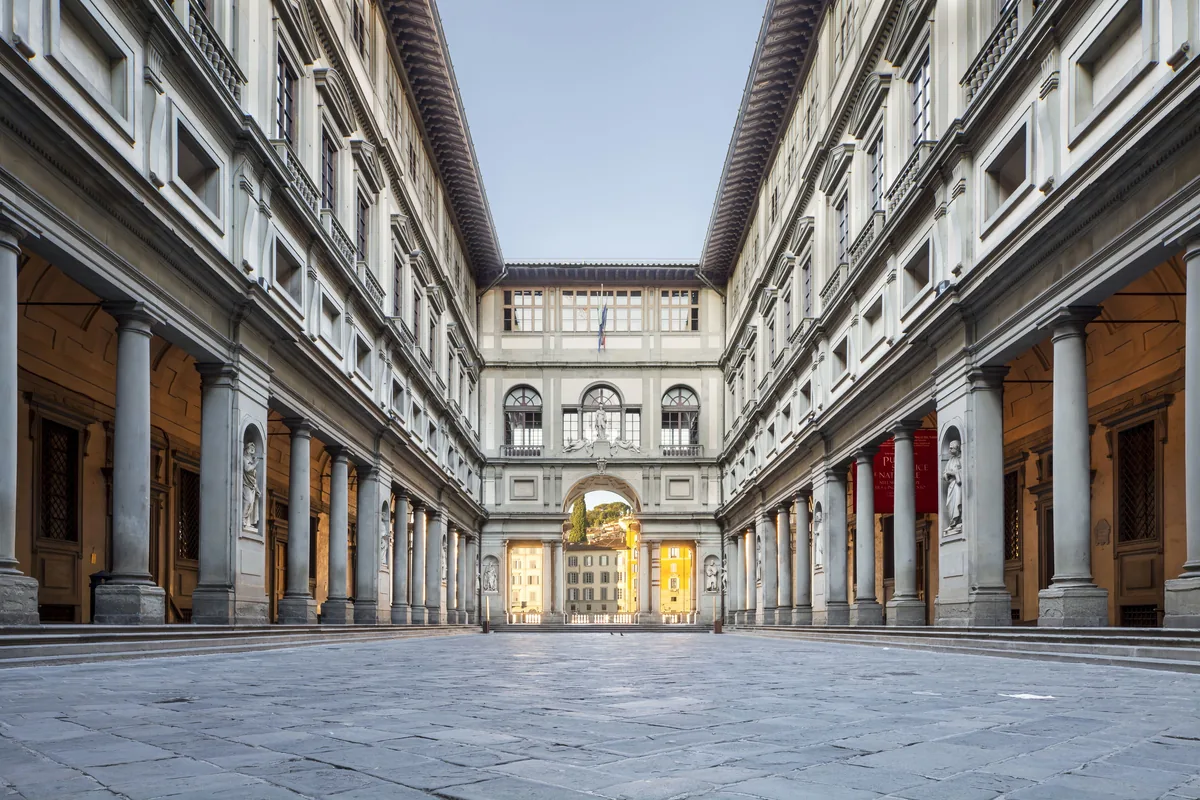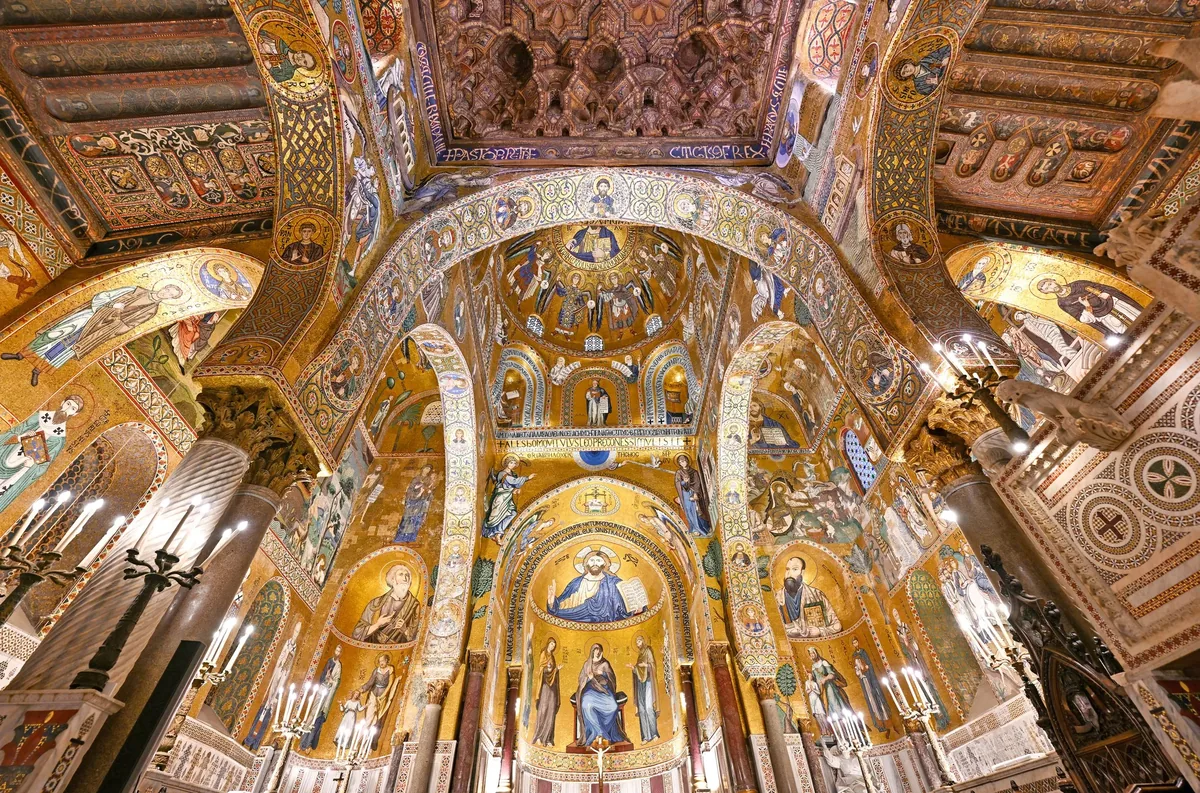
Inside this Sicilian chapel, Christian saints look out from golden walls while a ceiling carved by Muslim craftsmen depicts scenes of wine-drinking and courtly love.
About Capella Palatina
The chapel was consecrated in 1140 and survived the subsequent centuries of political upheaval in Sicily with remarkably little damage. While the Norman Palace around it was expanded and remodeled by the Spanish Bourbons, the chapel remained an untouched island of the 12th century. The mosaics were restored in the 19th and 20th centuries, but the original Fatimid ceiling, the only one of its kind in a Christian church, remains largely as it was when Roger II sat beneath it. It works as an echo of a Mediterranean that was once a bridge between cultures rather than a border.
Capella Palatina
Deep within the Norman Palace in Palermo lies a small, shadowed chapel where the gold of the East meets the geometry of the South. The Capella Palatina is a masterpiece of Arab-Norman-Byzantine architecture, a shimmering cave of mosaics that reflects the most tolerant and cosmopolitan era of Sicilian history. The area here is cool and carries the faint, dry scent of cedar wood and old stone. You walk across floors of intricate marble inlay, noticing that the light doesn't come from windows, but seems to be trapped within the millions of gold glass tiles that cover the walls. The ceiling is a 'muqarnas' honeycomb of carved wood, a feature usually found in mosques, looking down upon the image of Christ Pantocrator in the dome. It is a space of perfect, glittering synthesis.
commissioned the chapel, 1130
King Roger II of Sicily commissioned the chapel in 1130 after his coronation, intending to create a private sanctuary that reflected his multi-cultural kingdom. He employed Byzantine mosaicists to create the religious imagery, Fatimid craftsmen from North Africa for the wooden ceiling, and Norman architects for the structural bones. For a brief century, Palermo was a place where Greek, Latin, and Arabic were all official languages, and this chapel is the physical proof of that harmony. The images on the ceiling include scenes of court life, musicians, and lions, secular subjects that are exceptionally rare in a Christian place of worship.
Stepping into the chapel, the immediate visual overload of the gold mosaics. You register the way the faces of the saints seem to follow you, their eyes rendered with a startling lifelikeness by the Byzantine masters. The surface of the cool marble columns and notice the Arabic inscriptions on the ceiling, praising the king in the language of his former rivals. The sound is a hushed, reverent quiet that makes the space feel twice its actual size. What you catch first is the smell of beeswax candles and the faint dampness of the palace foundations. The most gripping moment is looking up at the muqarnas ceiling; as your eyes adjust to the dim light, seeing the tiny, painted figures of dancers and drinkers, a secret world of earthly delight hidden above the holy icons. The chapel is located inside the Palazzo dei Normanni, the seat of the Sicilian Regional Assembly. It is a short walk from the Palermo Cathedral and the Quattro Canti. Entry is through a security checkpoint, and because the chapel is small, visitor numbers are strictly limited. Buying tickets online in advance is essential to avoid long waits in the often-sweltering Palermo heat. The chapel is closed to tourists during Sunday morning mass, so plan your visit for a weekday or a Saturday. Once inside, take your time; the scale is small enough that you can see every detail if you stay long enough for your eyes to fully adapt to the golden gloom.
The Experience
Within the Capella Palatina is one of concentrated beauty. The temperature drop as you transition from the palace courtyard into the golden interior. Beginning with the play of light on the mosaic tiles, which are set at slight angles to catch the light and create a shimmering, liquid effect. The sound is muffled and intimate, making you feel like a guest of the king rather than a tourist. What remains with you is the realization of the harmony in the room; the different styles don't clash, but create a single, unified vision of a kingdom at peace with its own complexity.
Why It Matters
The Capella Palatina is the finest example of the Arab-Norman style and a UNESCO World Heritage site. It represents a peak of cultural fusion that has few parallels in world history. Historically, it is the most important site in Sicily for understanding the island's unique identity as the crossroads of the Mediterranean.
Why Visit
The pull is that this is the most beautiful room in Italy that isn't in Rome or Florence. It offers a kind of beauty that is dense, dark, and mysterious. You come here to see what the world looks like when three different civilizations decide to build something together, rather than fighting over the land.
✦ Photo Gallery
Best Season
🌤 April and May are wonderful; the orange blossoms are in bloom in Palermo, and the light in the chapel is at its most vibrant.
Quick Facts
Best time to visit
April and May are wonderful; the orange blossoms are in bloom in Palermo, and the light in the chapel is at its most vibrant.
Getting there
In Palermo, Italy; reach Palermo first, then continue to the site.
Location
Palermo, Italy
Type
attraction
Insider Tips
- 1
Bring a pair of binoculars to see the details of the painted wooden ceiling, as the figures are small and high up.
- 2
The ticket includes access to the Royal Apartments upstairs; don't skip them, as they contain rare 12th-century secular mosaics of hunting scenes.
- 3
Visit right at opening time (8:15 AM) to have the chapel to yourself for a few minutes before the group tours arrive.
- 4
Check the official website for closures, as the chapel is still used for government functions and can close without much notice.