“While the ruins of Pompeii are the skeleton of Roman history, this museum is the flesh, blood, and scandalous humor of that vanished world.”
About Museo Archeologico Nazionale di Napoli
The Farnese Marbles were originally part of the decoration of the Baths of Caracalla in Rome, excavated during the Renaissance by the Pope’s family. The collection moved to Naples when the Bourbons inherited the Farnese estate, bringing some of the largest monolithic statues ever carved to the city. Throughout the 20th century, the museum struggled with funding and earthquake damage, but recent renovations have returned it to its former glory. It remains a critical site for the study of the ancient world, housing the only surviving examples of many Roman painting techniques and household items.
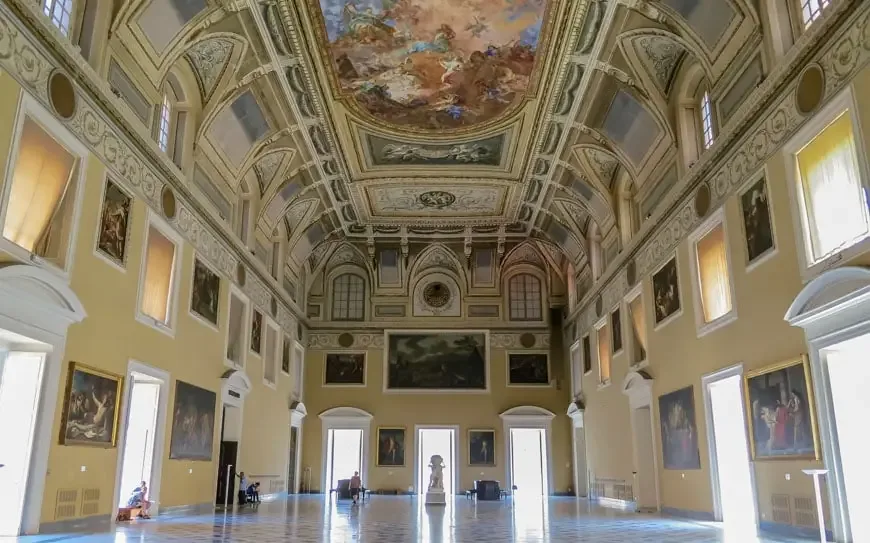
Sunlight pours through the grand windows
Sunlight pours through the grand windows of a former cavalry barrack, illuminating a collection of Roman antiquities that has no equal in the world. The National Archaeological Museum of Naples (MANN) is the final resting place for the treasures of Pompeii and Herculaneum, along with the colossal marble legacy of the Farnese family. The room here is cool and quiet, a sharp contrast to the frantic honking and shouting of the Neapolitan streets just outside the heavy wooden doors. The walk through vast halls where the scent of old paper and stone lingers, surrounded by mosaics so fine they look like silk tapestries. The grandeur of the Roman Empire feels remarkably personal and devastatingly immediate.
Sunlight pours through the grand windows of a former cavalry barrack, illuminating a collection of Roman antiquities that has no equal in the world.
History
King Charles VII of Bourbon founded the museum in the late 18th century to house his mother’s inheritance, the legendary Farnese Collection. When the nearby cities of Pompeii and Herculaneum were excavated, the finest frescoes and sculptures were moved here for protection, turning the MANN into the world’s premier center for Roman archaeology. The building itself is an architectural survivor, having was a university and a military barracks before becoming a temple to the past. During the 19th century, the museum’s 'Secret Cabinet', containing the erotic art of the ancient world, was a scandalous destination for Grand Tour travelers, frequently opened and closed depending on the prevailing morality of the time.
Standing before the 'Alexander Mosaic,'
Standing before the 'Alexander Mosaic,' The kinetic energy of a battle fought thousands of years ago. What registers is the two million tiny stone tiles that make up the image, their colors still vibrant and the expressions on the faces clearly visible. A chill of the marble in the Farnese gallery, where the 'Farnese Hercules' looms over you with a muscularity that seems impossible for stone. What is audible is the echo of your own footsteps on the marble floors and the distant tolling of church bells from the Sanità district. The standout is the smell of the city, espresso and sea air, wafting through the occasional open window. The most surprising experience is the 'Secret Cabinet,' where the ancient Roman sense of humor and sexuality is displayed with a frankness that still surprises modern visitors.
The museum is located
The museum is located at the edge of the historic center, easily reached by Metro Line 1 (stop: Museo) or Line 2 (stop: Piazza Cavour). It is a short but steep walk up from the Spaccanapoli district. The museum is large and can be overwhelming, so focusing on the ground floor (Farnese Marbles) and the first floor (Mosaics and Pompeian frescoes) is a good strategy for a single visit. Security is generally efficient, and the museum rarely feels as crowded as the Vatican or the Uffizi, allowing for a more meditative engagement with the art.
The museum is located at the edge of the historic center, easily reached by Metro Line 1 (stop: Museo) or Line 2 (stop: Piazza Cavour).
The Experience
The character of the MANN is one of quiet majesty. The temperature drop as you enter the high-ceilinged halls, a natural air conditioning provided by the thick Bourbon walls. The tiny, everyday objects, blue glass bowls, carbonized bread, surgical instruments, that make the Romans feel like people you could have known. Sound-wise is muffled and respectful, broken only by the occasional school group or the click of a camera. What lingers with you is standing in the Hall of the Sun-dial, one of the largest rooms in Europe, where you feel the sheer weight of the history gathered in this one building. It is a place that demands a slow pace and a curious mind.
Why It Matters
The National Archaeological Museum of Naples is home to the most important collection of Roman artifacts in existence. It is the only place to truly understand the domestic and artistic heights of the cities destroyed by Vesuvius. Historically, it was a foundation of the European Grand Tour and remains an essential pillar of Western cultural education.
Why Visit
The draw: you can't understand Pompeii without it. If the ruins are the stage, this museum is the costume and the script. It offers an intimacy with the past that grand monuments can't match, showing you everything from the heroics of Alexander the Great to the bronze keys a Roman woman used to lock her front door.
✦ Insider Tips
- 1
The 'Secret Cabinet' (Gabinetto Segreto) requires no extra ticket but has specific opening hours; check these at the information desk the moment you arrive.
- 2
Start on the ground floor with the Farnese Hercules to get a sense of the scale before moving to the delicate mosaics upstairs.
- 3
Look for the 'Blue Vase' from Pompeii, a masterpiece of cameo glass that is one of the rarest objects in the collection.
- 4
The museum shop is surprisingly good for high-quality reproductions of Roman jewelry and mosaics.
- 5
The stairs are grand but steep; use the elevators located in the back corners of the building if you want to save your energy for the galleries.