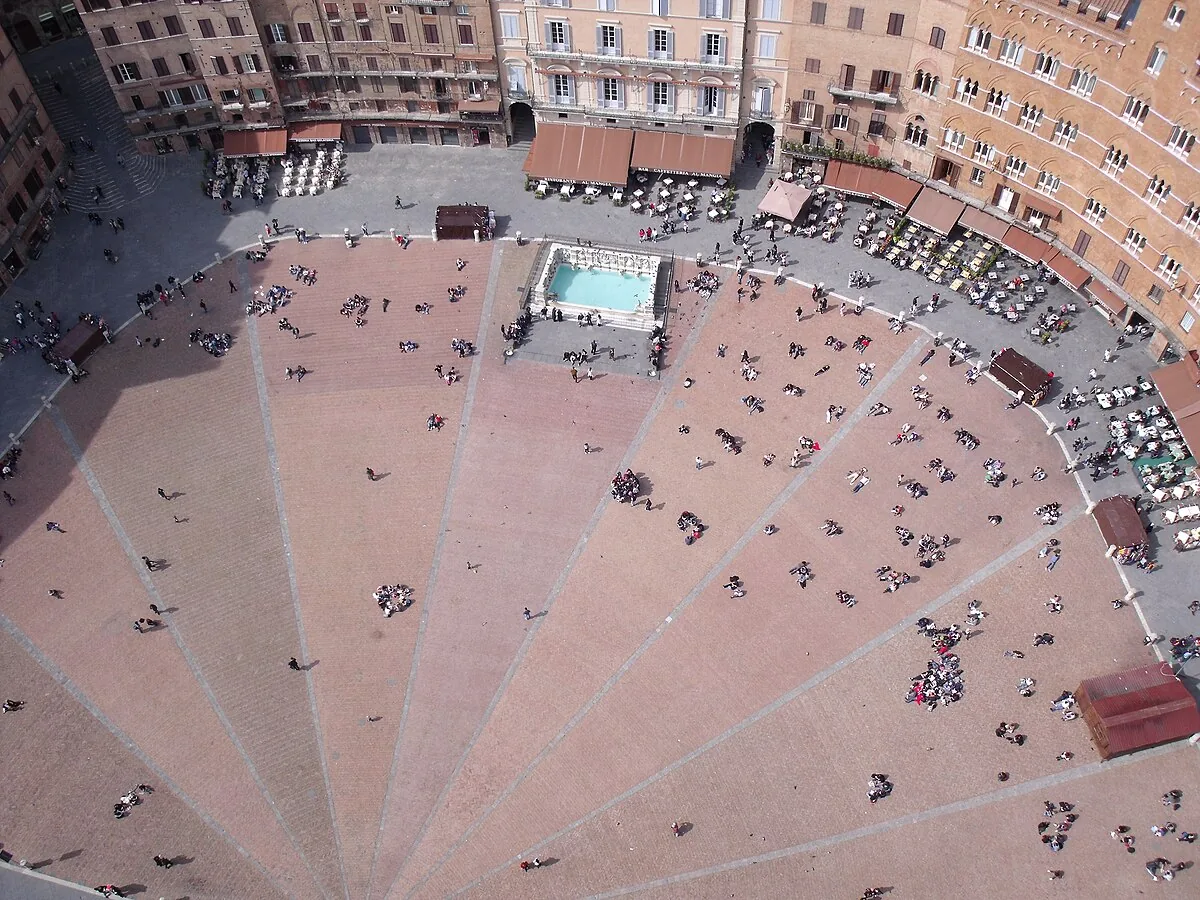
In this brick-paved bowl, the entire city of Siena gathers to sit directly on the ground, treating one of Europe's grandest monuments like a shared living room carpet.
About Piazza del Campo
The Piazza del Campo was designed as a neutral ground where the competing factions of the city could meet in a space that belonged to everyone. The construction of the Palazzo Pubblico in the early 14th century set the aesthetic standard for the entire city, with a law passed in 1297 requiring that all buildings facing the square match the architectural style of the town hall. This created a visual unity that remains unbroken today. The square has hosted everything from bullfights and boxing matches to the sermons of Saint Bernardino, but it is the biannual Palio horse race that continues to define its spirit, turning the elegant brickwork into a dusty, high-stakes arena twice a year.
What Piazza del Campo actually is
A shell-shaped expanse of red brick tilts gently toward the massive shadow of the Torre del Mangia, creating what is arguably the most beautiful public square in the world. Piazza del Campo is the social and architectural lungs of Siena, a medieval theater where the city’s seventeen neighborhoods, or contrade, have converged for centuries. This space smells of roasted coffee, damp stone, and the spicy aroma of panforte from the nearby bakeries. The walk across the 'nine sectors' of the brick pavement. Notice how the architecture curves to embrace the slope of the land. The sound is a rhythmic clatter of footsteps on stone and the deep, bronze tolling of the 'Sunto' bell from the heights of the Palazzo Pubblico.
“A shell-shaped expanse of red brick tilts gently toward the massive shadow of the Torre del Mangia, creating what is arguably the most beautiful public square in the world.”
Piazza del Campo, Italy
History
The piazza was created on the site of an ancient marketplace at the junction of the three hills on which Siena was built. In the 13th century, the 'Council of Nine', the city's governing body, ordered the construction of the Palazzo Pubblico and the paving of the square with the characteristic red brick. The nine distinct segments of the pavement represent the members of this council. Unlike the grand, symmetrical piazzas of the Renaissance, the Campo follows the natural contours of the bowl-shaped valley, reflecting a medieval philosophy of urban planning that sought harmony with the landscape. Since 1633, it has been the site of the Palio, the world’s most intense and dangerous horse race, where the entire square is covered in 'tuff' clay for ninety seconds of absolute madness.
Sitting on the brick floor in the late afternoon, The residual heat of the Tuscan sun radiating through your clothes. The first thing you register is the way the shadow of the 330-foot tower slowly sweeps across the square like a giant sundial. The sound is a mix of the low hum of conversation from the surrounding cafés and the echoes of children playing on the open bricks. A smooth, white marble of the Fonte Gaia, where the sound of splashing water provides a cool contrast to the dry heat of the square. First, the deep, burnt-sienna color of the buildings, a pigment that actually takes its name from the earth of this very city. The most magical moment is at twilight when the buildings turn a dark, moody gold and the first lights flicker on in the windows of the palazzo.
Siena is a ninety-minute bus or train ride
Siena is a ninety-minute bus or train ride from Florence, but the train station is located at the bottom of the hill, requiring a series of escalators to reach the historic center. The piazza is the focal point of the city, and all the narrow, winding streets eventually lead down to it. Because Siena is a pedestrian-only city, you must explore the square on foot. Arriving in the early morning allows you to see the market being set up in the quiet, misty air before the day-trippers arrive. For the best view, climb the five hundred steps of the Torre del Mangia, though the line is long and the climb is not for the claustrophobic.
“Siena is a ninety-minute bus or train ride from Florence, but the train station is located at the bottom of the hill, requiring a series of escalators to reach the historic center.”
The Experience
Within the Campo has a unique quality, trapped by the high surrounding buildings yet refreshed by the open sky. Instantly, the smell of ancient dust and the way the light reflects off the thousands of bricks, creating a warm, internal glow. The presence of the slight incline of the floor, which leads your eyes naturally toward the seat of government. The sound of the wind whistling around the top of the tower adds a haunting layer to the atmosphere. The most human moment is seeing the locals lie flat on their backs in the center of the square at night, staring at the stars framed by the medieval skyline. It is a place that encourages a rare kind of public intimacy.
Why It Matters
Piazza del Campo is the definitive masterpiece of medieval urban design and a UNESCO World Heritage site. It represents the pinnacle of the Sienese Gothic style and the city’s historical republican pride. Culturally, it is the home of the Palio, an event that preserves the medieval social structure of the city in the modern world.
Why Visit
There is no other place in Italy where you are encouraged to simply sit on the floor and watch the world go by. The Campo is not a monument to be looked at from a distance; it is a space to be inhabited. You come here to feel the heart of Tuscany beating in a rhythm that hasn't changed since the 1300s.
Insider Tips
- 1
Don't sit in the cafés if you're on a budget; do like the locals and sit directly on the brick pavement in the center of the square.
- 2
The line for the Torre del Mangia is much shorter in the late afternoon, about an hour before it closes.
- 3
Visit the 'Sala della Pace' inside the Palazzo Pubblico to see the 'Allegory of Good and Bad Government,' one of the most important secular fresco cycles in history.
- 4
Drink from the Fonte Gaia; the water is clean, cold, and comes from a medieval aqueduct system that is still in use.
- 5
If you are in town for the Palio (July 2 or August 16), be prepared for extreme crowds and intense heat; it is an endurance event as much as a race.