“Two thousand years ago, a mountain turned the sky to stone, burying an entire city in seconds and leaving us a perfect, haunting blueprint of Roman life.”
About Archaeological Park of Pompeii
Pompeii was a packed commercial center and a resort for wealthy Romans, known for its production of 'garum,' a fermented fish sauce. Its proximity to the sea made it a mixing ground for cultures, as evidenced by the Temple of Isis and the variety of foreign coins found in the shops. When the eruption began, many residents stayed behind to protect their property, unaware of the lethal pyroclastic surges to come. Today, the site is a battleground against time and the elements, with constant restoration work required to keep the excavated walls from crumbling back into the earth.
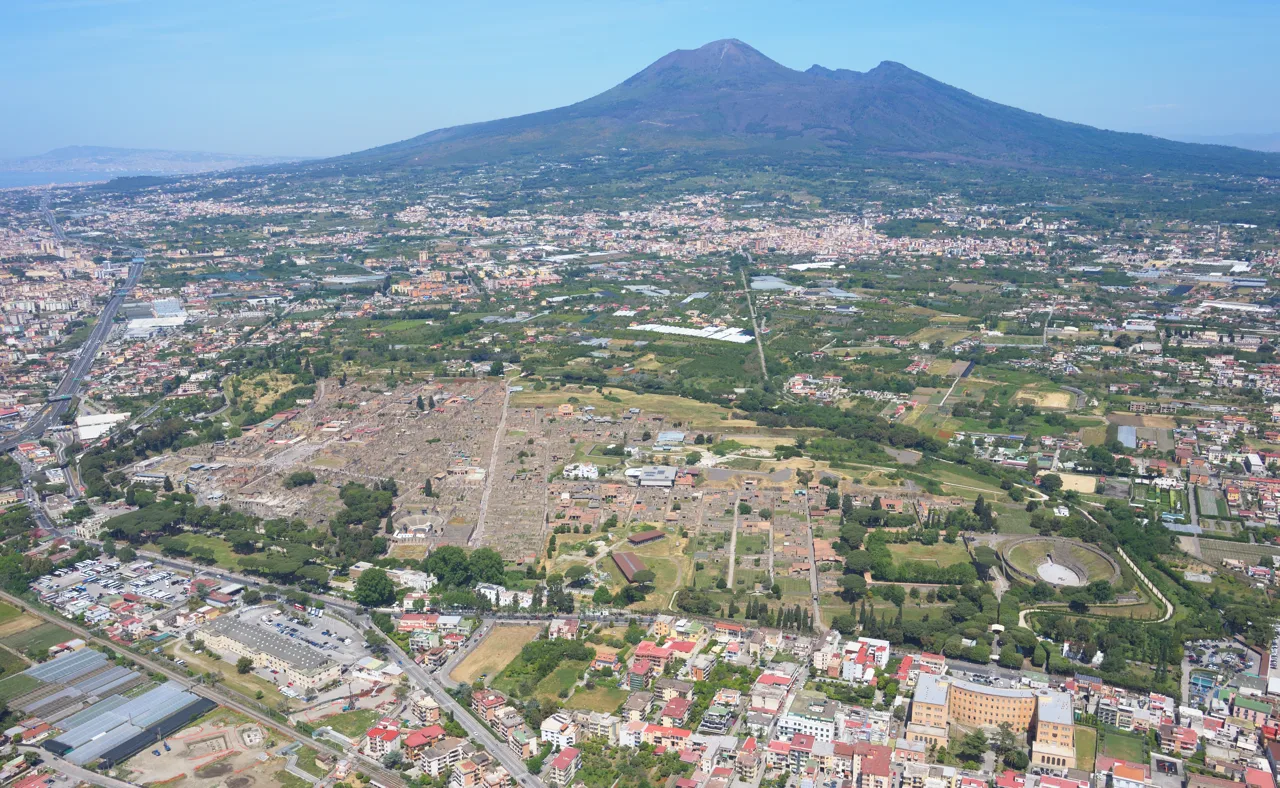
Overview
Silent streets of grey basalt wind between the roofless shells of homes that were once filled with the chatter of a Roman port. The Archaeological Park of Pompeii is a paradox of preservation, a city frozen in its dying moments by the very volcano that destroyed it. Mount Vesuvius looms on the horizon, a green, slumbering giant that dominates every view. The environment here is dry and carries the scent of wild rosemary and sun-scorched earth. Walking in the ruts of chariot wheels that are still visible in the stone, feeling a strange intimacy with the people who lived here nearly two thousand years ago. It is a place of immense scale, where the mundane details of life, a baker’s oven, a political slogan on a wall, are more moving than the grand temples.
Silent streets of grey basalt wind between the roofless shells of homes that were once filled with the chatter of a Roman port.
Visiting info
In October of 79 AD, a catastrophic eruption buried Pompeii under six meters of ash and pumice in less than twenty-four hours. The city remained untouched and forgotten until it was accidentally rediscovered in 1594 by an engineer digging a canal. Serious excavations began in 1748, revealing a society perfectly preserved in a vacuum. It was here that Giuseppe Fiorelli pioneered the technique of pouring plaster into the voids left by decomposed bodies, creating the haunting casts of victims that still reside in the ruins today. The site has taught us more about daily Roman life than any text or monument, from the diet of the common people to the complexities of their plumbing.
Walking through the Forum at midday , The intense heat of the Campania sun bouncing off the white marble remains. You register the vibrant 'Pompeian red' frescoes in the Villa of the Mysteries, their colors still startlingly deep after two millennia. The sound is the crunch of gravel underfoot and the occasional chirp of a cicada in the nearby pine trees. Entering a private villa, The domestic rhythm of the space, from the central atrium designed to catch rainwater to the small, dark bedrooms. The most unsettling moment is encountering the plaster casts, which capture the final, desperate gestures of the inhabitants. The opening note is the tiny mosaics of 'Cave Canem' (Beware of the Dog) at the entrances, a human touch that bridges the centuries.
The park is easily accessible from Naples or
Sorrento via the Circumvesuviana commuter train, stopping at Pompeii Scavi-Villa dei Misteri. The entrance is just steps from the station. The site is vast, covering 66 hectares, so a map and a strategic plan are essential to avoid exhaustion. Most people spend at least four hours wandering the ruins, but even a full day only scratches the surface. Comfortable footwear is non-negotiable, as the ancient Roman stones are notoriously uneven and hard on the feet. Arriving as the gates open allows you to experience the street of tombs in a silence that feels appropriately somber.
Sorrento via the Circumvesuviana commuter train, stopping at Pompeii Scavi-Villa dei Misteri.
The Experience
Inside Pompeii feels heavy with the presence of the past. What draws the eye is the graffiti on the walls, ranging from poetic declarations of love to complaints about local tavern owners. The smooth, rounded edges of the stepping stones used by Romans to cross the streets during rainstorms without getting their sandals wet. Sound-wise of the wind through the tall cypress trees adds to the sense of a city that is waiting for people who will never return. It is a place that makes you hyper-aware of your own mortality, yet marvel at the resilience of human culture.
Why It Matters
Pompeii is arguably the world's most important archaeological site, providing an remarkable window into the Roman world. It is the only place where a complete ancient city can be explored in its entirety, from the amphitheater to the brothels. Culturally, it has shaped our understanding of antiquity and continues to be a primary site for developing new archaeological techniques.
Why Visit
History here isn't something behind glass; it is under your feet. Pompeii allows you to walk through a Roman front door and stand in a Roman kitchen. It is the closest thing we have to a time machine, and the scale of the preservation is something that no book or movie can properly prepare you for.
✦ Insider Tips
- 1
The Villa of the Mysteries is a bit of a walk from the main center, but its frescoes are the best-preserved and most beautiful in the entire park.
- 2
Bring your own water and snacks, as the on-site cafeteria is often crowded and overpriced, and there are few shaded spots to rest.
- 3
Download an offline map or use a high-quality GPS guide, as the street signs in the park are often missing or confusing.
- 4
Visit the 'Antiquarium' near the entrance first to see the artifacts and casts that put the buildings into their human context.
- 5
The Lupanar (brothel) is the most popular stop; visit it early or very late in the day to avoid being caught in a slow-moving queue of tour groups.