For more than a century, the people of Florence built a cathedral with a hole in the roof, betting that someone would eventually be smart enough to figure out how to close it.
About Santa Maria del Fiore
The cathedral was built over the remains of the 4th-century church of Santa Reparata, whose ruins can still be visited in the crypt. Its construction was a matter of civic pride, funded by the wealthy wool guilds of Florence who wanted to outdo the rival cities of Pisa and Siena. Brunelleschi's dome was not just an artistic triumph but a logistical one, involving the invention of new cranes and hoists to lift tons of material hundreds of feet into the air. Despite earthquakes and the weight of six hundred years, the dome has never needed major structural repairs, evidence of the mathematical precision of its creator.
What Santa Maria del Fiore actually is
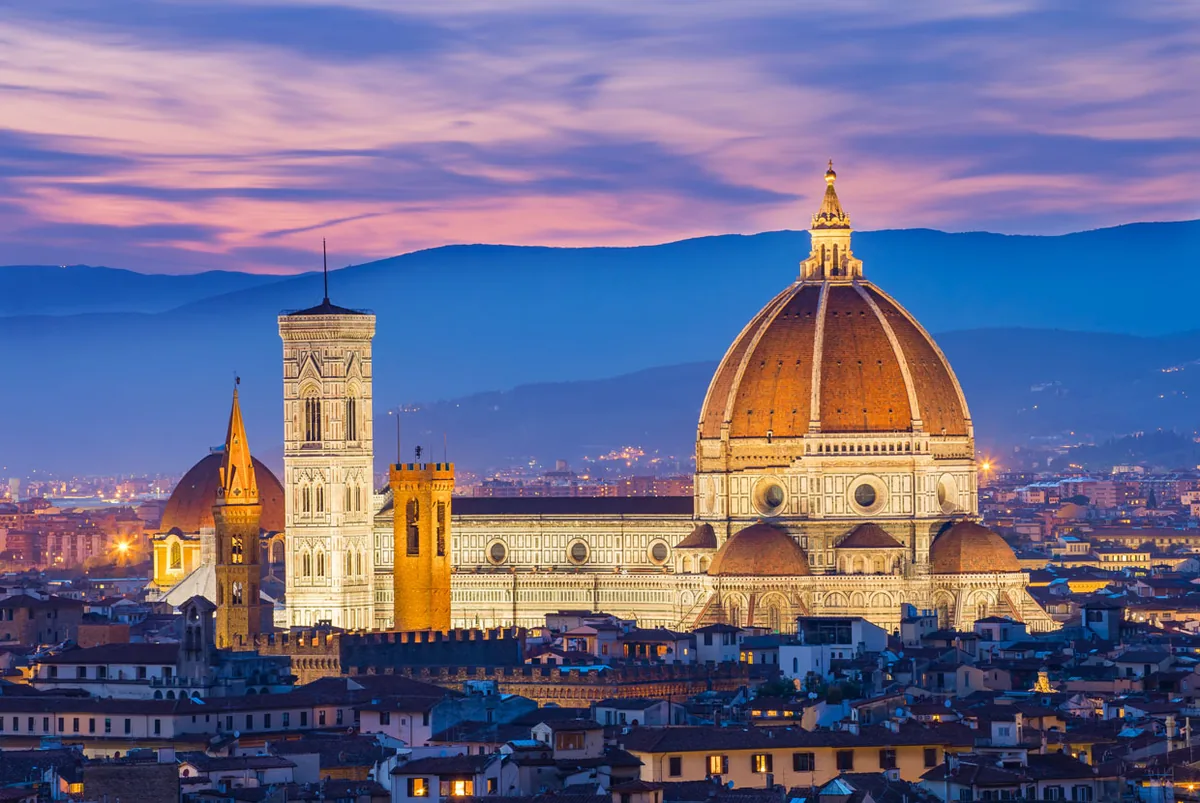
A massive shell of red terracotta tiles dominates the Florentine skyline, held together by a secret double-brick geometry that changed architecture forever. Santa Maria del Fiore, the cathedral of Florence, is a riot of green, pink, and white marble on the outside and a vast, austere cavern on the inside. Inside, the piazza is charged with the sound of the bells from Giotto’s Campanile and the constant shuffle of travelers looking upward. Walking around the perimeter, feeling the cool touch of the intricate marble inlays and noticing how the structure seems to shift in color as the sun moves across the sky. It is the heart of the Renaissance, a building that was designed to be the largest and most beautiful in the world at the time of its conception.
“A massive shell of red terracotta tiles dominates the Florentine skyline, held together by a secret double-brick geometry that changed architecture forever.”
Santa Maria del Fiore, Italy
Work began, 1296
Work began in 1296 under Arnolfo di Cambio, but for decades the cathedral sat roofless because nobody knew how to bridge the massive gap over the altar. In 1418, Filippo Brunelleschi, a goldsmith with no formal architectural training, won the competition to build the dome. He designed a self-supporting structure that required no wooden scaffolding, utilizing a herringbone brick pattern and an inner and outer shell. The dome was finally completed in 1436, a miracle of engineering that still is the largest masonry dome in the world. The exterior marble facade we see today was actually added much later, in the 19th century, to replace the unfinished original front.
Inside the cathedral, the immediate shift
Inside the cathedral, the immediate shift from the ornate exterior to a stark, massive interior that emphasizes the volume of the space. The incredible fresco of the Last Judgment covering the inside of the dome, its figures looking down from a terrifying height. You get a vibration of the organ during the midday service and notice the sunlight streaming through the stained glass windows by Donatello and Ghiberti. In your ears is an echoing murmur that fills the vast nave. The most visceral experience is the climb between the two shells of the dome; The slant of the walls and the proximity of the ancient bricks as you ascend toward the lantern, where you emerge to a view of the city that is nothing short of celestial.
The Duomo sits at the center
The Duomo sits at the center of the pedestrianized heart of Florence. Entry to the cathedral itself is free, though the lines can wrap around the entire building by mid-morning. Tickets are required for the Dome, the Bell Tower, the Crypt, and the Baptistery, and these must be booked days or weeks in advance for a specific time slot. The 'Grande Museo del Duomo' behind the cathedral is essential for seeing the original sculptures, including Michelangelo’s 'other' Pietà. Arriving at the piazza at sunrise allows you to appreciate the marble exterior in a rare moment of solitude before the city wakes up.
“The Duomo sits at the center of the pedestrianized heart of Florence.”
The Experience
The interior the Duomo is surprisingly thin and cool, feeling like a mountain cave. The standout is the contrast between the pale, simple walls of the nave and the explosion of color in the mosaics of the Baptistery across the square. A remnant of the physical effort of the 463 steps to the top of the dome, a journey that takes you into the heart of the machine. Audibly, the of the wind at the very top, looking out over the sea of Florentine rooftops, is a moment of pure clarity. It is a place that makes you feel the transition from the medieval dark into the light of the modern age.
Why It Matters
Santa Maria del Fiore is the definitive architectural achievement of the early Renaissance. Brunelleschi’s dome proved that ancient Roman engineering could be surpassed, sparking a wave of innovation that defined European culture for centuries. It remains the spiritual and visual anchor of Florence and a masterpiece of world heritage.
Why Visit
Visit to experience the scale of human ambition. Looking up at the dome from the inside is moving, but climbing inside its structure is life-changing. It is the only place where you can see the literal turning point of history written in brick and stone, all while standing above the most beautiful city in the world.
Insider Tips
- 1
Book the Dome climb (Cupola) for the very first slot of the morning to avoid being stuck in a human traffic jam in the narrow staircases.
- 2
Visit the Museo dell'Opera del Duomo to see the original 'Gates of Paradise' by Ghiberti; the ones on the Baptistery are replicas.
- 3
The 'Secret Terraces' tour is worth the extra cost, allowing you to walk on the roof of the nave for a unique perspective of the dome.
- 4
Look for the clock on the interior facade; it was designed by Uccello and follows 'Italic Time,' where the day ends at sunset.