“In the 1950s, this city was called the 'shame of Italy' and evacuated as a slum; today, those same caves are some of the most sought-after hotel rooms in the world.”
About Sassi di Matera
Matera's history is layered in its 'Rupestrian' churches, which feature frescoes painted by Byzantine monks who fled to these caves over a thousand years ago. The city survived the fall of Rome, Saracen raids, and the feudal neglect of the South, primarily because its architecture was built into the earth rather than upon it. The unique 'palombaro' cisterns under the main square could hold five million liters of water, sustaining the city through centuries of drought. This resilience is what eventually earned Matera its place on the world stage, proving that what was once seen as a liability was actually its greatest cultural asset.
What Sassi di Matera actually is
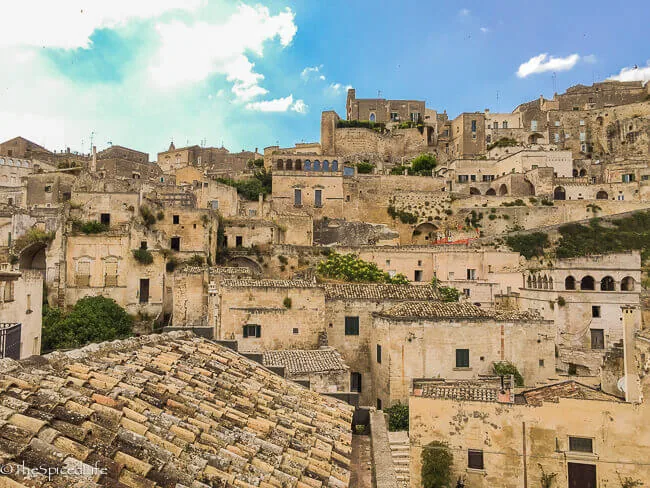
Pale calcarenite caves stack upon one another, where the roof of one house is the street for the one above. The Sassi di Matera, a complex of cave dwellings in the Basilicata region, is one of the oldest continuously inhabited cities in the world. The area here is dry and smells of calcified dust, wild oregano, and the distant woodsmoke of a city that still feels primitive. You walk through a labyrinth of narrow stone stairs and blind alleys that spill out over a deep, plunging ravine. The sound is a haunting mix of the wind howling through the Gravina canyon and the bells of rupestrian churches carved directly into the bedrock. It is a city of shadows and stone, looking more like a vision of ancient Jerusalem than a modern Italian town.
Pale calcarenite caves stack upon one another, where the roof of one house is the street for the one above.
Humans have lived in these caves since
Humans have lived in these caves since the Palaeolithic era, but the city became a focus of national shame in the 1950s. At that time, fifteen thousand people lived in the Sassi in conditions of extreme poverty, sharing cramped, unventilated caves with their livestock. The government forcibly evacuated the residents to modern apartment blocks, leaving the Sassi as a ghost town for decades. In the 1980s, a group of young locals began to move back, restoring the caves with modern amenities and sparking a cultural revival. This 'shame of Italy' was transformed into a UNESCO World Heritage site and, eventually, the European Capital of Culture in 2019, marking one of the most dramatic urban resurrections in history.
Know before you go
Navigating the Sassi at night, like you are walking through a living nativity scene, with the warm yellow lights of the caves reflecting off the white stone. A trace of the rough, porous texture of the cave walls in a 'casa grotta' and notice how the temperature remains constant regardless of the weather outside. Straight off, the intricate water filtration systems carved into the floors, a prehistoric marvel of engineering. The sound of your footsteps on the limestone is the only thing that breaks the silence of the deserted upper alleys. The most powerful moment is standing at the edge of the Murgia Timone across the ravine, seeing the entire city of stone clinging to the cliffside as the sun turns the limestone into a pale gold.
Matera is best reached by bus or
Matera is best reached by bus or the private Ferrovie Appulo Lucane train from Bari. Once in the city, the Sassi is a strictly pedestrian zone where GPS is notoriously unreliable due to the density of the tunnels and alleys. Staying in a 'cave hotel' is a fundamental part of the experience, offering a tactile connection to the city's subterranean history. Exploring the Sassi requires a significant amount of uphill walking on uneven stone, so light packing and sturdy shoes are essential. People typically find that the city reveals its best secrets in the blue hour after the day-trippers have left for the coast.
Matera is best reached by bus or the private Ferrovie Appulo Lucane train from Bari.
The Experience
The space in the Sassi feels ancient and strangely quiet, as if the stone absorbs the sounds of the modern world. The smell of damp limestone and the faint fragrance of blooming caper plants clinging to the walls. Part of the physical weight of the history around you as you descend into the massive subterranean cisterns. The most moving moment is watching the swallows dive through the canyon at sunset, their screams echoing off the cave entrances. It is a place that makes you rethink the definition of progress and the true value of home.
Why It Matters
The Sassi di Matera is a unique example of a troglodyte settlement that has adapted across ten thousand years of human history. It houses an exceptional collection of medieval art in its cave churches and represents a masterpiece of hydraulic engineering. Culturally, it is a symbol of the South’s resilience and the power of heritage-led regeneration.
Why Visit
Visit Matera because it is unlike any other city in Europe. It is a place where the boundary between the natural world and human architecture has completely vanished. You come here to lose yourself in a maze of stone that feels like it belongs to another planet, and to witness a city that came back from the dead.
✦ Insider Tips
- 1
Hire a local guide for the first two hours to understand the confusing geography of the Sasso Barisano and Sasso Caveoso.
- 2
Visit the 'Palombaro Lungo' under Piazza Vittorio Veneto to see the cathedral-like scale of the ancient water system.
- 3
Walk across the Tibetan bridge in the Gravina canyon for a perspective of the city that most tourists never see.
- 4
Try the 'Pane di Matera,' a huge, IGP-protected sourdough loaf that is shaped to look like the surrounding hills.
- 5
Stay in the Sasso Caveoso for a more 'authentic' and less commercial feel than the more developed Sasso Barisano.