While the celebrities below fight for sun loungers in Positano, shepherds have used this celestial ridge for millennia to move their flocks between the clouds and the sea.
About Sentiero degli Dei
Local lore claim the path was literally pounded into existence by the feet of deities, but the archaeological reality points to a sophisticated network of transhumance routes. These trails allowed the Republic of Amalfi to flourish during the Middle Ages, providing interior access for timber and agricultural products that fueled their maritime power. In the 1970s, as the coast became a global tourism magnet, the path was rediscovered by walkers who sought the rugged authenticity of the Lattari range. It was eventually renamed and mapped as a premier trekking destination, yet it retains the soul of a working agricultural landscape where donkeys still carry heavy loads of lemons up the steep inclines.
Sentiero degli Dei
High above the turquoise shimmer of the Tyrrhenian Sea, a limestone thread snakes through the Lattari Mountains, connecting the mountain hamlet of Bomerano to the vertical village of Nocelle. The Path of the Gods offers a perspective of the Amalfi Coast that feels entirely detached from the glamorous, lemon-scented chaos of the coastal road below. Here, the air is sharp with wild thyme and the faint, musky scent of goats that still graze on the dizzying terraces. Past crumbling stone farmhouses and deep limestone caverns that seem to exhale a prehistoric coolness even in the height of August. The horizon is a blur of cobalt blue where the water meets the sky, occasionally broken by the distant, jagged silhouette of Capri’s Faraglioni rocks.
“High above the turquoise shimmer of the Tyrrhenian Sea, a limestone thread snakes through the Lattari Mountains, connecting the mountain hamlet of Bomerano to the vertical village of Nocelle.”
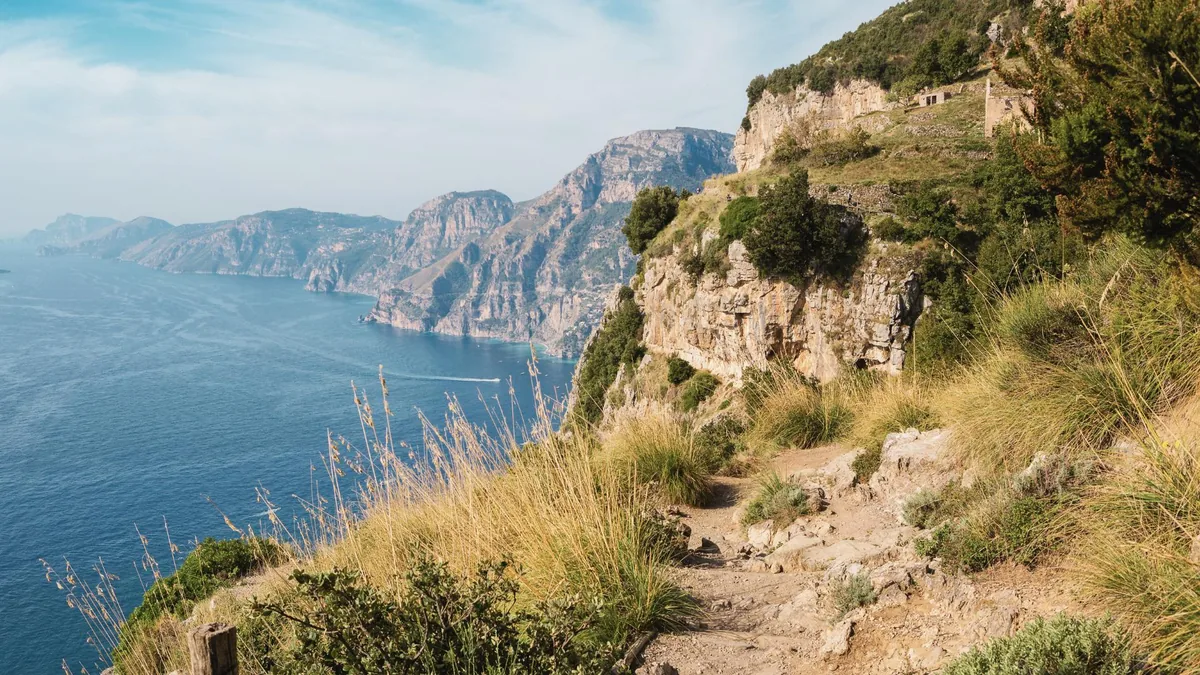
Sentiero degli Dei, Italy
Greek mythology suggests this
Greek mythology suggests this was the route taken by the gods to save Ulysses from the Sirens who sang from the Li Galli islands just offshore. Over the centuries, however, the path served a much more pragmatic purpose as the only overland link for local shepherds and farmers moving goods between isolated mountain communities. These mule tracks remained the lifeline of the peninsula until the mid-19th century when the modern coastal road was finally carved into the cliffs. The dry-stone walls you see lining the route were built by hand over generations, using techniques that have remained virtually unchanged since the Roman era. Today, it remains a protected park, preserved from the encroaching villas that dominate the lower slopes of the Amalfi coast.
Visiting Sentiero degli Dei
Starting from the trailhead in Bomerano, the immediate transition into an array of vertical silence. The way the light catches the silver-grey olive groves and the brilliant yellow of the gorse bushes clinging to the precipice. The volume is dominated by the rhythmic clinking of goat bells and the distant, muffled roar of the sea far below your boots. The grit of the white limestone path and notice the sheer drop-offs that make your pulse quicken as the trail narrows. At the halfway point at the Convent of San Domenico, seeing the coastline unfurl like a ribbon of pastel houses and terraced vineyards. The final descent into Nocelle brings a sense of accomplishment as the smell of wood-fired ovens begins to rise from the village kitchens. Most travelers arrive via the SITA bus from Amalfi town to Agerola, getting off at the Bomerano stop where the trail is clearly marked. Walking from Bomerano toward Positano is the preferred direction, as it keeps the most dramatic views directly in your field of vision and involves more downhill sections. The journey takes approximately three to four hours at a leisurely pace. Once you reach Nocelle, you can either descend the fifteen hundred stone steps to the coastal road or catch a local shuttle bus that winds down to the center of Positano. Arriving at the trailhead at sunrise is the only way to beat the heavy midday heat and the groups of hikers who arrive on the mid-morning buses.
The Experience
Around this altitude feels significantly thinner and cooler than the humid atmosphere of the beach. Beginning with the smell of sun-baked pine needles and the occasional waft of sea salt carried up by the thermals. You come across a heat radiating from the white rock faces as the afternoon sun gains strength. The element that stays with you is standing on a narrow outcrop near Vallone di Grarelle; the silence is so profound that you can hear the wings of a hawk circling above. It is a place where the scale of the landscape makes every human concern feel wonderfully small and fleeting.
Why It Matters
The Path of the Gods is the last remaining wild corridor of the Amalfi Coast, representing a human history of survival and adaptation in a vertical environment. It preserves the ancient agricultural traditions of the Lattari Mountains and serves as a vital ecological sanctuary for Mediterranean flora. Culturally, it bridges the gap between the mythic past of the Odyssey and the modern reality of rural Italy.
Why Visit
The Amalfi Coast is more than just a backdrop for photographs. This trail gives you the physical sensation of the land, the smell of the herbs, and the silence of the heights. You come here to earn the view of Positano, seeing it not as a postcard, but as a miracle of engineering clinging to the edge of the world.
Insider Tips
- 1
Buy a bottle of fresh lemon juice from the small stand near the start of the trail in Bomerano; it is the best fuel for the hike.
- 2
Avoid the steps down from Nocelle to Positano if you have weak knees; the local bus is cheap and saves you twenty minutes of jarring descent.
- 3
Check the wind forecast before you go; high gusts can make the narrowest parts of the cliff-side path feel genuinely precarious.
- 4
The trail passes through several private properties where elderly farmers sell water and fruit; carry small Euro coins for these transactions.
- 5
Look for the 'Vertical Oasis' midway through, where a natural spring provides ice-cold water even during the hottest weeks of summer.