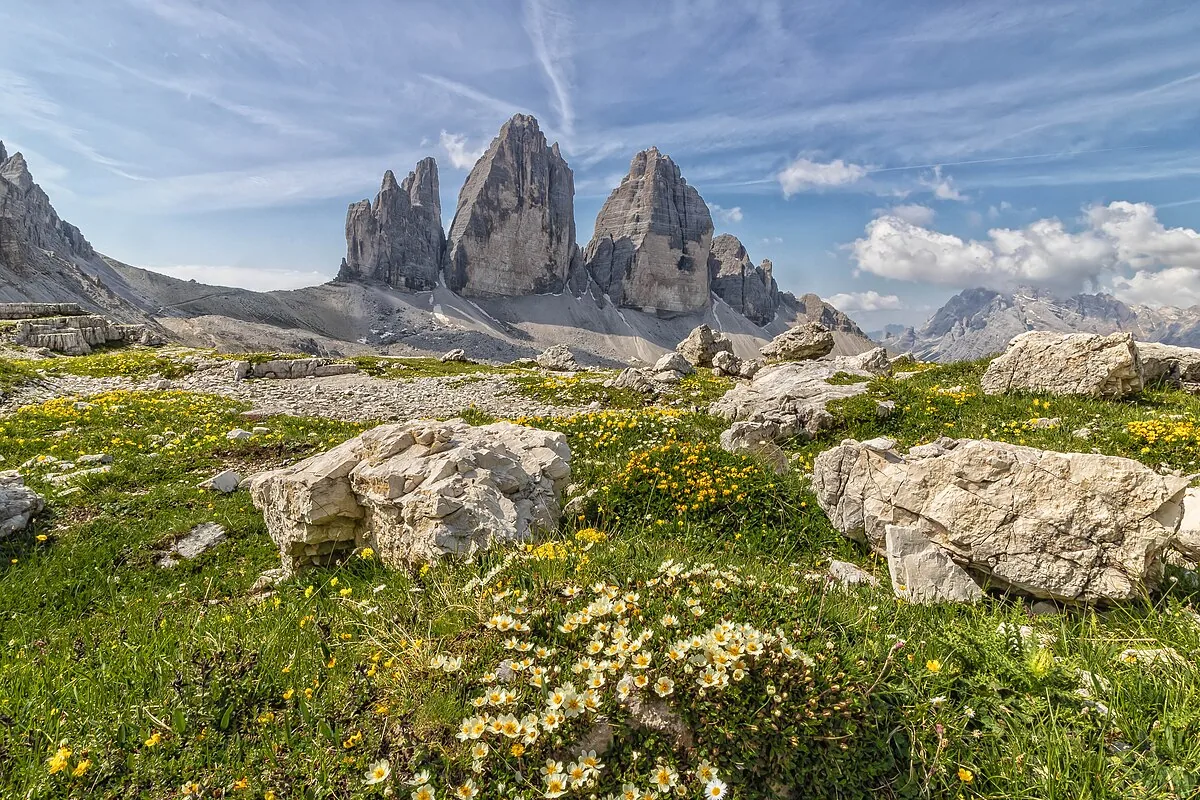
These three stone towers were once coral reefs at the bottom of a tropical sea, but today they stand nearly ten thousand feet high as the most dramatic skyline in Europe.
About Tre Cime di Lavaredo
The first ascent of the Cima Grande in 1869 by Paul Grohmann was considered a feat of madness at the time. Since then, the north faces of the Tre Cime have become some of the most coveted climbing routes in the world, attracting elite alpinists who test themselves against the sheer, overhang walls. During the Great War, the peaks were a high-altitude stalemate, with both sides suffering more from avalanches and frostbite than from direct combat. The area was declared part of a UNESCO World Heritage site in 2009, protecting the unique geological and historical value of this stark mountain range.
What Tre Cime di Lavaredo actually is
Three distinct battlements of pale dolomite rock thrust into the sky, their vertical faces glowing with a spectral light at dawn. The Tre Cime di Lavaredo are the unmistakable icons of the Sesto Dolomites, a trio of peaks that look like the teeth of a sleeping giant. On all sides, The air is thin and tastes of snow and cold stone, even in the height of summer. You walk along trails of white scree that crunch rhythmically under your boots, surrounded by a landscape of lunar plateaus and deep, emerald valleys. Sound-wise is an interplay of mountain silence, occasionally interrupted by the sharp whistle of a marmot or the distant clatter of falling rock. It is a place of extreme verticality, where the scale of the peaks makes the alpine hikers below look like slow-moving ants.
The mountains were formed millions
The mountains were formed millions of years ago from ancient coral reefs, which explains their unique, pale composition and the way they react to light. During World War I, this jagged landscape became a brutal battlefield between the Italian and Austro-Hungarian empires. Soldiers lived in tunnels and caves carved directly into the rock faces, fighting at altitudes where the cold was as lethal as the enemy. Remnants of these trenches and rusty barbed wire can still be found along the more adventurous paths. The peaks themselves, Cima Piccola, Cima Grande, and Cima Ovest, were first conquered in the late 19th century, marking the beginning of the golden age of Dolomite mountaineering.
Visiting Tre Cime di Lavaredo
Starting the loop from Rifugio Auronzo, The immediate pressure of the altitude and the bracing chill of the mountain air. The thing you pick up on is the color of the rock shifting from a dull grey to a vibrant, fiery pink as the sun begins to set, a phenomenon known locally as 'Enrosadira.' The sound of your own breathing becomes the rhythm of the journey as you navigate the steep sections of the trail. Part of the grit of the limestone on your hands if you touch the rock face, and The tiny, resilient alpine flowers blooming in the most inhospitable cracks. The most dramatic moment comes at the Paternsattel, where the full, iconic profile of the three peaks suddenly reveals itself against the deep blue sky.
The peaks are most easily reached
The peaks are most easily reached from the town of Cortina d'Ampezzo or the Puster Valley. A steep, private toll road leads from Lake Misurina up to the Rifugio Auronzo, where the main hiking trail begins. Parking is limited and the road is often closed once the upper lot is full, so arriving before 8:00 AM is vital during the summer months. The classic loop trail (number 101) is accessible to anyone with a moderate level of fitness, but the weather can change in minutes, requiring hikers to carry gear for both sun and sudden mountain storms. The majority spend the day on the trail, but staying overnight in one of the high-altitude rifugios allows you to see the peaks under a blanket of stars.
The Experience
The light at Tre Cime is unlike anywhere else; it feels clean and sharp, revealing every crack and fissure in the dolomite. The immensity of the space as you round the back of the mountains and see the jagged peaks of the surrounding Cadini di Misurina. The smell of wild herbs and damp earth in the lower meadows, giving way to the scent of dry stone at the higher elevations. The piece that stays with you is sitting at Rifugio Locatelli with a plate of speck and a cold beer, watching the clouds drift through the gap between the peaks. It is a place that makes you feel both incredibly small and vibrantly alive.
Why It Matters
The Tre Cime di Lavaredo are the geological and aesthetic heart of the Dolomites. They represent the incredible story of the earth's crust being thrust upward from the sea floor to the heavens. Historically, they are a powerful memorial to the soldiers of the 'White War,' and culturally, they remain the ultimate symbol of the Italian Alps.
Why Visit
The 'Enrosadira.' There is no other mountain range that turns this shade of glowing, impossible rose at sunset. You don't have to be an elite climber to experience the high-altitude drama; the trails here allow regular walkers to get intimately close to some of the most aggressive and beautiful topography on the planet.
✦ Photo Gallery
Best Season
🌤 September is the sweet spot; the summer crowds have thinned, the air is the clearest of the year, and the first autumn dustings of snow add a silver rim to the peaks.
Quick Facts
Best time to visit
September is the sweet spot; the summer crowds have thinned, the air is the clearest of the year, and the first autumn dustings of snow add a silver rim to the peaks.
Getting there
In Dolomites, Italy; reach Dolomites first, then continue to the site.
Location
Dolomites, Italy
Type
attraction
Coordinates
46.6167°, 12.3000°
Insider Tips
- 1
Park your car at the bottom and take the local shuttle bus from Lake Misurina to avoid the expensive toll road and the parking lottery.
- 2
Walk the loop counter-clockwise to keep the best views of the north faces directly in front of you for the second half of the hike.
- 3
Look for the small caves in the rock face near Rifugio Locatelli; these were used as sniper positions during World War I.
- 4
Pack a pair of binoculars to spot the tiny dots of climbers making their way up the vertical 'yellow' walls of the north face.