“While modern Agrigento hums on the hill above, these seven ancient temples have spent twenty-five centuries staring back across the sea toward Africa.”
About Valle dei Templi
The city was famously described by Pindar as 'the most beautiful of mortal cities,' and at its peak, it housed over 200,000 residents. Its wealth was built on the export of wine and olive oil, a prosperity reflected in the sheer number of temples dedicated to the gods of the Greek pantheon. After the Carthaginian siege in 406 BC, the city never quite regained its former glory, eventually falling to the Romans who renamed it Agrigentum. The park was declared a UNESCO World Heritage site in 1997, protecting not only the temples but the entire surrounding landscape of ancient orchards and necropolises that tell the story of the city’s rise and fall.
What Valle dei Templi in Italy is
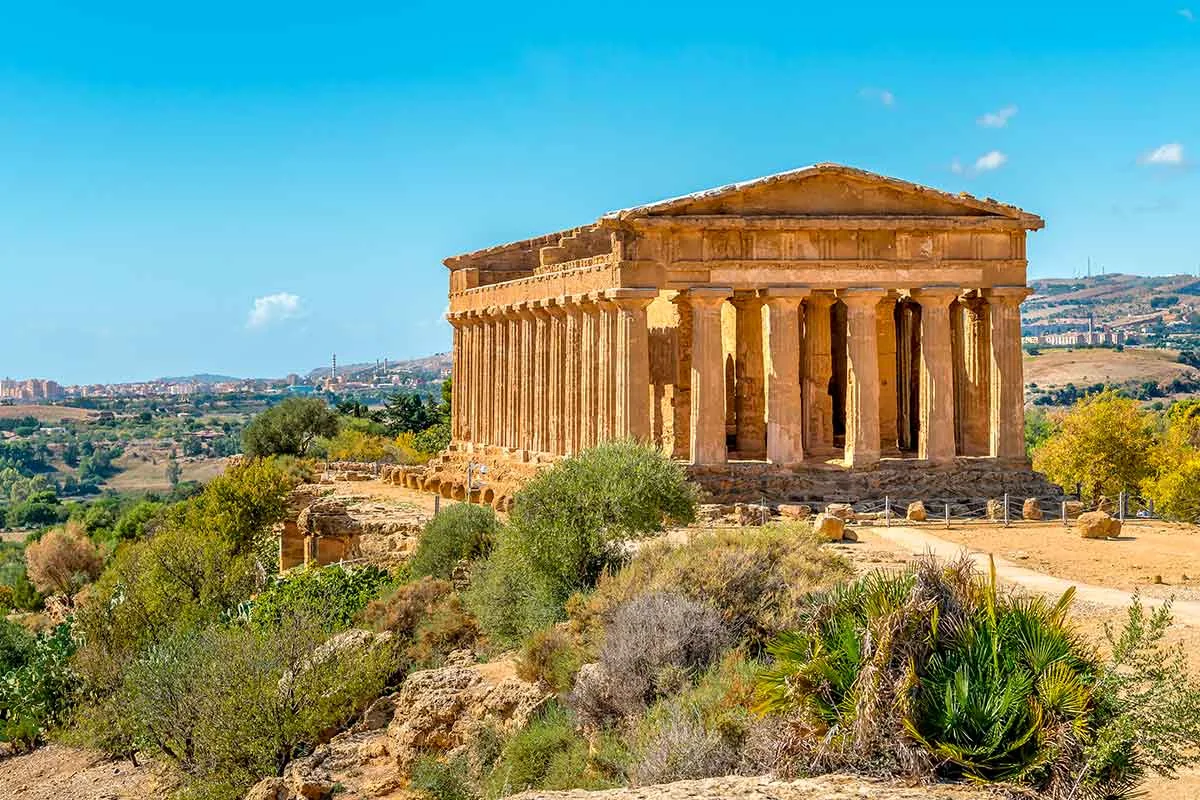
Seven golden sandstone temples stand silhouetted against the Mediterranean horizon, their massive Doric columns weathered by centuries of salt air and Saharan winds. The Valley of the Temples in Agrigento is a vast archaeological park that preserves the remains of the ancient Greek city of Akragas. Nearby, The air is dry and carries the scent of almond blossoms, wild fennel, and the heat of the Sicilian sun reflecting off the yellow calcarenite stone. The walk along the 'Via Sacra,' a high ridge that overlooks the modern city on one side and the distant, sparkling sea on the other. It is a landscape of olive trees that are hundreds of years old, their twisted trunks providing rare patches of shade among the ruins of one of the greatest cities of the classical world.
Seven golden sandstone temples stand silhouetted against the Mediterranean horizon, their massive Doric columns weathered by centuries of salt air and Saharan winds.
The past
Founded in 581 BC by colonists from Gela, Akragas grew to be the second most important city in Magna Graecia after Syracuse. The temples were built in the 5th century BC during a period of immense wealth and power, meant to project the city's dominance across the Mediterranean. The Temple of Concordia, which remains one of the best-preserved Greek temples in existence, owes its survival to being converted into a Christian church in the 6th century AD. Other structures, like the colossal Temple of Olympian Zeus, which was intended to be the largest Doric temple ever built, were toppled by earthquakes and the systematic pillaging of their stones for the construction of the nearby port of Porto Empedocle in the 1700s.
Approaching the Temple of Juno
Approaching the Temple of Juno at the eastern end of the ridge, The immense scale of the Greek vision. The deep ruts of ancient chariot wheels in the stone path and the orange-red tint of the stone, caused by the oxidation of iron in the local sandstone. The sound is a constant, rhythmic rustling of the sea breeze through the gnarled branches of the 'Kolymbetra' garden below. A rough, sandy texture of the columns and notice the 'telamons', colossal stone giants, lying flat in the grass near the ruins of the Zeus temple. The most atmospheric moment occurs at sunset when the stone turns a deep, fiery amber and the temples are illuminated, making them appear to float above the dark valley floor.
Agrigento is accessible by train or bus
Agrigento is accessible by train or bus from Palermo or Catania, but the walk from the modern train station to the temples is long and steep. The bulk of visitors take a local bus or a taxi to one of the two main entrances of the park. The site is divided into an eastern and western zone by a modern road, and a single ticket covers both areas as well as the excellent Archaeological Museum. Because there is very little shade, arriving as the gates open at 8:30 AM is crucial for a comfortable experience. The park often stays open late into the evening during the summer months, offering a cooler, more romantic experience of the illuminated ruins under the Sicilian stars.
Agrigento is accessible by train or bus from Palermo or Catania, but the walk from the modern train station to the temples is long and steep.
The Experience
Within the valley feels remarkably still and heavy with the scent of the Mediterranean scrub. The tiny green lizards that scurry over the sun-warmed stone of the altars. The physical weight of the history as you stand before the Temple of Concordia, its perfect proportions creating a sense of mathematical peace. You catch is punctuated by the calls of local birds and the occasional clank of a metal gate. The most evocative moment is found in the 'Kolymbetra' garden, a lush ravine filled with citrus trees and ancient irrigation channels that provides a cool, fragrant contrast to the dry stone of the ridge above. It is a place that captures the intersection of nature and ancient human ambition.
Why It Matters
The Valley of the Temples is the largest archaeological site in the world and the most significant collection of Greek architecture outside of Greece itself. It provides a unique record of the Doric style and the urban planning of the classical era. Humanly, it is evidence of to the enduring influence of Greek culture on the Italian landscape and the fragility of even the most powerful civilizations.
Why Visit
These temples are more intact and accessible than almost anything you will find in Athens. The setting, perched on a ridge between the mountains and the sea, offers a raw, atmospheric beauty that is completely different from a museum. You come here to walk the same limestone roads as the ancients, with the smell of the sea in your nose and the history of the world in your sight.
✦ Insider Tips
- 1
The Kolymbetra Garden requires a separate, small entry fee but is the only place to find shade and cool air during a midday visit.
- 2
Visit the Archaeological Museum (Museo Archeologico Regionale) halfway through your tour to see the original 25-foot Telamon statue standing upright.
- 3
Wear a hat and bring more water than you think you need; the 'valley' is actually an exposed ridge that catches the full force of the sun.
- 4
Enter through the Temple of Juno gate and walk downhill toward the Temple of Castor and Pollux for an easier, more scenic route.
- 5
Look for the ancient Byzantine tombs carved directly into the city walls near the Temple of Concordia; they are often overlooked.