“Established in 1646 with the radical rule that anyone who could read was welcome, this golden hall of cedar and parchment is the oldest public library in the Western Hemisphere.”
About Biblioteca Palafoxiana
The collection within the Palafoxiana was built primarily from the seized libraries of Jesuit colleges after their expulsion from the Spanish Empire in 1767. This influx of knowledge made the library a repository for the most controversial and advanced science, philosophy, and law of the Enlightenment era. Despite the religious oversight, the library functioned as a window into the broader world, preserving texts that were elsewhere banned or burned. In 2005, UNESCO recognized the library as part of the Memory of the World Register, a status that helped fund the meticulous restoration of the cedar shelves after they were damaged by the 1999 earthquake. It remains a working research institution, where scholars can still apply for permission to consult the original 15th-century incunabula.
Biblioteca Palafoxiana
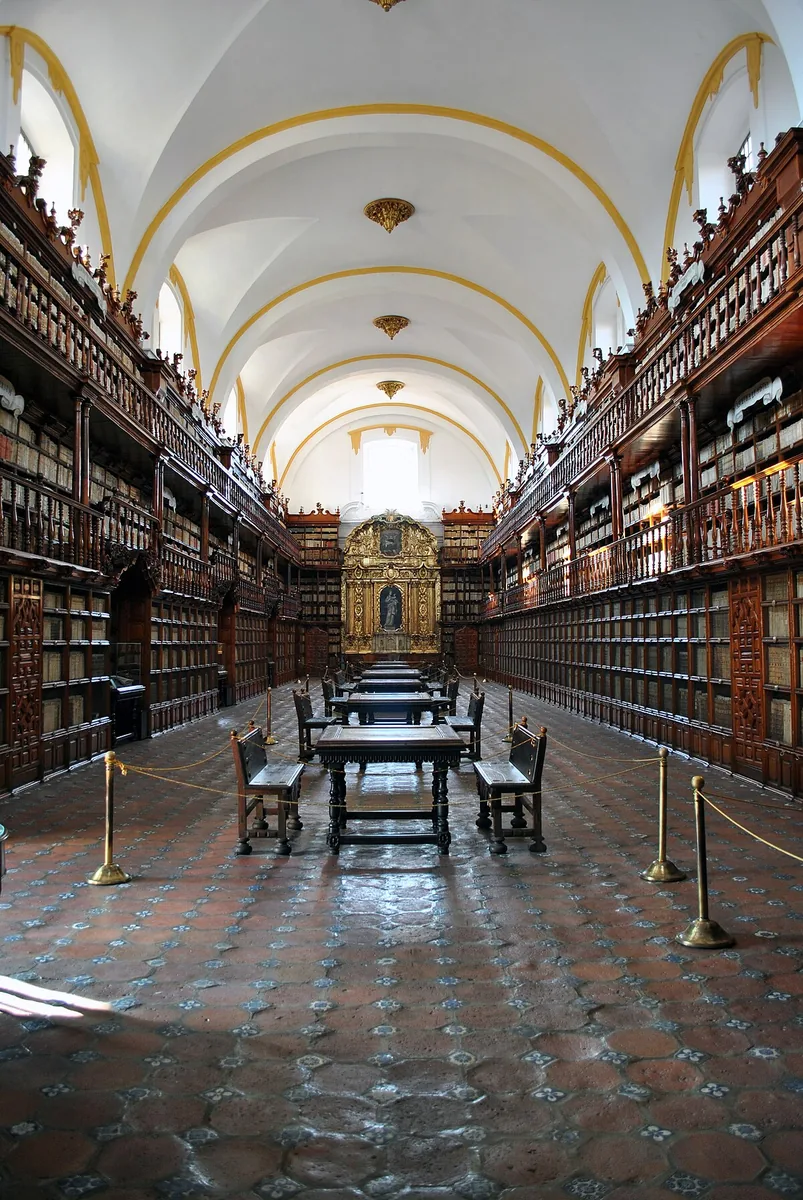
Three tiers of cedar shelving rise in a cathedral of cedar and gold, housing the first public library in the Americas within central Puebla. Biblioteca Palafoxiana is a sanctuary of the written word, where forty-five thousand volumes rest in a silent, climate-controlled embrace of the 18th century. Within, the space the hall is cool and carries a dense, intoxicating perfume: the scent of old parchment, beeswax polish, and the faint, vanilla-tinged aroma of decaying leather bindings. The walk across the original red tile floor. Notice how the light from the high windows catches the intricate carvings of the altarpiece at the far end of the room. The audio element is a profound, academic hush, punctuated only by the distant chime of the Puebla cathedral and the soft, muffled echo of your own footsteps on the terracotta.
Three tiers of cedar shelving rise in a cathedral of cedar and gold, housing the first public library in the Americas within central Puebla.
the Tridentine College, 1646
Bishop Juan de Palafox y Mendoza donated five thousand of his personal volumes to the Tridentine College in 1646, with the revolutionary condition that the books be made available to anyone who could read, not just the clergy. This act of intellectual generosity predates the foundation of the British Museum and the Library of Congress by over a century. In 1773, Bishop Francisco Fabián y Fuero commissioned the magnificent cedar shelves that define the room today, adding a third tier in the 19th century to accommodate a growing collection that survived the fires of the Mexican Revolution and the devastating earthquakes common to the region. The library was the intellectual engine of New Spain, housing rare texts such as the Nuremberg Chronicle of 1493 and a 16th-century polyglot bible that remains one of the world's great typographic treasures.
Visiting Biblioteca Palafoxiana
Stepping into the main gallery, There is a sudden, physical drop in pace as the frantic energy of Puebla’s streets is replaced by the weight of several centuries of thought. You catch the way the gold leaf on the central retablo glows against the dark, polished wood of the bookcases. The sound of the city disappears entirely, leaving a silence so thick it is like a physical barrier between you and the modern world. A urge to speak in whispers as you lean in to see the delicate, handwritten labels on the spines of the oldest books. The symmetry of the vaulting above, which creates a rhythmic pattern of shadow and light along the entire length of the hall. The most striking moment is standing at the library’s entrance and realizing that you are looking at a living archive that has remained in continuous use for nearly four hundred years.
The library is situated on the upper floor
The library is situated on the upper floor of the Casa de la Cultura, right next to the massive Puebla Cathedral in the city’s historic center. Puebla itself is a two-hour drive or bus ride from Mexico City, making it an easy day trip, though the library warrants a slow, contemplative visit. Once inside the cultural center, a grand stone staircase leads you away from the courtyard’s noise and into the silent sanctuary of the books. Arriving in the morning provides the best natural light for viewing the intricate woodwork and the rare volumes often on display in the glass cases. Because the environment is strictly controlled to protect the paper, visitors are asked to maintain silence and avoid using flash, preserving the library's atmospheric gravity.
The library is situated on the upper floor of the Casa de la Cultura, right next to the massive Puebla Cathedral in the city’s historic center.
The Experience
The energy at the Palafoxiana is one of reverent, intellectual stillness. The first thing you register is the smell of the room, it is the dry, comforting scent of history, a combination of old wood and the dust of ages. The physical scale of the knowledge housed here, with books reaching all the way to the vaulted ceiling. The light is soft and indirect, designed to protect the fragile pages while highlighting the rich textures of the cedar and gold. What you catch first is the small wooden reading desks, built into the shelves themselves, where scholars have sat for hundreds of years. The most evocative detail is the 'Virgin of Trapani' altarpiece at the end of the hall, which watches over the readers like a silent librarian. It is a place that reminds you of the enduring power of the written word.
Why It Matters
Biblioteca Palafoxiana is a foundation of the Enlightenment in the Americas and the most important colonial library in the world. It represents the early democratic ideal that knowledge should be a public good rather than a private privilege. Historically, it is a rare survivor of the colonial period that has maintained both its original collection and its original architectural setting.
Why Visit
Worth it because you want to stand in a place that treats books like holy relics. While modern libraries are sterile and digital, the Palafoxiana is a sensory experience of wood, light, and history. You come here to see what a library looked like when books were the most valuable things on earth, and to feel the weight of four centuries of curiosity. It is the most beautiful room in Mexico.
✦ Insider Tips
- 1
Look for the oldest book in the collection, a 1493 copy of the Nuremberg Chronicle, usually displayed in a central glass case.
- 2
The library is located inside the Casa de la Cultura; don't miss the rotating art exhibitions in the downstairs courtyard after your visit.
- 3
Notice the 'Index Librorum Prohibitorum' section; these were the books the Church once banned, kept here under lock and key.
- 4
Pay attention to the floor; the original red tiles are worn smooth in the center, showing the paths of thousands of readers over 300 years.
- 5
Ask the staff about the 'revolving' book stands, a clever 18th-century design that allowed scholars to consult multiple heavy volumes at once.