“This earthen fortress has survived for centuries against the desert wind, only to find a second life as the most famous movie set in the world.”
About Ait Benhaddou
The architecture of Aït Benhaddou is a masterclass in sustainable desert living, utilizing the thermal mass of the earth to create habitable spaces in an extreme climate. The granary at the top, or 'agadir,' was the most important building in the ksar, where the community’s collective wealth was stored under guard. Throughout the 19th century, the village was a thriving hub of the Glaoui family’s territory, who controlled the mountain passes. The transition from a functional trade hub to a cinematic icon began in earnest with David Lean’s filming of Lawrence of Arabia, which brought international attention to the site. Today, the village is maintained through a combination of UNESCO funds and the revenue generated from the film productions that still frequent its streets.
What Aït Benhaddou actually is
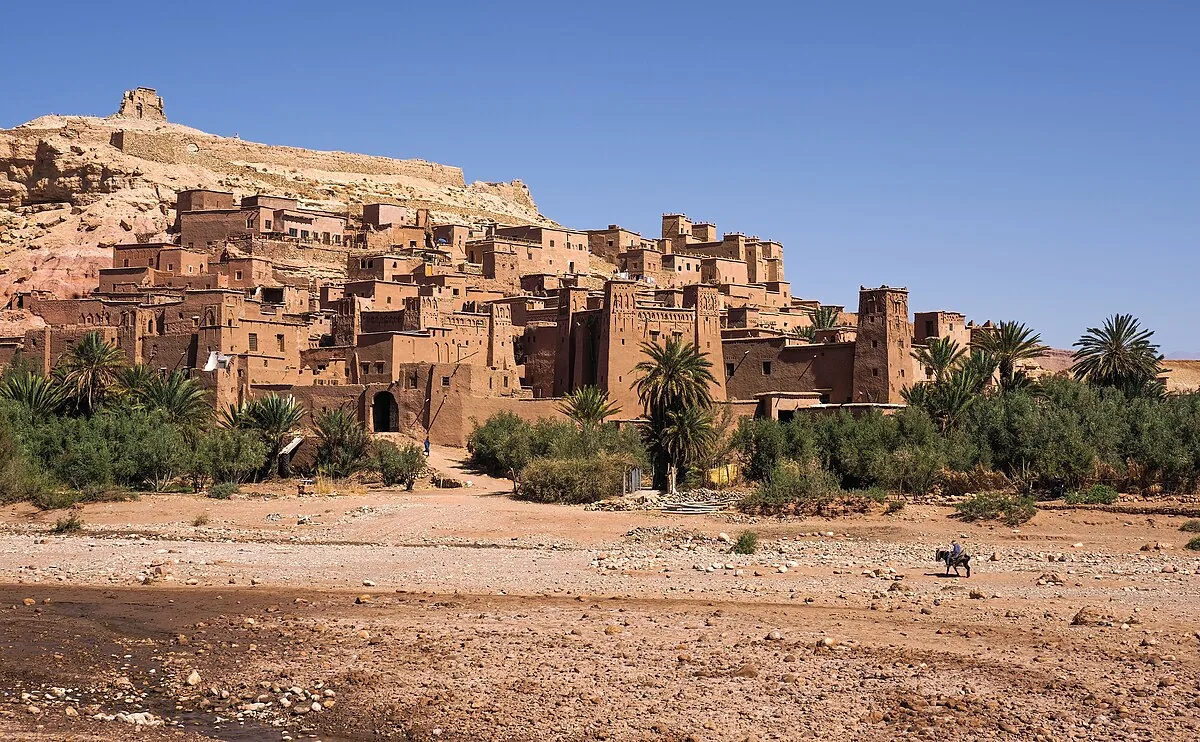
Rising from the sun-baked earth on the edge of the High Atlas, Aït Benhaddou is a striking example of southern Moroccan clay architecture. This 'ksar,' or fortified village, consists of a group of earthen buildings surrounded by high walls, reinforced by corner towers that look like they grew directly out of the hillside. The entire complex is built from local mud, straw, and stone, a material that regulates temperature against the desert heat but requires constant repair after the rare mountain rains. Inside the walls, the village is a maze of narrow, shadowed alleys and low-ceilinged homes, leading up to the ruins of a collective granary at the summit. The site overlooks the Ounila River, which mostly flows as a shallow trickle through a green ribbon of palms, providing a stark contrast to the red, lunar landscape of the surrounding hills.
Rising from the sun-baked earth on the edge of the High Atlas, Aït Benhaddou is a striking example of southern Moroccan clay architecture.
The ksar was established
The ksar was established in the 17th century as a critical stop on the trade route between Marrakech and the Sahara. It provided a secure place for caravans to rest and trade, protected by the Benhaddou tribe. As the trans-Saharan trade declined in the early 20th century, the village was slowly abandoned as families moved across the river into more modern homes with electricity and running water. Its fate changed when the film industry 'discovered' the site in the 1960s; its dramatic, timeless appearance made it the perfect backdrop for epics like Lawrence of Arabia, Gladiator, and Game of Thrones. This cinematic fame helped secure its UNESCO World Heritage status in 1987 and provided the funding for the ongoing preservation of its fragile mud-brick structures. Today, only a handful of families still live within the original ksar, while the rest of the community thrives in the new village on the opposite bank.
What it represents
Crossing the river on the stepping stones, The scent of dry dust and the sweet smoke from wood-fired ovens. The village is surprisingly quiet, punctuated only by the occasional call of a vendor or the wind whistling through the towers. The texture of the walls, which are rough and cool to the touch, with patterns of geometric brickwork near the top that represent Berber protection symbols. The light in the late afternoon is golden and thick, highlighting the textures of the mud-brick and making the entire ksar look like a giant sandcastle. The steepness of the climb as you head toward the granary, but the view from the top, stretching across the palm groves to the snow-capped Atlas peaks, is the ultimate reward. People tend to miss the small, darkened workshops where local artists use saffron and indigo to create 'invisible' paintings that appear when heated over a flame. First, the heavy, iron-studded doors that once protected the wealth of the caravans.
Aït Benhaddou is located about thirty
Aït Benhaddou is located about thirty kilometers from Ouarzazate, the 'Hollywood of Morocco.' Most travelers visit as a day trip from Marrakech, a journey that takes about four hours and involves crossing the spectacular Tizi n'Tichka pass. While group tours are common, hiring a private driver allows you to arrive before the midday crowds. Access to the ksar is free, though some of the individual homes that have been turned into small museums may ask for a small donation to see their interiors and rooftops.
' Most travelers visit as a day trip from Marrakech, a journey that takes about four hours and involves crossing the spectacular Tizi n'Tichka pass.
The Experience
See the way the mud-brick absorbs the sound, creating an eerie, muffled atmosphere within the narrow corridors. The light flickers through the small, high windows of the homes, illuminating swirling dust motes in the air. There is a weight of the history in the uneven stairs and the worn thresholds of the shops. Most visitors miss the small cemetery just outside the walls, where simple stone markers point toward Mecca. The element that stays with you is standing in the central square, imagining the noise and chaos of a thousand camels arriving with salt and gold, while today only the sound of a distant weaver’s shuttle remains.
Why It Matters
Aït Benhaddou is the preeminent example of Moroccan ksar architecture and proof of the sophistication of Berber social organization. It preserves an ancient way of life that relied on communal defense and resource sharing. Its survival provides an essential link to the history of the trans-Saharan trade routes that shaped the wealth and culture of the Maghreb.
Why Visit
Visit Aït Benhaddou to step into a landscape that feels like it was pulled from a dream of the ancient world. It is the best place to see the incredible ingenuity of earthen construction and to witness how a historic site can adapt and survive through the lens of modern cinema. It offers a visual drama that no stone cathedral can match.
✦ Insider Tips
- 1
Avoid the bridge and use the stepping stones across the river for a more traditional and scenic approach to the main gate.
- 2
Look for the 'fire painters' in the village who use lemon juice and heat to create secret messages on paper; it's a unique local craft.
- 3
Climb to the very top of the hill to the ruins of the granary for a 360-degree view that puts the scale of the ksar into perspective.
- 4
Bring a small amount of cash in dirhams; while entry is free, the local families who maintain the houses rely on small tips from visitors.
- 5
Wear sturdy shoes with good grip, as the packed mud and stone paths inside the ksar can be surprisingly slippery when dry.