Every single night for nearly a thousand years, this sun-baked pavement has transformed into the world's most crowded theater where no one ever knows exactly how the play will end.
About Jemaa el-Fnaa
The Almoravid dynasty laid the foundations of the square in 1070, originally using it as a parade ground and a marketplace for the caravans arriving from Timbuktu. Throughout the 12th century, the Almohads expanded the area, building the nearby Koutoubia Mosque whose minaret still serves as the square's primary visual anchor. During the 16th century, the Saadian sultans utilized the space for grand public displays, reinforcing its status as the symbolic heart of Morocco. It survived the French protectorate era without being paved over or modernized into a European plaza, largely because the local population refused to let their traditional social hub be sanitized. Today, it remains a rare pocket of living history where oral traditions that predate the printing press are still passed from master to apprentice in the shadows of the food stalls.
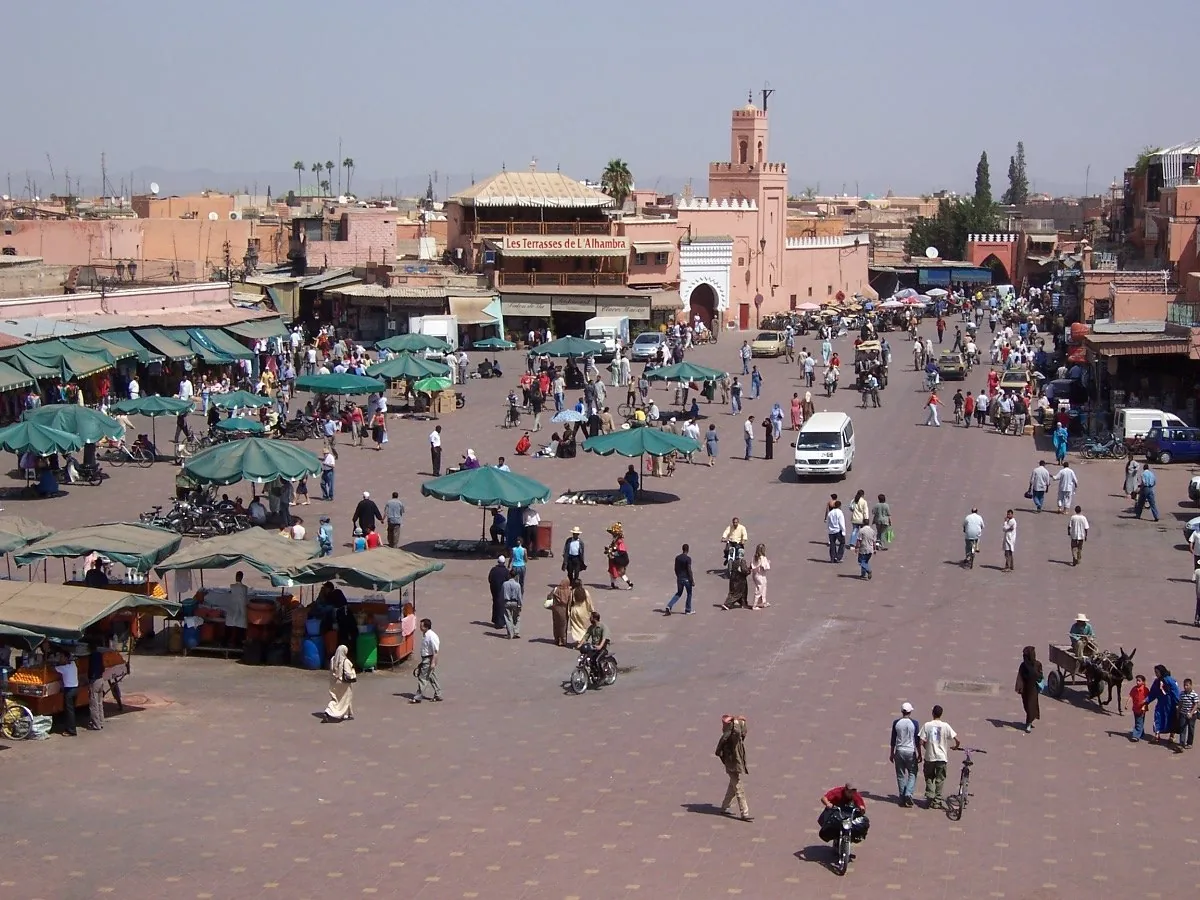
Marrakech’s main square functions as an ancient, open-air theater that never bothers to close its heavy wooden curtains. By day, the vast expanse of dust-colored pavement belongs to the juice sellers and the snake charmers who coax cobras from woven baskets with the shrill, hypnotic drone of the ghaita. As the sun dips behind the Koutoubia Mosque, a transformation occurs like a shift in time itself. Steam begins to rise from dozens of open-air kitchens, carrying the heavy, savory perfume of cumin, grilled lamb, and boiling snails. The square swells with a dense, moving sea of humanity where the roar of Berber storytellers competes with the rhythmic metallic clacking of water sellers in their fringed red hats. You end up pulled into a chaotic, beautiful orbit of noise and light that has remained largely unchanged since the city’s medieval founding.
“Marrakech’s main square functions as an ancient, open-air theater that never bothers to close its heavy wooden curtains.”
Jemaa el-Fnaa, Morocco
Historians still debate the etymology
Historians still debate the etymology of the name Jemaa el-Fnaa, which most often translates to 'Assembly of the Dead,' perhaps referencing a time when public executions were carried out here by the Almoravid sultans in the 11th century. Despite its grim linguistic roots, the square evolved into the vital commercial and social lung of the city, serving as the terminus for Saharan trade caravans. These nomadic traders brought more than just gold and salt; they brought the oral traditions of the desert, which took root in the square and flourished. Through various dynasties from the Almohads to the Saadians, the space was preserved as a communal ground where the high culture of the royal palaces met the raw energy of the street. In 2001, UNESCO inaugurated its 'Proclamation of Masterpieces of the Oral and Intangible Heritage of Humanity' right here, recognizing that the square's true value lies not in its stones, but in the voices of its storytellers and musicians.
Walking into the square at dusk,
Walking into the square at dusk, There is a physical wall of heat and aroma hitting you from the charcoal grills of Stall 100. What lands is the way the light turns a hazy purple as smoke from the food stalls catches the last rays of the sun. Overhead, the space is a dizzying polyphony: the percussive pulse of Gnaoua drums, the sharp hiss of fat dripping on embers, and the urgent invitations of vendors who seem to speak every language on earth. You get a grit of the red city under your feet and the occasional brush of a heavy wool djellaba as a local navigates the throng. The standout is the circles of listeners huddled around a storyteller, their faces illuminated by the flickering glow of a single lamp. The detail that sticks is retreating to a rooftop terrace with a glass of mint tea, watching the square below pulse like a living, phosphorescent organism under the North African stars.
Most visitors arrive by foot from the surrounding
Most visitors arrive by foot from the surrounding Medina, as the square is the central hub toward which almost all souk alleys eventually gravity. If arriving from the modern Gueliz district, a petite taxi will drop you at the edge of the pedestrian zone near the Koutoubia Mosque. The square is best experienced starting around 5:00 PM when the food stalls are being erected with theatrical speed. For the best vantage point, secure a seat on the upper balcony of Le Grand Balcon du Café de la Poste at least thirty minutes before sunset. This allows you to witness the precise moment the square switches from a dusty marketplace to a glowing, smoke-filled carnival.
The Experience
Inside the center of the square is thick with the scent of woodsmoke and Harira soup, a warm and savory fog that clings to your skin. The first thing you register is the glint of silver jewelry on the Berber women and the striking movement of the Gnaoua dancers' tassels as they spin. The clatter of a hundred different flutes creates a shimmering, dissonant cloud of noise that somehow feels harmonious in the open air. The vibration of the drums in your chest, a deep and ancient rhythm that dictates the pace of the crowd. The standout is the quiet intensity of the henna artists as they map out intricate patterns on the palms of travelers. The most striking detail is the contrast between the high-energy chaos of the center and the sudden, cool silence found just ten steps inside the entrance of a neighboring riad.
Why It Matters
Jemaa el-Fnaa is the cultural heartbeat of Marrakech and a global landmark for intangible heritage. It serves as a vital bridge between Morocco's nomadic Saharan past and its active urban present. Historically, it is one of the few places on earth where medieval street culture has not been relegated to a museum but continues to exist as a primary economic and social reality.
Why Visit
The appeal is that you need to witness the raw power of human connection before the digital world completely erases it. While other plazas offer statues and fountains, Jemaa el-Fnaa offers a visceral, unscripted experience that engages every sense simultaneously. You come for the spectacle, but you stay because you realize you are part of a human chain of visitors that stretches back ten centuries.
Insider Tips
- 1
Always ask for the price of a photo before pointing your lens at a performer, or you will find yourself in an aggressive negotiation for several hundred dirhams.
- 2
Head to the stalls with the longest lines of locals; the snail broth at Stall 6 is a local rite of passage and is surprisingly restorative.
- 3
Carry small change in your pocket to tip the storytellers; even if you don't understand the Darija dialect, your presence in the circle is part of the tradition.
- 4
Be wary of anyone trying to place a monkey on your shoulder or a snake around your neck; these are purely for tourist profit and the animals are often poorly treated.
- 5
The orange juice stalls are numbered; find one you like and return there, the vendors remember faces and will often give you a 'bonus' splash for your loyalty.