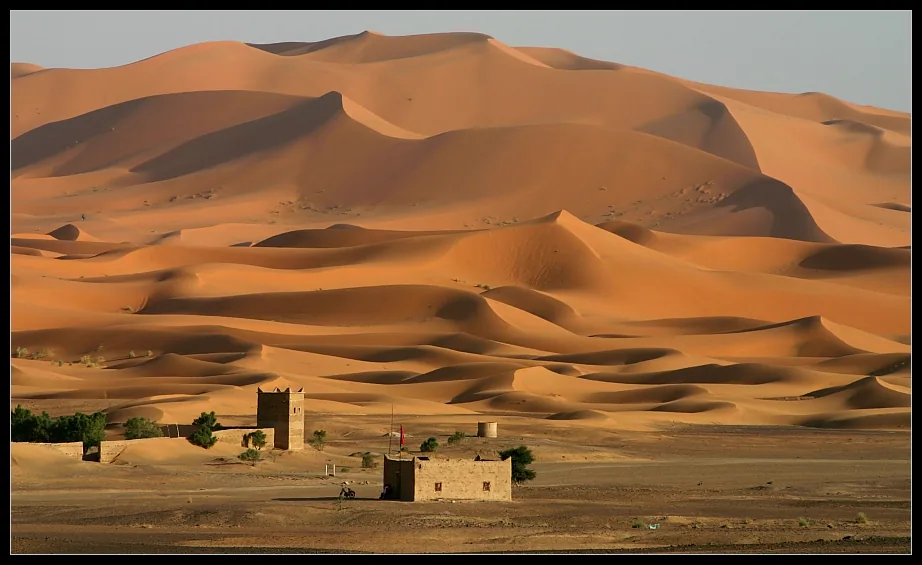
Towering 150 meters over the black hammada, these shifting peaks of apricot sand are the last true silence you will ever hear.
About Erg Chebbi
The dunes are a geological anomaly, formed by wind-borne sand trapped by the surrounding mountains and plateaus. For centuries, the nearby town of Rissani was the capital of Sijilmasa, one of the most important trading hubs in the Islamic world. The Alaouite dynasty, which currently rules Morocco, traces its roots to this desert region. In the late 20th century, the area shifted from an economy based purely on date farming and trade to one centered on desert tourism. Despite this, the Sahrawi culture remains dominant, with the blue robes of the desert dwellers still the standard attire for those who live and work among the dunes.
What Erg Chebbi actually is
Rising like solidified waves of orange silk from a black stone plateau, the dunes of Erg Chebbi represent the Sahara of the imagination. This massive field of sand, stretching twenty-eight kilometers from north to south, contains dunes that reach heights of over 150 meters. The landscape is in a state of perpetual motion, with the crests shifting and reforming under the influence of the 'chergui' wind. Far from being a barren wasteland, the erg is a place of dramatic atmospheric changes where the sand transitions from a pale lemon yellow at dawn to a deep, burnt ochre at midday. The silence here is absolute, a heavy and profound quiet that is rarely encountered in the modern world. At the edge of the dunes, the village of Merzouga is The way into this sea of sand, where the paved road ends and the nomadic traditions of the desert begin.
Legend says that the dunes were sent
Legend says that the dunes were sent by God as a punishment after a wealthy family refused hospitality to a poor woman during a feast. Sand began to fall from the sky, burying the village and creating the massive peaks we see today. Historically, Erg Chebbi was a vital waypoint for the trans-Saharan trade caravans that moved gold, salt, and slaves between Sub-Saharan Africa and the Mediterranean coast. The Berber (Amazigh) people of the Tafilalt region have navigated these sands for centuries, possessing a generational knowledge of the stars and the wind. While the caravans have been replaced by four-wheel drives and tourism, the local Ait Atta and other tribes maintain their cultural connection to the desert, serving as the guides and guardians of the dunes. The region also sits atop a massive aquifer, which allows for the small palm groves and gardens that ring the desert’s edge.
Visiting Erg Chebbi
Climbing the crest of a 'cathedral' dune, The sand is deceptively fine, flowing like water over your feet and filling your shoes in seconds. Audible: the desert is composed of nothing but your own heartbeat and the faint, crystalline hiss of wind-blown sand moving across the surface. The light at sunset is a transformative event, casting shadows so long and sharp they look like black ink spilled on the orange slopes. What registers is the temperature drop with startling speed the moment the sun disappears, the heat of the day vanishing into the thin desert air. Frequently skipped is the tiny life forms in the sand, like the scarab beetles whose rhythmic tracks are the only evidence of movement in the morning. What registers is the stars appearing one by one until the sky is a dense, glittering canopy that feels close enough to touch. The scent is remarkably clean, a dry, scentless void that sharpens your other senses.
Erg Chebbi is a long journey
Erg Chebbi is a long journey from Morocco’s major cities, usually requiring a full day’s drive from either Fes or Ouarzazate. Most travelers arrive in Merzouga, the main settlement at the foot of the dunes. From there, the traditional way to enter the erg is via a camel trek, which typically takes ninety minutes to reach the deeper desert camps. For those with limited mobility or a preference for speed, 4x4 vehicles can navigate the perimeter of the dunes to reach the luxury glamping sites. The drive through the Ziz Valley to reach the desert is spectacular in its own right, transitioning from alpine forests to date palm oases.
The Experience
Start with the way the sand feels cool and damp just a few inches below the sun-scorched surface. The hum of the camels chewing is a steady, rhythmic grind that accompanies the trek into the heart of the dunes. Something of vastness of the space in your chest, a sense of insignificance that is strangely liberating. Most visitors miss the 'singing' of the dunes, a low-frequency hum caused by sand grains sliding against each other during a breeze. What stays with you is the blue hour before dawn, when the desert is a landscape of cold violets and greys, just before the first ray of sun turns the world back into a furnace of orange.
Why It Matters
Erg Chebbi is the most accessible part of the Great Sahara in Morocco and a vital ecological zone for specialized desert species. It is a cultural theater where the traditions of the nomads are preserved through tourism. For the world, it serves as a powerful reminder of the planet's extreme environments and the ancient human civilizations that mastered them.
Why Visit
Visit Erg Chebbi for the sunset, but stay for the stars. It is the best place in Morocco to disconnect entirely from the digital world and experience the raw, unpolished power of the desert. No other place offers the chance to sleep under the clearest sky of your life and wake up to a landscape that changes its shape every single day.
✦ Photo Gallery
Best Season
🌤 October, November, and March offer the most tolerable temperatures; the summer months are dangerously hot, while winter nights can drop well below freezing.
Quick Facts
Best time to visit
October, November, and March offer the most tolerable temperatures; the summer months are dangerously hot, while winter nights can drop well below freezing.
Getting there
In Merzouga, Morocco; reach Merzouga first, then continue to the site.
Location
Merzouga, Morocco
Type
attraction
Coordinates
31.1667°, -3.9833°
Insider Tips
- 1
Bring a wide cotton scarf (shesh) to protect your face and hair; it is far more effective than a hat in the desert wind.
- 2
Pack a portable power bank, as many desert camps rely on limited solar energy and may not have outlets in the tents.
- 3
If you are prone to motion sickness, take precautions before the camel ride; the swaying gait is similar to being on a small boat.
- 4
Keep your camera in a sealed plastic bag when not in use; the fine Saharan dust can destroy a digital sensor in a single afternoon.
- 5
Wake up at least forty minutes before the scheduled sunrise to see the desert's most beautiful color transitions.