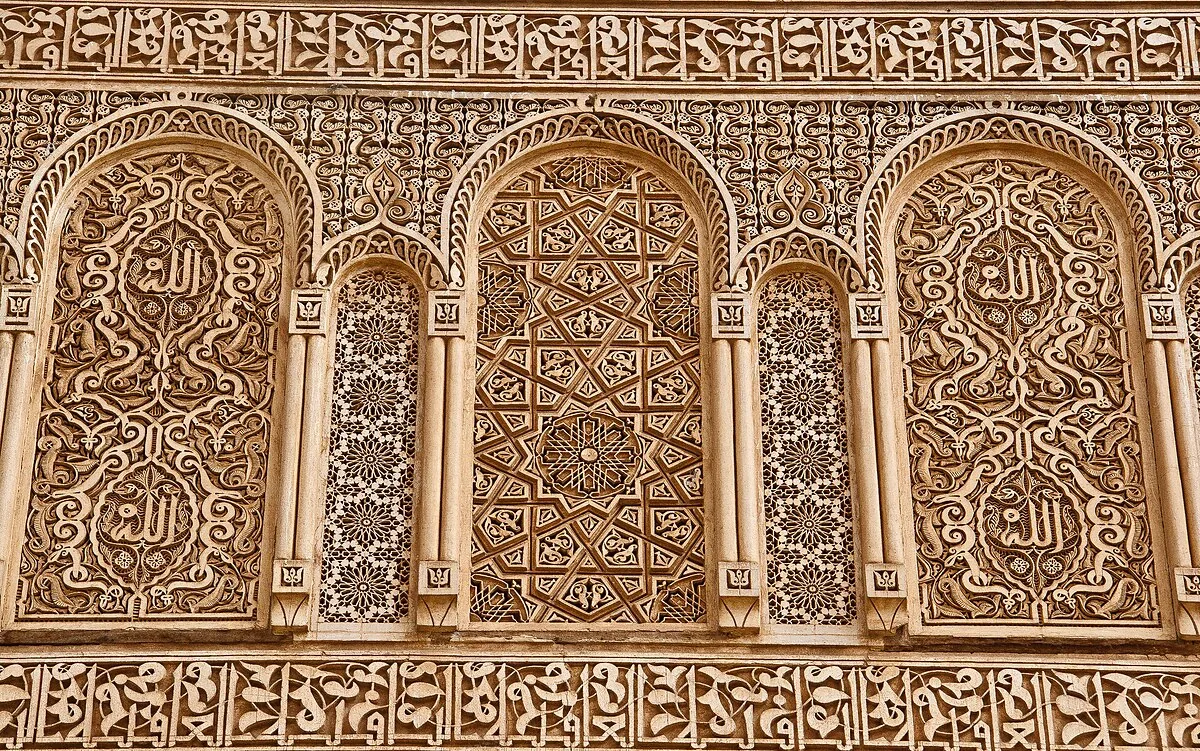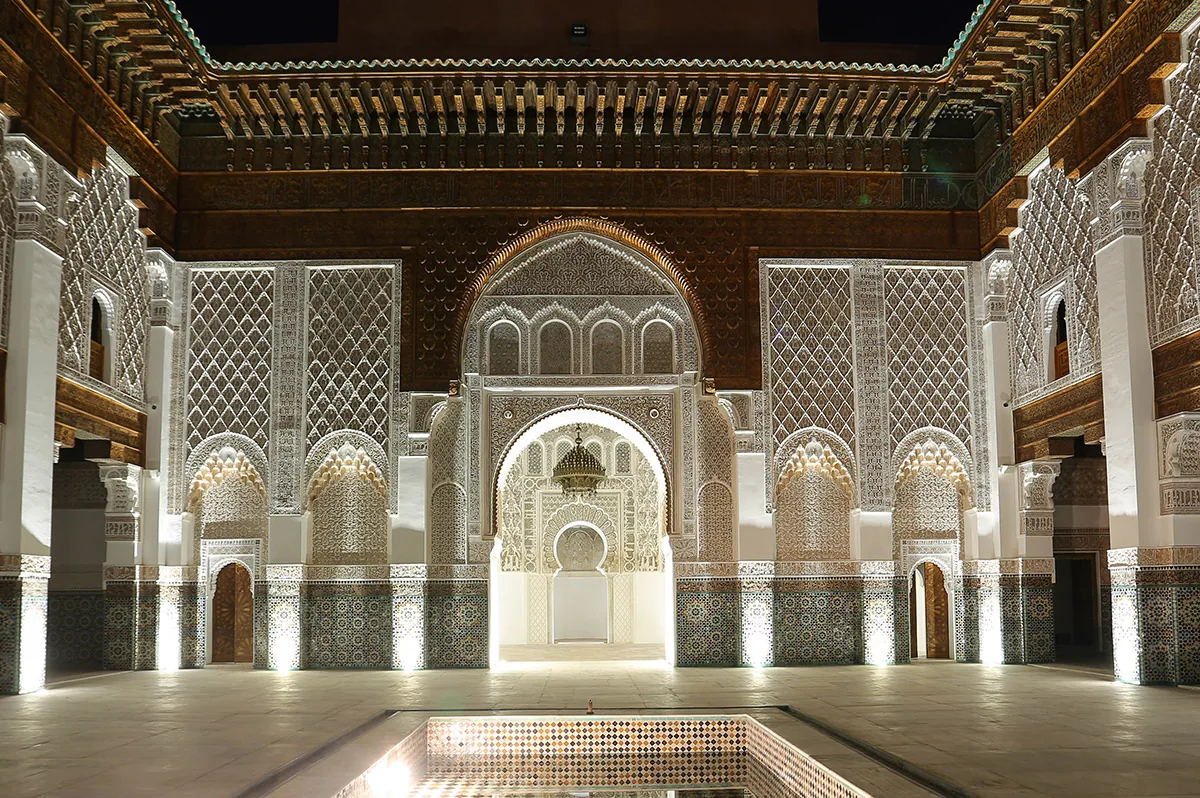
Eight hundred students once lived in tiny, windowless cells within these walls, sacrificing every physical comfort to study beneath the most beautiful ceiling in North Africa.
About Medersa Ben Youssef
The Saadian dynasty, who gave the building its current form, were masters of the 'Andalusian-Maghrebi' style, a blend of architectural influences from Moorish Spain and the African interior. Every inch of the medersa was designed to inspire awe and focus; the cedar wood was brought from the Atlas Mountains, the marble was imported from Italy, and the tiles were hand-cut in Fes. The inscriptions on the walls are not merely decorative but consist of verses from the Quran and prayers for the sultan. Over the centuries, the building survived several periods of neglect, especially after the capital moved to Meknes. Its survival is a product of the enduring quality of its materials and the respect that even rival dynasties had for this center of learning.
What Medersa Ben Youssef actually is
Deep withdeep in the Marrakech medina, a heavy cedar door opens into a courtyard so perfectly balanced it is like a physical manifestation of mathematics. Medersa Ben Youssef was once the largest Islamic college in North Africa, a place where hundreds of students lived in ascetic cells while surrounded by the most opulent craftsmanship imaginable. The room here is still and cool, smelling of damp stone and the faint, ghostly scent of old books. The walk across a floor of marble and zellij tile. Notice how the light reflects off a central rectangular pool that is a mirror for the sky. The sound is a profound, hollow silence that swallows the roar of the surrounding souks, leaving only the soft echo of water dripping and the occasional rustle of a bird in the eaves.
Origins
The original structure was founded in the 14th century by the Merenid Sultan Abu al-Hassan, but it was the Saadian Sultan Abdallah al-Ghalib who rebuilt it in 1564 into the masterpiece that stands today. He intended it to be a statement of his power and religious devotion, and at its peak, it housed over 800 students specializing in theology and Islamic law. These young men lived in tiny, dark rooms on the upper floors, sleeping on mats and cooking in communal corridors, while their days were spent in the ornate halls below studying the Quran. The college operated for four centuries before closing in 1960. Following a massive and meticulous restoration that concluded in 2022, the site has returned to its former glory, showcasing the heights of Moroccan decorative arts from the 16th century.
Standing in the center of the courtyard, you
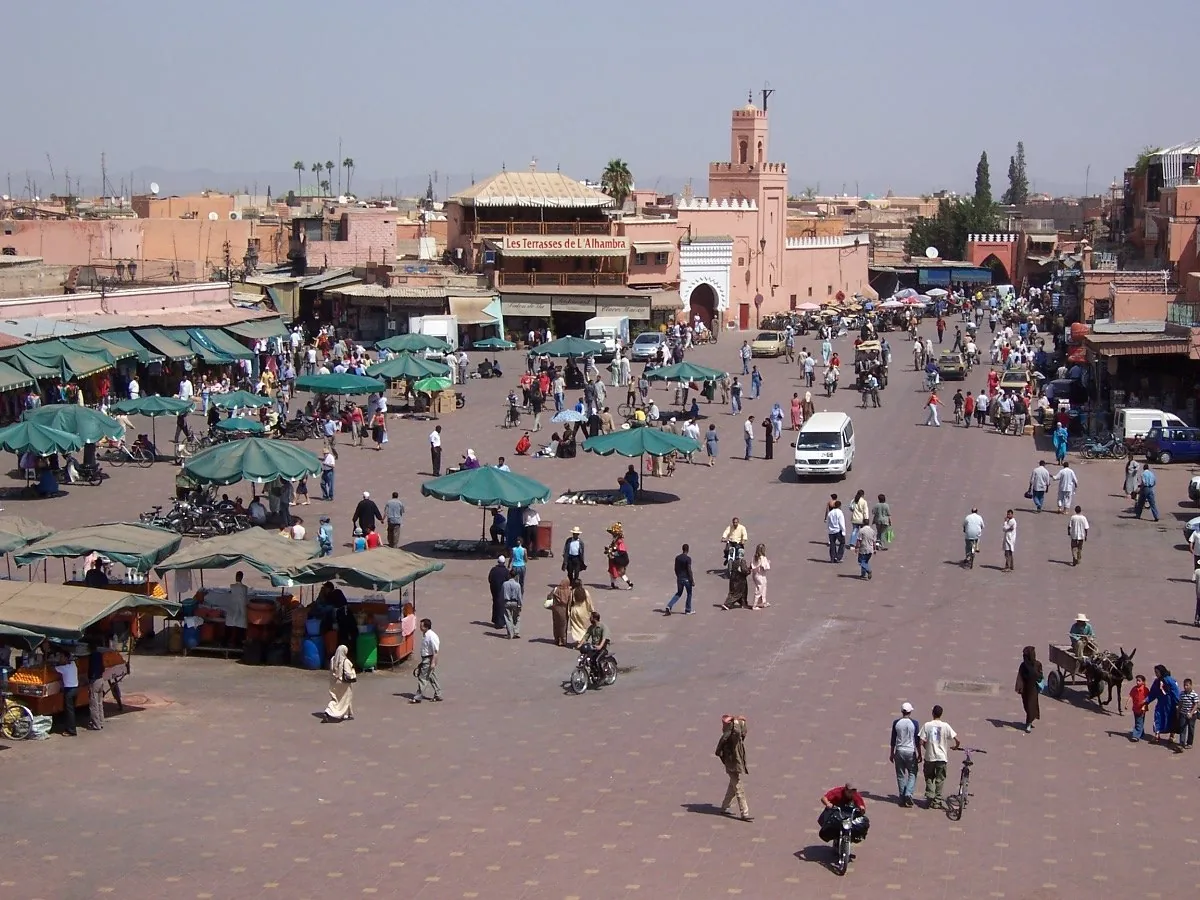
Standing in the center of the courtyard, The geometric precision of the universe closing in around you. You catch the way the 'muqarnas', the honeycomb carvings in the corners, create a dizzying array of shadows that move with the sun. Sound-wise is a miraculous pocket of quiet where the distant cries of the spice market become a melodic hum. Something of the texture of the 'stucco' walls, which are actually a mixture of plaster, egg white, and marble dust, carved into poems and floral patterns. First, the upper windows of the student cells, tiny wooden lattices that allowed the scholars to peer down at the courtyard without being seen. The most evocative moment is climbing the narrow stairs to the second floor, where the claustrophobia of the tiny living quarters highlights the spiritual sacrifice required of the students who once called this palace home. The medersa is located next to the Ben Youssef Mosque in the northern part of the medina. It is easily reached on foot from the Jemaa el-Fnaa, though the walk involves navigating the dense textile and leather souks. Arriving at 9:00 AM sharp is essential if you wish to see the courtyard without the crowds, as the reflective pool only works its magic when the water is still and the space is empty. The entrance fee is modest, and the site is best paired with a visit to the nearby Museé de Marrakech. Because the streets around the medersa are some of the narrowest in the city, using a GPS is helpful, though following the signs for the mosque is usually more reliable.
The Experience
The mood is one of intense, frozen devotion. What hits is the smell of the sun-warmed cedar, a dry and spicy fragrance that seems to have been trapped in the rafters for five hundred years. The temperature drop as you move from the open courtyard into the prayer hall, where the walls are thick enough to hold the cool of the night throughout the day. The light behaves differently here, bouncing off the polished marble floors to illuminate the dark corners of the carvings. The intentional contrast between the humble student quarters and the celestial beauty of the shared spaces. The most lasting detail is the central pool; when the wind is low, it creates a perfect symmetrical duplicate of the building, making you feel as though you are standing between two worlds. It is a place of absolute focus.
Why It Matters
Medersa Ben Youssef is the most important historical educational monument in Marrakech and a definitive example of Saadian architecture. It represents the historical importance of the city as a center of Islamic scholarship and the preservation of traditional Moroccan artisan techniques. Historically, it is a rare example of a space where religious architecture was applied to a residential and educational setting.
Why Visit
The pull is that this is the quietest place in the loudest city on earth. While the palaces of Marrakech are about the ego of kings, the medersa is about the pursuit of knowledge and the beauty of symmetry. You come here to see the finest woodcarving in the kingdom and to experience the sensation of standing inside a prayer carved from stone. It is the only landmark in the medina that feels like a temple to silence.
✦ Photo Gallery
Best Season
🌤 March and April are ideal, as the spring light is soft enough to capture the details of the plasterwork without the harsh glare of the summer sun.
Quick Facts
Best time to visit
March and April are ideal, as the spring light is soft enough to capture the details of the plasterwork without the harsh glare of the summer sun.
Getting there
In Marrakech, Morocco; reach Marrakech first, then continue to the site.
Location
Marrakech, Morocco
Type
attraction
Insider Tips
- 1
Look for the small doorway on the ground floor that leads to the old communal latrines; the architecture even in the plumbing is surprisingly beautiful.
- 2
The best photo of the courtyard is taken from the small wooden windows on the first floor looking down toward the pool.
- 3
Bring a small flashlight or use your phone to see the details of the carvings in the darker student cells.
- 4
Respect the silence; the acoustics of the courtyard are designed to carry whispers, and loud talking is considered a major disruption.
- 5
After your visit, the 'Photo Museum' (Maison de la Photographie) is just a short walk away and offers a rooftop view that overlooks the medersa’s roofline.