While Marrakech burns under a desert sun, this fortified Atlantic port remains wrapped in a perpetual sea mist that once protected pirates and now inspires world-class jazz musicians.
About Medina of Essaouira
This started as a Carthaginian trading post before the Romans established a purple dye factory here, harvesting the murex sea snail from the nearby Purpuraires Islands. In 1506, the Portuguese built a fortress called Castelo Real de Mogador, but their stay was short-lived as local tribes reclaimed the coast. The modern city we see today was a deliberate geopolitical project by the Alouite Sultan in the 18th century. He forced the country's wealthiest merchants to relocate here, creating a sophisticated middle class that turned Essaouira into Morocco's route into the world. Despite the decline of its commercial dominance in the 19th century, the city's architectural integrity remained untouched, eventually earning it a place on the UNESCO World Heritage list in 2001.
What Medina of Essaouira actually is
Trade winds howl through limestone archways, carrying the sharp tang of Atlantic salt and the sweet, resinous scent of freshly carved thuya wood. Essaouira, once known as Mogador, presents a stark contrast to the ochre intensity of inland Morocco with its brilliant white facades and sky-blue shutters. The medina follows a surprisingly orderly grid, a legacy of its European-influenced design, yet it retains the soul of a North African port. Past blue fishing boats piled high with yellow nets. Notice how the sunlight catches the silver scales of sardines being hauled onto the docks. In your ears of the ocean is a permanent resident here, crashing against the 18th-century ramparts where brass cannons still point toward the horizon, silent sentinels over the spray-flecked Skala de la Ville.
“Trade winds howl through limestone archways, carrying the sharp tang of Atlantic salt and the sweet, resinous scent of freshly carved thuya wood.”
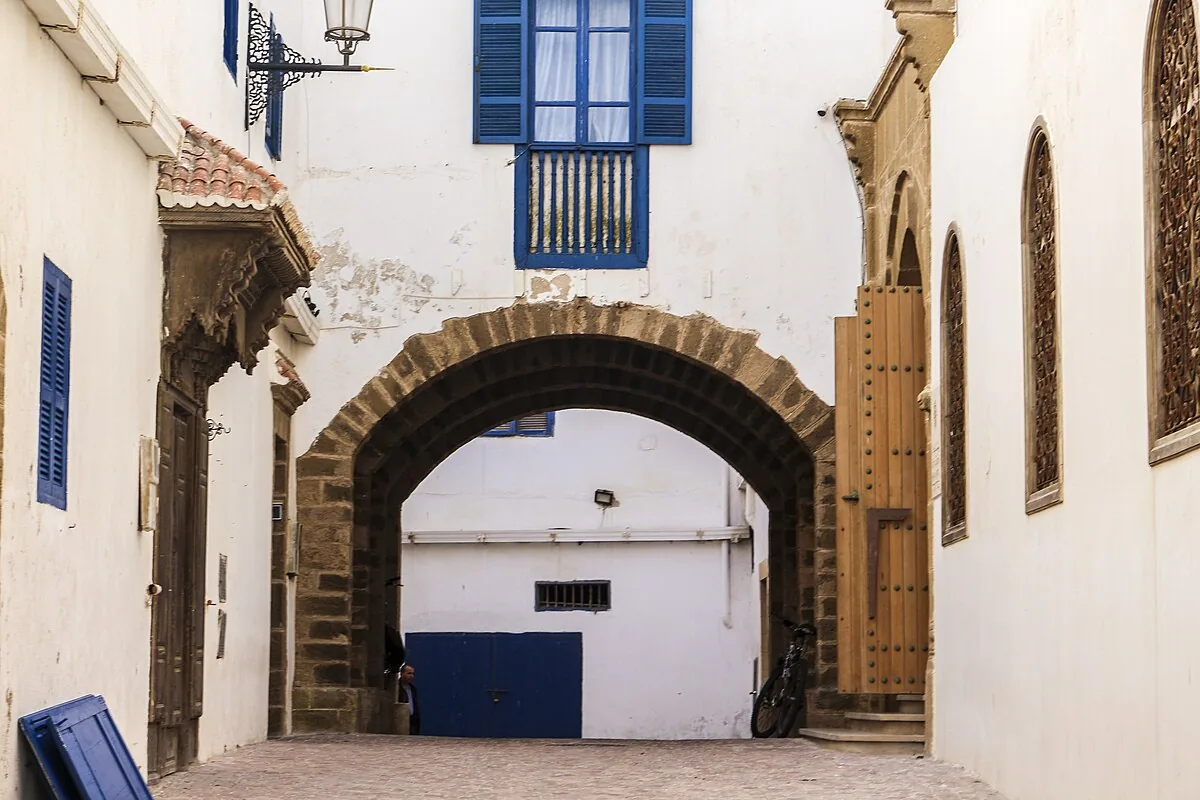
Medina of Essaouira, Morocco
History
Sultan Sidi Mohammed ben Abdallah envisioned a port that would link his kingdom to Europe while cementing his control over Saharan trade. In 1760, he commissioned the French architect Théodore Cornut to design a city according to the most modern military principles of the time. Cornut, a student of the legendary Vauban, laid out the 'Well-Designed' city with broad avenues that cut through the usual labyrinthine sprawl of Moroccan urban life. For a century, Essaouira flourished as the only port open to European trade south of Tangier, becoming a cosmopolitan melting pot where Jewish, Muslim, and European merchants lived in profitable harmony. The town eventually faded into a sleepy fishing village until the 1960s, when its rugged beauty and artistic atmosphere attracted the likes of Jimi Hendrix and Cat Stevens, sparking a modern cultural revival.
Standing atop the sea bastion at sunset, you
Standing atop the sea bastion at sunset, The spray of the Atlantic mist cooling the heat of the day. You register the way the light turns the white medina walls into a canvas of shifting golds and soft purples. The volume is a chaotic interplay of screaming seagulls and the rhythmic rhythmic rhythmic thud of waves against stone. The rough grain of the pink sandstone walls under your fingertips as you navigate the narrow alleys. From the start, the smell of grilled fish from the open-air stalls near the port, a smoky and briny invitation that defines the local culinary experience. The piece that lingers is watching the artisans in the 'squala' workshops, where the high-pitched whine of sanders reveals the intricate, swirled patterns of the local thuya wood.
Direct buses from Marrakech make the three-hour journey
Direct buses from Marrakech make the three-hour journey across the Argan-forested plains several times a day. The bus station sits just a short walk from the Bab Doukkala gate, the northern entrance to the medina. Taxis cannot enter the old city, so you must rely on blue carts pushed by local porters to transport luggage to your riad. Arriving in the late morning allows you to catch the peak of the fish auction at the harbor before the sea breeze becomes too aggressive in the afternoon. Walking the perimeter of the ramparts provides the best orientation before diving into the interior souks, which are significantly more relaxed than those in Marrakech or Fes.
“Direct buses from Marrakech make the three-hour journey across the Argan-forested plains several times a day.”
The Experience
Within Essaouira is one of unhurried, salty resilience. What you catch first is the smell of the air changes every few blocks, shifting from the ozone of the harbor to the earthy spice of the herb markets. You discover a wind, the Alizee, pushing against your back, a constant physical presence that dictates the rhythm of life here. Audibly, the of the Gnaoua lute, the guembri, often drifts from open doorways, its deep and percussive notes grounding the airy coastal light. The piece that hits is how the residents move with a lack of urgency, stopping to chat in the middle of wide plazas. The most striking detail is the scale of the gulls; they are the true owners of the medina, circling the tall minarets with a sense of entitlement. It is a place that feels weathered in the most beautiful way possible.
Why It Matters
Essaouira represents a unique fusion of 18th-century European military architecture and traditional North African urbanism. It is a symbol of the peaceful coexistence between various ethnic and religious groups that fueled Morocco's maritime history. Culturally, it remains the spiritual home of Gnaoua music, hosting an annual world festival that draws performers from across the globe.
Why Visit
Worth it because you need a breather from the intensity of the Moroccan interior. Essaouira offers the history of a great fortress without the claustrophobia of a labyrinth. You come here to eat grilled sardines on a wooden bench, to watch the sunset from the ramparts, and to realize that Morocco is just as much a creature of the Atlantic as it is of the Sahara.
Insider Tips
- 1
Head to the port around 3:00 PM to watch the fishing fleet return; it is the most visceral and unedited moment of daily life in the city.
- 2
The best 'sfenge' (Moroccan doughnuts) are sold at a tiny, unmarked stall near the Clock Tower in the early morning.
- 3
Thuya wood is the local craft specialty, but check for 'hallmarks' to ensure you are buying real wood rather than a cheap stained substitute.
- 4
Walk the ramparts at high tide; the sight of the waves exploding against the fortress walls is far more dramatic than at low tide.
- 5
Avoid the restaurants directly on the main square; the smaller spots hidden in the alleys of the jewelry district offer better food for half the price.