“Two thousand years of desert sun have failed to fade the vibrant stone mosaics that still pave the floors of this lonely Roman outpost on the edge of the world.”
About Roman Ruins of Volubilis
Marcus Aurelius and Septimius Severus are names etched into the very fabric of this city, with the latter responsible for the grand Triumphal Arch built in 217 CE. The city was the administrative heart of Mauretania Tingitana, generating vast wealth through olive groves that still blanket the surrounding hills. After the Roman military withdrawal, the city became a crossroads where Latin was spoken alongside Berber and Greek for centuries. It served as the initial seat of power for Idris I, the founder of Morocco’s first royal dynasty, before the capital moved to Fes. Excavations only began in earnest during the French Protectorate in 1915, slowly peeling back the layers of earth to reveal the most significant archaeological site in the country.
What Roman Ruins of Volubilis actually is
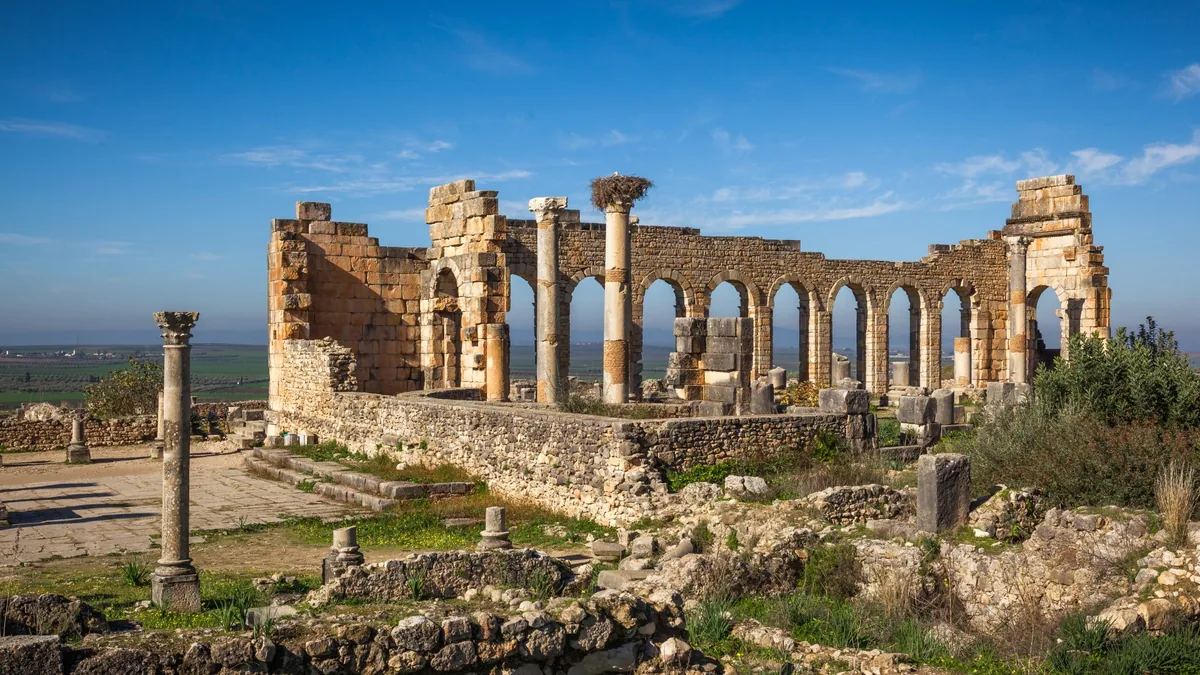
Standing amidst the rolling green hills of the Zerhoun plain, the bleached limestone columns of Volubilis rise like skeletal fingers against the Moroccan sky. This site represents the farthest southern reach of the Roman Empire, a frontier outpost that once thrived on the production of olive oil and the export of wild beasts for the Colosseum. Unlike the crowded ruins of Rome or Pompeii, Volubilis feels expansive and exposed to the elements. Storks build massive, messy nests atop the triumphal arches, their rhythmic bill-clacking the only sound breaking the mountain silence. The site is famous for its remarkably preserved mosaics, which remain in their original positions, exposed to the sun and rain rather than tucked away in a museum. These intricate stone pictures tell stories of Orpheus charming animals and Bacchus encountering Ariadne, their colors deepening when a sudden rain shower hits the plains.
Standing amidst the rolling green hills of the Zerhoun plain, the bleached limestone columns of Volubilis rise like skeletal fingers against the Moroccan sky.
History
The Romans didn't build on a blank slate here; they expanded upon a Carthaginian settlement that dated back to the 3rd century BCE. When the Empire annexed the kingdom of Mauretania in 44 CE, Volubilis became a provincial capital, growing to house nearly 20,000 residents at its peak. The city flourished for two centuries until Roman administration collapsed locally around 285 CE, yet the lights didn't go out. Local tribes continued to live within the walls, followed by a Christian community, and eventually, the first Islamic dynasty of Morocco under Idris I in 788. It wasn't war that finally brought the city to its knees, but the Lisbon earthquake of 1755, which toppled the remaining grand structures. For years afterward, the site was a quarry for the construction of nearby Meknes, leaving only the most stubborn pillars standing.
On site
Walking the Decumanus Maximus, the main thoroughfare, The deep grooves worn into the stone by chariot wheels nearly two millennia ago. It smells of wild fennel and drying grass, a sharp contrast to the damp, cool interiors of the ancient oil presses you can still see in the house ruins. First, the texture of the mosaics underfoot, rough, small cubes of colored stone that form surprisingly fluid images of sea monsters and hunting scenes. The light at mid-morning is particularly revealing, casting long shadows through the Basilica's rows of columns. The isolation of this outpost, looking out toward the holy city of Moulay Idriss on the neighboring ridge. People often miss the tiny communal latrines and the sophisticated drainage systems that prove the Romans brought their obsession with plumbing even to the edge of the Sahara.
Most travelers reach Volubilis by taking
Most travelers reach Volubilis by taking a grand taxi or hiring a driver from the nearby city of Meknes, which is about thirty kilometers away. The drive winds through olive groves and small Berber villages, offering a slow transition from modern Morocco to the ancient world. If you are coming from Fes, it is a longer day trip but easily combined with a visit to the hilltop town of Moulay Idriss. Walking the site requires about two hours of exposure to the elements, so timing your arrival for the early morning avoids the intense glare of the North African sun.
Most travelers reach Volubilis by taking a grand taxi or hiring a driver from the nearby city of Meknes, which is about thirty kilometers away.
The Experience
What grabs you is the way the wind whistles through the gaps in the Capitoline Temple, a lonely, high-pitched sound that emphasizes the emptiness of the surrounding plains. You hear the storks on top of the columns is a constant, percussive clatter that feels like a conversation across time. The heat radiating off the white stone, even in the cooler months. Most visitors miss the subtle engravings on the brothel stones or the intricate floral patterns hidden in the shadows of the House of Venus. What remains with you is standing at the far end of the city at dusk, watching the ruins turn a deep honey-gold as the call to prayer drifts over from the mountains.
Why It Matters
Volubilis is the most complete Roman ruins in North Africa and a UNESCO World Heritage site that preserves the complex transition between Roman and Islamic eras. It functions as a physical record of the agricultural wealth that once fueled an empire and the cultural overlap that defined the early Maghreb. It is a rare place where ancient history isn't behind glass but under your boots.
Why Visit
Visit Volubilis to see how an empire ends not with a bang, but with a slow, beautiful absorption into the landscape. It offers a sense of scale and survival that the medinas cannot provide. If you want to understand the deep, pre-Islamic roots of Morocco, this is the only place where that history is written in stone and mosaic.
✦ Insider Tips
- 1
Bring a bottle of water and pour it gently over the mosaics; the moisture temporarily revives the stones' original colors for a perfect photo.
- 2
Hire one of the official guides at the gate for twenty minutes just to find the hidden 'dirty' carvings that are impossible to spot on your own.
- 3
Look for the ancient olive presses in the residential quarters to understand why this city was so vital to the Roman economy.
- 4
Wear a wide-brimmed hat, as there is absolutely no shade once you move away from the entrance gate.
- 5
Visit the small on-site museum first to see the bronze busts before they are moved to Rabat for permanent display.