At 4,167 meters, you aren't just standing on the highest point in North Africa; you are standing where the Atlantic breeze meets the heat of the Sahara.
About Toubkal National Park
The High Atlas range is relatively young in geological terms, still rising as the plates continue their slow-motion collision. This youth is reflected in the sharp, unweathered peaks that define Toubkal. For the Berber tribes like the Ait Mizane, the park is a ancestral territory where they have managed the delicate balance of grazing and water rights for generations. The creation of the park in 1942 was a landmark in African conservation, though it initially struggled to balance the needs of the local people with the goals of preservation. Today, a community-based tourism model ensures that the money from trekkers goes directly into the mountain villages, funding schools and solar projects. The park remains a vital habitat for the Atlas Cedar and a crucial catchment area that provides water to the haouz plain and Marrakech.
What Toubkal National Park actually is
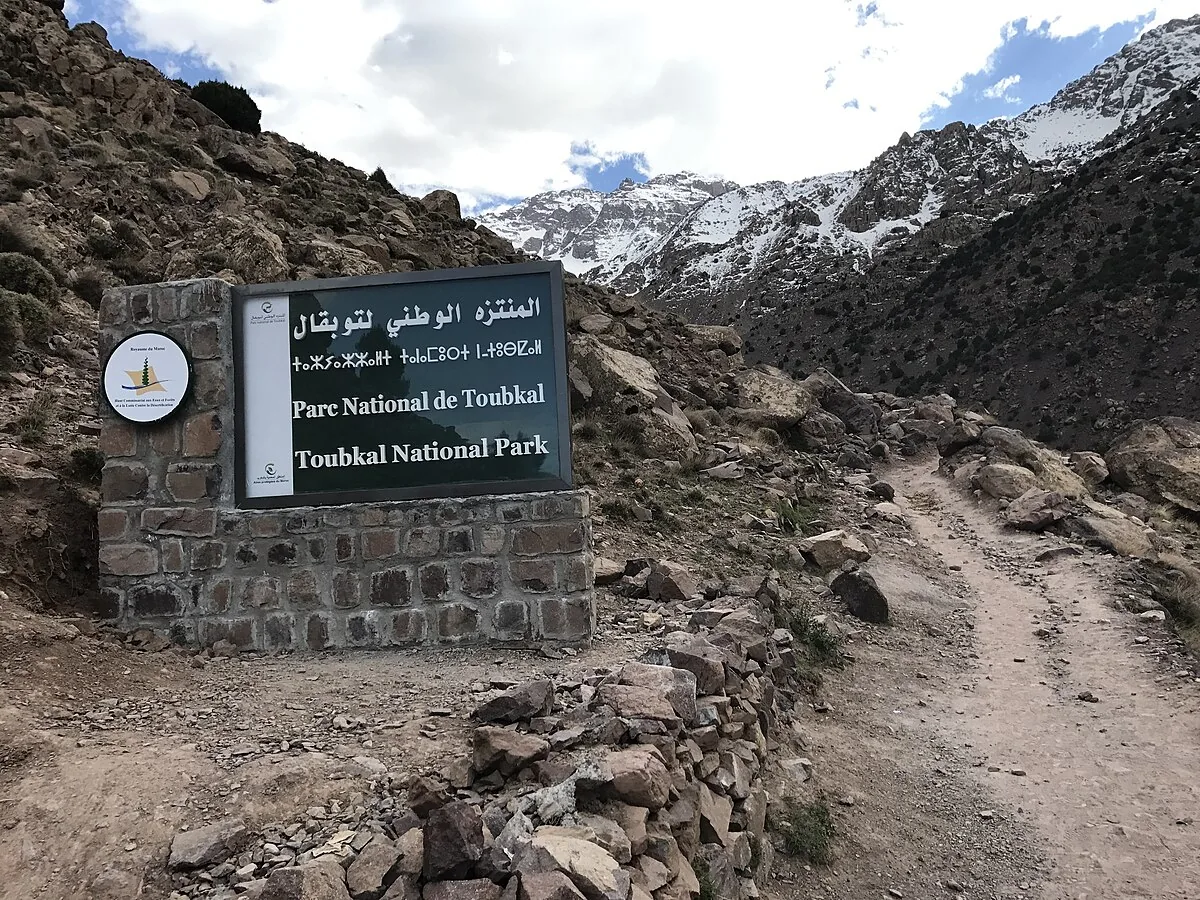
Just seventy kilometers south of the humid heat of Marrakech, the world rises abruptly into the sky. Toubkal National Park is home to the roof of North Africa, Jebel Toubkal, a peak that stands 4,167 meters above sea level. This is a landscape of granite giants, high-altitude plateaus, and valleys where the ancient Berber way of life persists in stone-built villages that cling to the hillsides. The air is thin, sharp, and carries the scent of wild thyme and juniper. In winter, the park is a monochrome world of snow and ice, while spring brings a chaotic explosion of wildflowers and the roar of meltwater rivers. It is a place that demands physical respect and rewards it with views that stretch from the Atlantic coast to the shifting sands of the Sahara. The park is the ultimate playground for trekkers and the spiritual home for the mountain people of the High Atlas.
Established in 1942 during the French
Established in 1942 during the French Protectorate, Toubkal was Morocco's first national park, created to protect the unique alpine ecosystem of the High Atlas. The geology of the park is a story of tectonic violence, where the African and Eurasian plates collided to push these jagged peaks into the clouds. The indigenous Berber people have lived in these valleys for millennia, developing a sophisticated system of terrace farming and communal irrigation that allows them to thrive in an environment that is frozen for half the year. The ascent of Jebel Toubkal first gained international attention in 1923 when a group of French climbers reached the summit, but for the locals, the mountains have always been a sacred space of refuge and resource. Today, the park is a UNESCO biosphere reserve, protecting endangered species like the Barbary sheep and the imposing bearded vulture.
Ascending from the trailhead at Imlil,
Ascending from the trailhead at Imlil, The sound of the world changes; the noise of the city is replaced by the rhythmic clink of mule hooves on rock and the constant, cold rush of the Mizane River. The air feels lighter with every thousand meters of gain, and the sun has a direct, stinging heat that is cooled by the mountain breeze. First, the texture of the Berber villages, where the houses are made of the same red and grey stone as the mountains, making them almost invisible from a distance. The strain in your lungs and the burn in your legs, a physical tax for the privilege of the view. What most skip is the tiny mountain shrines, like Sidi Chamharouch, where pilgrims still bring offerings to the 'King of the Djinn.' The hospitality of the mountain people, where a cup of sweet mint tea in a stone refuge feels more luxurious than any five-star hotel. The piece that stays with you is reaching the metal tripod at the summit just as the sun breaks, turning the entire world into a sea of orange peaks.
Most journeys to the park begin
Most journeys to the park begin in the village of Imlil, which is about a ninety-minute drive from Marrakech by grand taxi. From Imlil, the road ends and the paths begin. Most trekkers take two days to reach the summit, staying overnight at the CAF (Club Alpin Français) refuge or the nearby Les Mouflons. While it is possible to hike some of the lower trails independently, a licensed local guide and a mule for your supplies are highly recommended for the higher elevations. The paths are steep and rocky, requiring a decent level of fitness and proper mountain gear. Even in the summer, the summit can be freezing, so layering is essential for anyone attempting the climb.
The Experience
Notice the way the stars seem to double in number at the high-altitude refuge, undimmed by any city light. You hear the wind at the col is a constant, low-frequency roar that reminds you of the mountain's power. The crunch of scree under your boots, a sliding, unstable surface that requires your full focus. Most visitors miss the ancient rock carvings hidden in the upper valleys, left by prehistoric hunters thousands of years ago. What sticks with you is the descent, looking back at the peak and realizing that you have physically crossed into a different world and come back down.
Why It Matters
Toubkal National Park is the crown jewel of the Atlas Mountains and a critical ecological sanctuary. It is the premier destination for high-altitude adventure in Africa outside of the Rift Valley. It preserves the unique mountain culture of the Berbers and remains a guardian of the region's biodiversity and water resources.
Why Visit
Visit Toubkal for the ultimate physical and mental reset. It is the best place in Morocco to experience the raw, unpolished majesty of the mountains. If you want to earn your view and see the sunrise from the highest point between the Alps and the Sub-Sahara, there is simply no substitute for this trek.
✦ Photo Gallery
Best Season
🌤 Early autumn (Sept-Oct) offers stable weather and clear views, while April and May provide the beautiful contrast of green valleys and snowy peaks.
Quick Facts
Best time to visit
Early autumn (Sept-Oct) offers stable weather and clear views, while April and May provide the beautiful contrast of green valleys and snowy peaks.
Getting there
In High Atlas, Morocco; reach High Atlas first, then continue to the site.
What's nearby
Dar Si Said, Jemaa el-Fnaa and Ait Benhaddou are also in the area.
Location
High Atlas, Morocco
Type
attraction
Coordinates
31.0833°, -7.8333°
Insider Tips
- 1
Hire a local guide from Imlil; they are not just for directions, they are the key to understanding the Berber culture of the valleys.
- 2
Bring high-altitude sunblock; the thin air and reflection from the rocks will burn you faster than any beach.
- 3
Pack a warm sleeping bag even in the summer, as the mountain refuges at 3,200 meters get very cold at night.
- 4
Drink plenty of water and move slowly on the first day to help your body acclimatize to the altitude.
- 5
If you aren't up for the summit, the hike to the village of Aroumd offers spectacular views for much less effort.