“Three hundred years of copper dust and subarctic winds have polished this mountain town into a timber jewel that refuses to acknowledge the invention of the modern world.”
About Røros Mining Town
The discovery of copper in the mid-17th century by Hans Aasen turned a wilderness into a crown jewel of the Dano-Norwegian kingdom. Over the centuries, the Røros Copper Works operated as a state-within-a-state, with its own laws, currency, and social hierarchy. The town's layout was meticulously planned after the Swedish destructions, ensuring that the workers lived in proximity to the smelting house while the elite occupied the grander houses near the church. The Great Northern War brought hardship, but the mine's wealth ensured a rapid recovery every time. Even after the industrial revolution introduced steam and electricity, the core of Røros remained a spread of wood and tallow, a characteristic that led to its UNESCO listing just three years after the last mine closed.
What Røros Mining Town in Norway is
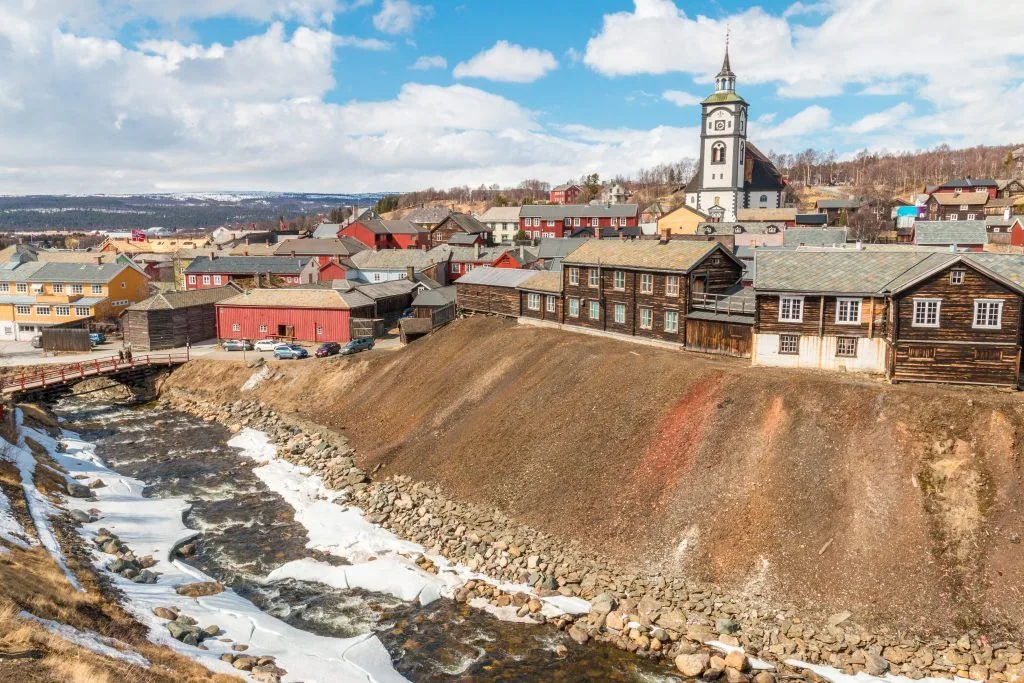
Smoke curls from crooked chimneys into a sky so cold it feels brittle, while the crunch of snow beneath your boots provides the only percussion in these silent, wooden streets. Røros exists as a living, breathing paradox: a high-altitude industrial relic that feels more like a cozy mountain sanctuary than a former copper titan. The environment carries the sharp, nostalgic scent of burning birch wood and the faint, mineral metallic tang of the slag heaps that loom like dark mountains at the edge of town. You walk past low-slung log cabins painted in shades of ochre, oxblood, and coal-dust grey. Notice how the heavy sod roofs press down on the ancient timber. Audible here is defined by the absence of modern roar, replaced by the occasional jingle of a horse-drawn sleigh and the distant, somber tolling of the stone church bell. Here the 17th century didn't just stay behind; it simply never felt the need to leave.
Smoke curls from crooked chimneys into a sky so cold it feels brittle, while the crunch of snow beneath your boots provides the only percussion in these silent, wooden streets.
was discovered here, 1644
Copper was discovered here in 1644 by a lone hunter named Hans Aasen, an event that transformed a barren mountain plateau into one of Norway's most vital economic engines for over three hundred years. The Røros Copper Works dominated every aspect of life, attracting workers from across Scandinavia who built their homes in a particular fusion of urban planning and rural mountain architecture. Despite two devastating fires set by Swedish troops in the 1670s, the town rose from its ashes each time, rebuilt with the same sturdy logs and functional grit. The mines finally silenced their drills in 1977, leaving behind a community that refused to become a hollow museum. Instead, the inhabitants stayed, preserving the eighty historic wooden blocks that now constitute one of the oldest and most authentic timber towns in Europe.
Walking up the Sleggveien slope at dawn, you
Walking up the Sleggveien slope at dawn, The physical weight of the history as the shadows of the old miners' cottages stretch across the frozen earth. You catch the way the light catches the rough, hand-hewn texture of the wood, revealing centuries of weather-beaten resilience. The interior of the Røros Church offers a sudden contrast, with its vast, baroque space and surprisingly elegant blue pews that once seated the wealthy mine administrators. There is a temperature drop significantly as you descend into the Olav's Mine, where the damp stone walls whisper stories of the men and children who labored in the dark. Immediately, the craftsmanship in every door handle and window frame, a reflection of a time when beauty was a byproduct of utility. What lingers with you is standing atop the slag heaps as the sun dips below the horizon, watching the town’s lights flicker on like a scatter of fallen stars against the snow. Røros sits high in the mountains of central Norway, accessible by a scenic five-hour train journey from Oslo or a shorter two-hour trip from Trondheim. The Rørosbanen railway offers some of the most meditative views in the country, winding through deep forests and along rushing rivers. A small regional airport also serves the town, though arriving by rail or road allows for a much more gradual immersion into the subarctic atmosphere. Once you arrive, the town is best navigated entirely on foot, as the narrow lanes were designed for sleds and hooves rather than cars. For those visiting in deep winter, renting a traditional spark, a Finnish kick-sled, is the most authentic and efficient way to glide through the icy streets.
The Experience
The mood of Røros is one of hushed, communal warmth amidst a vast, cold wilderness. You catch the smell of the air is remarkably clean, save for the sweet aroma of local reindeer stew wafting from the small cafes. Something like a sense of peace that is increasingly rare, born from the town's slow pace and the tactile reality of the log walls. The light during the winter months is a permanent twilight, a soft blue 'blue hour' that makes the glowing yellow windows look like sanctuary. First, the tiny details, like the moss growing between logs or the intricate patterns carved into the church’s stone facade. The most evocative detail is the sound of the 'spark' sleds clicking on the ice, a sound that has signaled the arrival of winter for generations.
The mood of Røros is one of hushed, communal warmth amidst a vast, cold wilderness.
Why It Matters
Røros is a global benchmark for wooden architectural preservation and a rare survivor of the European industrial frontier. It represents the successful transition from a resource-dependent mining society to a cultural capital without losing its soul. Humanly, it matters because it demonstrates how a community can inhabit its heritage rather than merely displaying it for tourists.
Why Visit
Worth it because you want to see what 'winter' actually looks like when it's not a seasonal inconvenience but a way of life. While Bergen offers color and Oslo offers sleekness, Røros offers a raw, wooden intimacy that feels like stepping into a folktale. You come here to walk on the slag heaps of history and to drink coffee in a house that has been warm since the 1600s.
✦ Insider Tips
- 1
Rent a kick-sled (spark) from your hotel; it is the primary mode of transport for locals and incredibly fun once you get the rhythm.
- 2
The local Røros-butter is legendary in Norway; seek it out at a local grocer to taste the richness of high-mountain pastures.
- 3
Visit the mine museum (Rørosmuseet) inside the smelting house to see the intricate working models of the mine's original water-powered machinery.
- 4
Walk the residential backstreets behind the church to see the private 'sod' gardens that residents still tend on their roofs.