While the rest of Europe built cathedrals from cold stone, medieval Norwegians chose the heartbeat of the forest, crafting a wooden sanctuary that has refused to rot for nine centuries.
About Urnes Stave Church
Urnes is a rare survivor of a building style that once numbered over a thousand structures across Norway. Dendrochronological testing reveals that the timber used was felled in the winter of 1129-1130, but the carvings on the northern wall are significantly older, dating back to 1050. These panels were likely part of an earlier chieftain’s church, preserved and incorporated into the new design as a bridge between the Viking past and the Christian future. During the 17th century, the interior was renovated with a new pulpit and altarpiece, but the fundamental 12th-century structure remained untouched. In 1979, it became one of the first sites in the world to be inscribed on the UNESCO World Heritage list, ensuring that its particular fusion of Celtic, Viking, and Romanesque art would be protected for future generations.
What Urnes Stave Church actually is
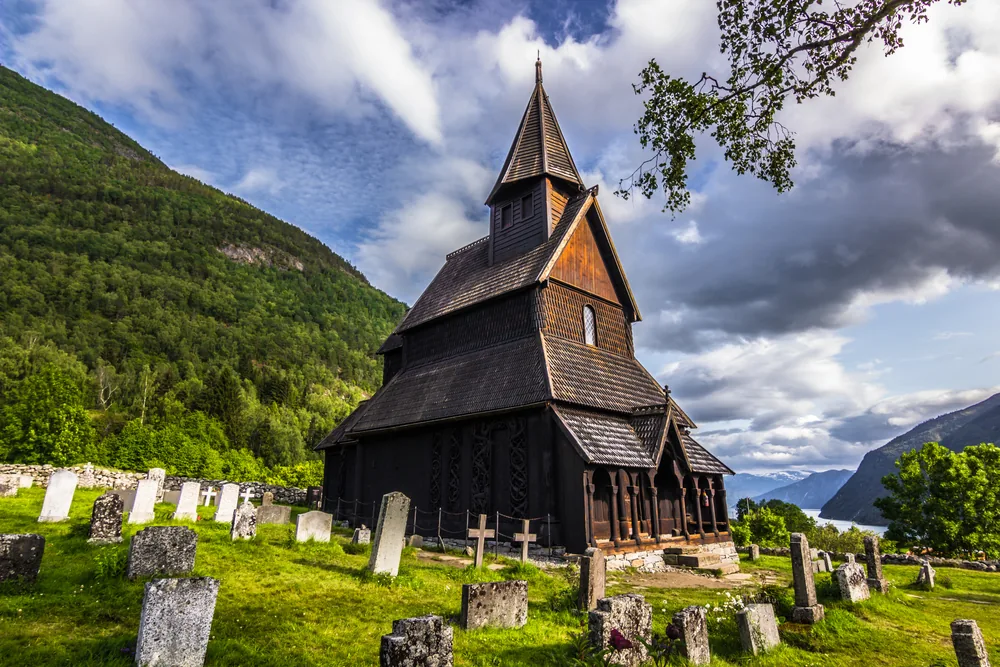
Dark, pine-tarred timber remains a masterclass in Viking age survival on a high ridge overlooking the emerald waters of the Lustrafjord. Urnes Stave Church is the eldest of its kind, a twelfth-century skeleton of wood that seems to grow directly from the wildflower meadows. This space carries a heavy, intoxicating scent of ancient resin and sun-warmed pitch, mixed with the crisp breeze coming off the glaciers across the water. You walk across the uneven grass of the churchyard. Notice how the scorched-earth black of the exterior walls contrasts with the vibrant greens of the valley. Audible here is a meditative stillness, broken only by the rhythmic bleating of sheep and the soft creak of the timber frame as it settles in the afternoon heat.
the current structure, 1130
Master builders began the current structure around 1130, though they cannily reused ornate carvings from an even older church that stood on this very spot. These salvaged panels represent the pinnacle of the Urnes style, where lean, intertwining beasts and snakes engage in a graceful, eternal struggle across the north portal. The church was built during the precarious transition from Norse mythology to Christianity, a time when the old gods were being whispered away into the shadows of the fjords. Century after century, this was the spiritual heart for the isolated farmers of Ornes, reachable only by boat or treacherous mountain paths. It survived the Black Death, the Reformation, and the brutal Norwegian winters because the community recognized the wood was sacred, meticulously applying coats of protective tar every few years to keep the rot at bay.
Stepping through the low wooden door,
Stepping through the low wooden door, There is a sudden, cool embrace as the interior darkness swallows the bright fjord sun. You catch the way your eyes take a moment to adjust, slowly revealing the ancient pine pillars that rise like forest giants toward the ceiling. The smell of the tar is even stronger inside, a dry, smoky perfume like it has been trapped here since the Middle Ages. Something of the smooth, worn texture of the pews, polished by centuries of wool-clad parishioners. The faint, ghostly remnants of medieval paintings on the wooden walls, depicting saints and symbols that have faded to beautiful, dusty pastels. The most striking moment occurs when a shaft of light pierces a high porthole, illuminating the dust motes and the carvings of the choir screen, making the wood appear almost translucent. Reaching Urnes requires a pilgrimage of its own, involving a scenic ferry ride from the village of Solvorn across the Lustrafjord. The small vessel carries only a handful of cars and passengers, depositing you at the base of a steep, winding lane that leads up to the church. Walking up from the quay is the best way to soak in the scale of the landscape, passing through fruit orchards that bloom brilliantly in the spring. Solvorn itself is easily reached by bus or car from Sogndal, which is the regional transport hub. Because the interior is delicate and space is limited, the church operates with a small team of guides who manage the flow of visitors during the short summer season.
The Experience
The energy at Urnes is one of fragile, ancient dignity. What emerges is the smell of the interior, a deep, earthy woodiness that reminds you of a forest floor in midsummer. A trace of the age of the floorboards beneath your boots, sensing the slight give of the pine that has supported thousands of souls. The light is the true protagonist, entering through small circular apertures that create spotlights on the hand-carved capitals of the pillars. The silence is not empty, but filled with the character of the building itself, a quiet presence that demands a whisper. What stays with you is looking at the exterior carvings, where a four-legged animal is bitten by a snake, and realizing that someone’s hand moved a chisel across that exact grain of wood before the Crusades ended.
Why It Matters
Urnes Stave Church is the most important wooden building in the world and the definitive example of the 'Urnes Style' of animal ornamentation. It represents a unique cultural crossroads where pagan Viking aesthetics were harnessed to serve a new faith. Humanly, it is a reflection of the endurance of local communities who preserved this fragile masterpiece through centuries of isolation and harsh climate.
Why Visit
Worth it because you need to see stone-age ambition translated into timber. While other stave churches are impressive for their dragon gables, Urnes is the one that feels the most ancient and authentic. You come here to stand inside a twelve-century pine tree and to witness the exact moment the Viking age transformed into something new. It is the most intimate connection to the medieval world you will ever find.
✦ Photo Gallery
Best Season
🌤 June and July are the essential months for visiting, as the ferry runs frequently and the surrounding orchards are lush with fruit, providing the perfect contrast to the dark church.
Quick Facts
Best time to visit
June and July are the essential months for visiting, as the ferry runs frequently and the surrounding orchards are lush with fruit, providing the perfect contrast to the dark church.
Getting there
In Vik, Norway; reach Vik first, then continue to the site.
Location
Vik, Norway
Type
attraction
Insider Tips
- 1
Bring binoculars to study the upper carvings and the capitals of the pillars, which are often too high to see in detail from the floor.
- 2
Walk the 'culture path' that leads from the church further up the hill for a perspective that places the building within the massive scale of the fjord.
- 3
Check the ferry schedule carefully for the last return trip; Solvorn is a much better place to be stranded than the quiet hillside of Urnes.
- 4
The guide's presentation is usually included in the ticket; listen for the stories about the 'hidden' carvings that are invisible to the untrained eye.