Seven hundred sheets of solid gold once covered these walls, creating a temple so bright it was said to rival the sun it was built to worship.
About Qorikancha
The site reached its zenith under Emperor Pachacuti, who transformed it into the 'navel' of the world from which all sacred paths radiated. Every major astronomical event and religious festival in the empire was calibrated against the windows of these stone chambers. When the Spanish arrived in 1533, they viewed the temple as a pagan affront and a source of immediate plunder. The subsequent construction of the Convent of Santo Domingo was a deliberate act of spiritual erasure, yet the earth itself seemed to favor the Inca. Major earthquakes in 1650 and 1950 leveled the Spanish arches while the Inca walls remained perfectly intact, forcing the world to recognize the sophistication of pre-Columbian engineering. Today, it functions as a hybrid site where the Dominican friars and the spirit of the Sun God coexist in a tense architectural truce.
About Qorikancha
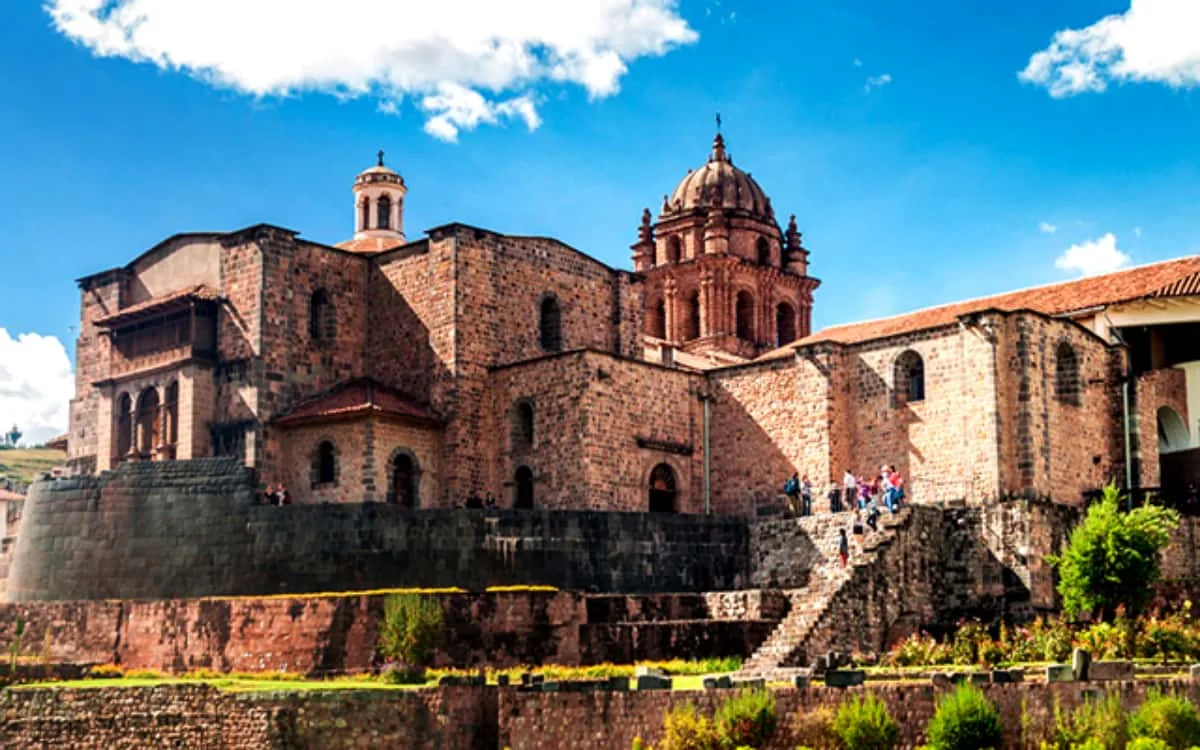
Gold once sheathed every exterior wall of this temple, reflecting the Andean sun with such intensity that the building appeared to be a fallen star resting deep in Cusco. Qorikancha, the Golden Enclosure, is a startling architectural collision where the supreme masonry of the Inca Empire provides the literal foundation for the Spanish Colonial Church of Santo Domingo. The air within the stone corridors feels dense and cool, a sharp contrast to the active, thin-aired heat of the city outside. You walk through trapezoidal doorways that have survived centuries of seismic upheaval. Notice how the volcanic basalt blocks are polished to a mirror-like sheen. Sound-wise is a haunting mix of echoing footsteps on Spanish tiles and the distant hum of the modern city filtering through the manicured gardens. Standing here, you witness the physical scar tissue of two civilizations fused into a single, complex monument.
Pachacuti rebuilt this site in the 15th century to honor Inti, the Sun God, making it the most sacred coordinate in the Inca universe. According to early chronicles, the gardens were filled with life-sized statues of llamas, corn stalks, and shepherds, all fashioned from solid gold and silver. This staggering wealth became the ultimate target during the Spanish conquest; the gold was stripped and melted down to fill the ransom room of Atahualpa. Following the fall of Cusco, the site was granted to the Dominican Order, who erected their monastery directly atop the sun temple’s walls. While the colonial structure has collapsed multiple times due to earthquakes, the Inca foundations have never shifted a millimeter, proving the structural superiority of the ancients over their conquerors. The 1950 earthquake was a pivotal moment, shaking away the plaster of the church to reveal the hidden Inca chambers that had been forgotten for generations.
Fingertips tracing the seams between the massive stones , There is a connection to a level of craftsmanship that defies modern logic. You catch the way the light enters the interior chambers, which were designed to track the winter solstice with mathematical precision. The smell of the courtyard is a blend of damp earth from the gardens and the dry, ancient scent of cold basalt. The temperature drop entering the chambers dedicated to the Moon and the Stars, where the walls incline slightly inward for seismic stability. The deep grooves in the stone that once held the golden plates in place, a visceral reminder of the temple's lost splendor. The most quiet, powerful moment occurs in the central courtyard, where you see the curved apse of the sun temple rising toward the Spanish bell tower, a visual paradox of power and permanence.
Qorikancha sits at the intersection of Avenida El Sol and Calle Santo Domingo, just two blocks from Cusco's main Plaza de Armas. Walking is the preferred way to arrive, allowing your lungs to adjust to the 3,400-meter altitude while you navigate the narrow stone streets. Taxis are plentiful but unnecessary if you are staying in the historic center. The site is open Monday through Saturday with shorter hours on Sunday for religious services. Admission requires a separate ticket from the general tourist circuit (Boleto Turístico), which can be purchased at the entrance. Visiting in the late afternoon allows you to see the sun set behind the church, casting long shadows across the Inca walls that once captured its light.
The Experience
Walking into Qorikancha is one of heavy, overlapping histories. The first thing you register is the smell of incense from the church above mingling with the crisp, metallic scent of the stone chambers below. There is a sense of vertigo looking at the precision of the joints, stones so perfectly fitted that they resemble a giant, seamless puzzle. The light plays a crucial role here, specifically the golden hour glow that highlights the red hues of the Spanish brick and the charcoal grey of the Inca basalt. The silence within the interior rooms is absolute, as if the thick walls are absorbing the noise of the 21st century. The most striking detail is the contrast between the ornate, gilded altars of the cathedral and the austere, powerful simplicity of the sun-worshippers' architecture.
Why It Matters
Qorikancha is the ultimate symbol of the clash between European and Andean worldviews. It represents the pinnacle of Inca stonemasonry and their advanced understanding of the cosmos. Culturally, it is the heart of Cusco, serving as a reminder that the indigenous foundations of Peru are literally and metaphorically supporting the structures built upon them.
Why Visit
What makes it worth the trip: you need to see the limits of human skill. While Machu Picchu offers the vista, Qorikancha offers the technical soul of the empire. You come here to witness the invincible masonry that survived the wrath of both men and nature. It is the only place in the world where you can stand in a 17th-century Spanish courtyard and touch a 15th-century sun temple at the same time.
✦ Photo Gallery
Best Season
🌤 June is the most evocative month, as the city prepares for Inti Raymi (The Festival of the Sun) and the clear winter skies allow the sunlight to hit the temple walls at the intended sacred angles.
Quick Facts
Best time to visit
June is the most evocative month, as the city prepares for Inti Raymi (The Festival of the Sun) and the clear winter skies allow the sunlight to hit the temple walls at the intended sacred angles.
Getting there
In Cusco, Peru; reach Cusco first, then continue to the site.
Location
Cusco, Peru
Type
attraction
Insider Tips
- 1
Hire a guide specifically for the Inca chambers; the subtle architectural details like the 'acoustic' niches are easy to miss without expert explanation.
- 2
Look for the carved holes in the floor of the sun temple used to drain the sacrificial liquids, a grim but vital detail of the site's original function.
- 3
Visit the exterior gardens on the side of Avenida El Sol at night when the Inca walls are illuminated, revealing the curve of the stonework without the daytime crowds.
- 4
Stay in the courtyard for a full rotation of the sun to see how the light interacts with the trapezoidal windows.
- 5
The museum in the basement houses fascinating artifacts, but the real treasure is the exterior masonry, spend your time there first.