For four centuries, the daughters of the Spanish elite lived behind these vivid blue walls in a secret world of music, servants, and silent prayer, entirely cut off from the city outside.
About Santa Catalina Monastery
Santa Catalina is a masterpiece of Mudejar-style architecture, blending Spanish and indigenous influences. The monastery survived several major earthquakes, including the devastating tremors of 1600 and 1868, leading to constant rebuilding that added layers of different architectural periods. Each 'street' in the complex is named after a Spanish city, reflecting the origins of the founding families. The reform of 1871 fundamentally changed the physical space, as grand private suites were partitioned into simpler quarters. Today, it remains one of the most important religious monuments in Peru, preserved so perfectly that it feels as though the sisters simply stepped out for a moment and might return at any time.
What Santa Catalina Monastery actually is
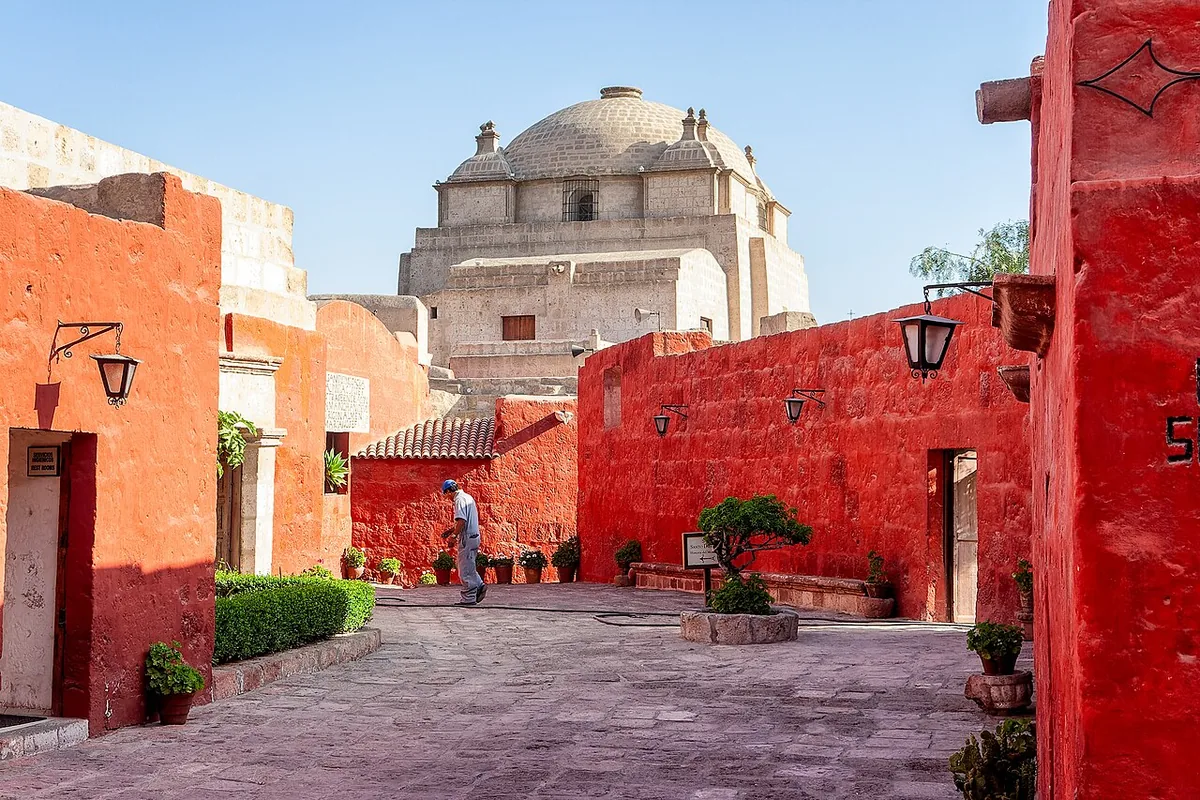
Vibrant walls of cobalt blue and volcanic sienna rise against the white sillar stone of Arequipa, creating a city within a city that remained sealed from the world for nearly four hundred years. Santa Catalina Monastery is a sprawling four-acre labyrinth of narrow cloisters, private cells, and secret plazas where the daughters of Peru's colonial elite lived in a state of cloistered luxury. This space smells of dried rose petals, orange blossoms, and the cold, damp smell of thick ashlar walls. You walk down the 'Calle Sevilla,' noticing how the intense high-altitude light creates sharp, geometric shadows against the vivid pigments of the facades. Overhead, the space is a profound, enforced silence, broken only by the trickle of water in a stone fountain and the distant, muffled chime of a convent bell. It feels like stepping into a Mediterranean village that has been barely changed since and transported to the shadow of an Andean volcano.
“Vibrant walls of cobalt blue and volcanic sienna rise against the white sillar stone of Arequipa, creating a city within a city that remained sealed from the world for nearly four hundred years.”
Santa Catalina Monastery, Peru
Founded the monastery, 1579
Maria de Guzman, a wealthy widow, founded the monastery in 1579, originally intended as a sanctuary for the second daughters of Spanish families who brought with them lavish dowries and personal servants. Across centuries, the convent operated as a high-society fortress, where the nuns lived in private houses rather than communal dormitories, hosting musical salons and maintaining their own kitchens. This era of indulgence ended in 1871 when Pope Pius IX sent a strict Dominican sister to reform the convent, enforcing vows of poverty and communal living. The monastery remained entirely closed to the public until 1970, when the mayor of Arequipa convinced the sisters to open the gates to pay for modern infrastructure. Today, a small community of nuns still lives in a private northern wing, while the rest of the site is a silent witness to the religious and social contradictions of colonial Peru.
Exploring the private cells of the nuns, you
Exploring the private cells of the nuns, the physical transition from the bright, sun-drenched courtyards to the dim, cool interiors where charcoal-blackened kitchens still stand. The first thing you register is the way the light filters through high, arched windows, illuminating the dust motes and the religious paintings of the Cusco School. The surface of the walls is rough and porous, made from the volcanic sillar that gives Arequipa its name, yet painted in colors so saturated they feel almost liquid. A sense of melancholy in the laundry area, where stone basins are still filled with water, reflecting the square of sky above. First, the small, hidden gardens tucked behind heavy wooden doors, filled with geraniums and herbs that have been cultivated for generations. The most striking moment is standing in the Plaza Zocodober, realizing that this entire complex was built to keep the world out, yet it holds all the beauty the world has to offer. The monastery is located just a few blocks from Arequipa’s Plaza de Armas, making it an easy walk from any central hotel. Its massive white walls occupy an entire city block, with the main entrance situated on Santa Catalina Street. Admission is paid at the gate, and while you can wander the labyrinth alone, hiring a guide is highly recommended to decipher the complex history of the various cloisters. The site is open daily, but Tuesday and Wednesday evenings often feature candlelight openings, which provide a significantly more atmospheric experience. Because of the complex's size, allow at least three hours to get lost in the various streets and cells without feeling rushed.
The Experience
The quality of Santa Catalina is one of artistic, colonial solitude. What registers is the smell of the old wood and the faint metallic tang of the volcanic stone, a scent that changes as you move from the open-air kitchens to the vaulted chapels. The history in the uneven cobblestones beneath your feet, which have been polished smooth by centuries of leather sandals. The light is the true artist here, especially at sunset when the red walls of the Novice Cloister seem to glow from within. Right away, the sound of your own breathing in the enclosed spaces, a trace of the meditative life the nuns led. The most evocative detail is the sight of the volcanoes, Misti and Chachani, towering over the colorful walls, an echo of the wild nature that surrounds this sanctuary.
Why It Matters
Santa Catalina is the most important convent in South America and a unique example of a 'citadel' monastery. It represents the complex intersection of class, gender, and religion in the Spanish colonies. Culturally, it is a living museum of Arequipeño tradition, preserving everything from colonial art to the specific culinary heritage of the region’s religious orders.
Why Visit
What makes it worth the trip: you want to see a color palette that shouldn't exist in the mountains. While the rest of Arequipa is white, Santa Catalina is an explosion of red and blue. You come here to lose yourself in a maze where every turn reveals a new courtyard, a hidden staircase, or a view of a volcano. It is the only place where you can feel the true, silent weight of the colonial past.
Insider Tips
- 1
Visit during the late afternoon on a Tuesday or Wednesday for the candlelight tour; the flickering shadows bring the old kitchens and cells to life in a way daylight cannot.
- 2
Look for the 'silence' signs above the doors, a trace of the convent's original purpose that still dictates the behavior of the few remaining nuns.
- 3
Climb to the rooftop near the laundry area for a view that perfectly frames the red cloisters against the snow-capped peak of Misti volcano.
- 4
Bring a spare battery for your camera; the sheer number of color-saturated corners and architectural details makes this the most photographed site in the city.