Eight hundred European bison roam this primeval woodland, a living bridge to an era before the first cities were built on the continent.
About Białowieża Forest
Białowieża survived the industrial revolution because it was the personal playground of the Jagiellon dynasty and later the Romanovs. Tsar Alexander III even built a lavish palace here in 1894, though it was destroyed during the world wars, leaving only the park and the gatehouse behind. The forest was the site of the 1991 Białowieża Accords, where the leaders of Russia, Ukraine, and Belarus signed the agreement that effectively dissolved the Soviet Union. Since then, the forest has been the center of intense conservation debates, pitting traditional forestry against the modern desire to let nature follow its own undisturbed course. It remains the only place on Earth where you can see the European lowland ecosystem exactly as it looked ten thousand years ago.
Giant oaks that have seen five centuries of snow stand as silent sentinels over the last fragment of the primeval forest that once blanketed the European continent. Białowieża is a realm where the modern world’s clock stops, replaced by the slow, moss-covered rhythm of biological decay and rebirth. This space tastes different than anywhere else in Poland, cool and dense with the scent of damp bark, wild garlic, and the pungent musk of the European bison. You navigate a landscape of fallen giants, where trees are left to rot where they fall, creating a chaotic but beautiful nursery for thousands of species of fungi and insects. The audio element is an intricate layer of woodpeckers drumming on hollow trunks and the distant, heavy snap of a branch under a bison’s hoof. It feels like standing in the world’s most ancient library, where the books are made of timber and the stories take centuries to read.
“Giant oaks that have seen five centuries of snow stand as silent sentinels over the last fragment of the primeval forest that once blanketed the European continent.”
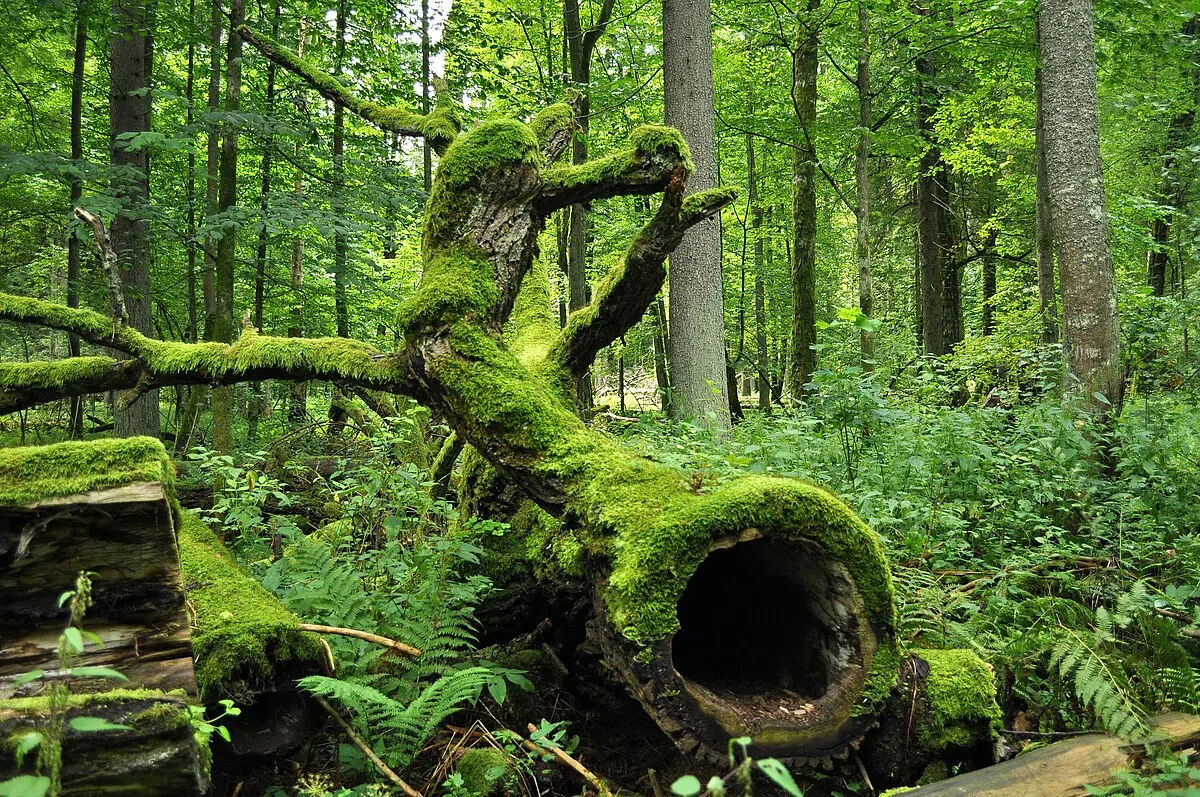
Białowieża Forest, Poland
Polish kings and Russian tsars accidentally
Polish kings and Russian tsars accidentally saved this wilderness by declaring it their private hunting ground as early as the 15th century, imposing death penalties for anyone caught poaching the royal game. This protected status kept the ax away while the rest of Europe’s lowland forests were cleared for timber and farmland. In 1921, the last wild lowland bison was killed by a poacher, but a painstaking reintroduction program using zoo animals saw the species return to these woods just a few years later. During World War II, the forest became a dark hideout for partisans and a target for Nazi exploitation, yet the core of the Strictly Protected Area remained largely untouched. Today, it remains a UNESCO World Heritage site and a Transboundary Biosphere Reserve, shared between Poland and Belarus, representing the final frontier of the European wilderness.
Entering the Strictly Protected Area with a local guide, the temperature drop as the canopy closes over you, creating a perpetual green twilight even at noon. What registers is the way the light filters through the leaves in dusty shafts, illuminating the vibrant chartreuse moss that coats every available surface. The smell of the forest floor is earthy and intoxicating, a mixture of decomposing leaves and fresh pine needles that stays on your skin long after you leave. Something like a sudden, electric surge of adrenaline when a massive bull bison emerges from the mist, its prehistoric silhouette barely distinguishable from the shadows. First, the eerie silence of the deep woods, where the absence of human noise allows the wind in the treetops to sound like a rushing river. The most evocative moment is touching the bark of the 'Oak of the Tsar,' realizing that this single organism has outlived every empire that tried to claim it.
The village of Białowieża is the primary
The village of Białowieża is the primary base for exploration, located about three hours east of Warsaw near the Belarusian border. Travelers usually arrive via car or a combination of train to Siedlce or Hajnówka followed by a local bus. The most precious part of the park can only be entered on foot or by horse-drawn carriage in the company of a licensed guide, a rule that ensures the delicate ecosystem remains undisturbed. Arriving in the pre-dawn hours increases your chances of spotting the elusive bison before they retreat into the deeper thickets for the day. Staying overnight in one of the village's traditional wooden guesthouses allows you to hear the nocturnal blend of the forest and experience the absolute darkness of a world without streetlights.
“The village of Białowieża is the primary base for exploration, located about three hours east of Warsaw near the Belarusian border.”
The Experience
The energy at Białowieża is one of profound, heavy age. What hits is the smell of the 'Deadspeak', the scent of rotting wood that provides life to the next generation of trees, which is surprisingly sweet and rich. The spongy, uncertain texture of the peat underfoot, a reminder that much of this forest is a high-altitude wetland. The light is constantly shifting, playing tricks with shadows that make every stump look like a crouching animal. The thing you pick up on is the sound of the 'Bison grass' rustling in the meadows, a sharp, dry noise that contrasts with the muffled dampness of the deep woods. The most striking detail is the sheer height of the spruce trees, which tower like cathedral spires over the tangled undergrowth below.
Why It Matters
Białowieża is the last remaining primeval lowland forest in Europe and the home of the world's largest population of European bison. It is a biological time capsule that provides essential data on how ecosystems function without human interference. Culturally, it is a symbol of the shared heritage of the Eastern European borderlands and a product of the power of royal protection in preserving nature.
Why Visit
This one matters because you want to see what the world looked like before we moved in. While other parks are groomed and managed, Białowieża is raw, messy, and ancient. You come here to stand in the presence of animals that survived the Ice Age and to realize that a forest is more than just a collection of trees, it is a single, breathing organism. It is the only place where you can feel the true weight of deep time.
Insider Tips
- 1
Hire a guide specifically for a 4:00 AM 'Bison Safari' on the edge of the forest meadows; these animals are masters of camouflage and nearly impossible to spot alone.
- 2
Try the local Żubrówka (Bison Grass Vodka) in the village, which is flavored with grass hand-picked from the forest clearings.
- 3
Bring binoculars not just for the bison, but for the rare white-backed woodpeckers that thrive in the standing dead timber.
- 4
Wear waterproof boots even in summer; the forest trails are notoriously boggy and can swallow a sneaker in seconds.
- 5
The Palace Park (Park Pałacowy) is the best spot for a quiet evening walk among English-style gardens designed for the tsars.