“This Atlantic outpost was so vital to the Portuguese Empire that it twice was the nation's capital despite being 1,500 kilometers from the mainland.”
About Centro Histórico de Angra do Heroísmo
Angra was established during the first wave of Atlantic exploration and quickly became an indispensable hub for the Carreira da Índia. Its name, meaning 'Cove of Heroism,' was granted by Queen Maria II in 1834 to honor the city’s bravery during the Liberal Wars. The city’s layout was revolutionary for its time, designed with wide streets and squares to accommodate the movement of troops and precious cargo. Its resilience was tested again in the 1980 earthquake, but the subsequent reconstruction proved the local commitment to preserving their unique Luso-Atlantic identity.
In brief
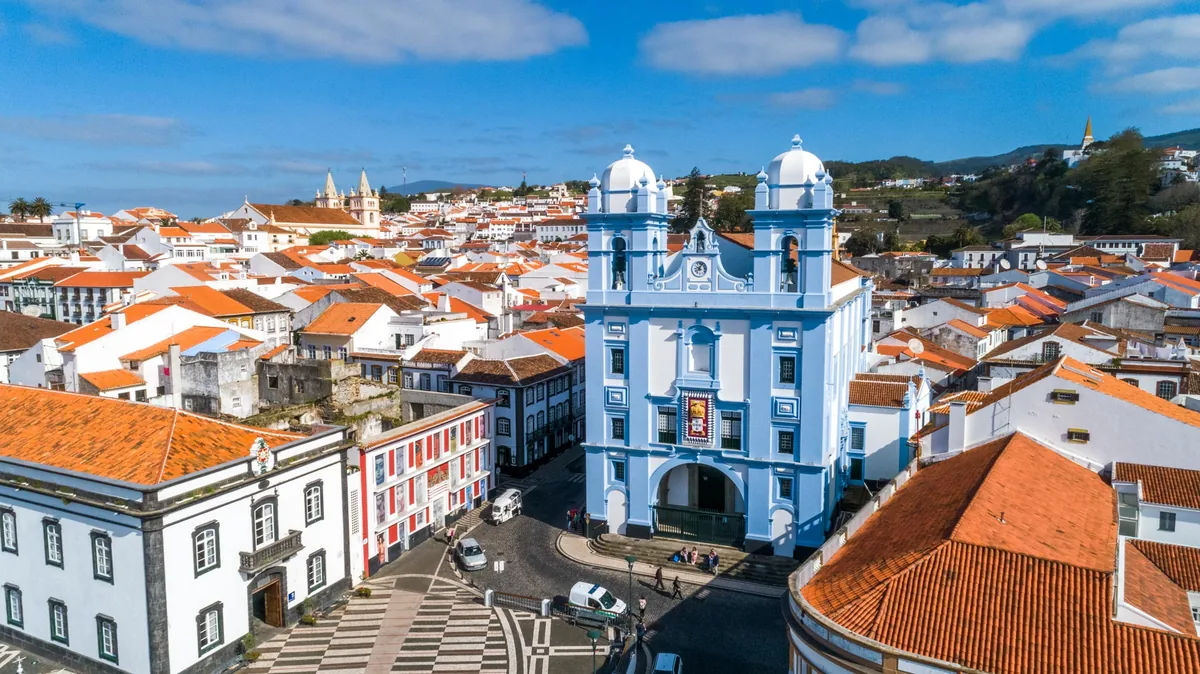
Cobblestone streets lined with pastel-colored houses sweep down toward a deep blue harbor on the island of Terceira. Angra do Heroísmo was the first city in the Azores to be designated a UNESCO World Heritage site, shaped by its role as a vital stopover for the galleons returning from the Americas and the Indies. The city's architecture is a vibrant blend of metropolitan Portuguese style and Atlantic resilience, featuring wrought-iron balconies and bright window frames in shades of ochre, sky blue, and emerald. Looming over the city is the Monte Brasil volcano, a green giant that provided the natural protection needed to make this the most important port in the mid-Atlantic for three hundred years.
Cobblestone streets lined with pastel-colored houses sweep down toward a deep blue harbor on the island of Terceira.
Founded, 1474
Founded in 1474, Angra’s strategic location made it the 'universal port' of the Atlantic. During the 16th and 17th centuries, it was here that the gold of Brazil and the spices of India were tallied and protected by the massive fortifications of São João Baptista. The city even was the capital of Portugal on two occasions, once during a dynastic crisis and later during the Liberal Wars of the 19th century. In 1980, a devastating earthquake struck the island, damaging much of the historic fabric. Rather than modernizing, the citizens of Angra embarked on a meticulous restoration, using traditional materials and techniques to rebuild the city exactly as it was, earning its UNESCO status just three years later.
Visiting Centro Histórico de Angra do Heroísmo
Walking through the Praça Velha, The intricate 'calçada' pavement patterns underfoot, depicting maritime symbols and compass roses. Around you it is incredibly fresh, a mix of salty sea breeze and the floral scent of hydrangeas from the nearby Duke of Terceira Garden. The vibrant colors of the 'impérios,' the small, colorful chapels dedicated to the Holy Spirit that are unique to the Azores. The steepness of the streets climbing toward the Alto da Memória obelisk, where the panoramic view reveals the city’s red-tiled roofs against the grey volcanic stone of the harbor. What most skip is the interior of the Cathedral of Angra, where the cedar-wood ceilings and silver altarpieces reflect the immense wealth that once passed through these docks. What stays with you is watching the sunset from the harbor wall as the fishing boats return, the city lights reflecting in the water like a scattered box of jewels.
Angra do Heroísmo is located
Angra do Heroísmo is located on the south coast of Terceira Island. The Lajes International Airport is about twenty minutes away by car, with regular flights from Lisbon, Porto, and several North American cities. Once in the city, everything is walkable, though the terrain is hilly. The local bus system connects Angra with the rest of the island, including the prehistoric volcanic caves of Algar do Carvão, making it the perfect base for exploring both the cultural and natural wonders of Terceira.
Angra do Heroísmo is located on the south coast of Terceira Island.
The Experience
The thing that lands is the way the light reflects off the whitewashed walls, making the bright blue and yellow window frames pop with intensity. The hum of the city is dominated by the Atlantic, the crashing of waves against the harbor and the cry of shearwaters at night. There is a feeling of solid, volcanic foundation of the city in the heavy basalt blocks used for the church corners. Most visitors miss the small workshops where artisans still make traditional Azorean embroidery and pottery. The piece that stays with you is the view from the top of Monte Brasil, looking back at the perfectly preserved 16th-century grid.
Why It Matters
Angra do Heroísmo is the most significant example of a maritime city in the Atlantic. It represents the logistical and cultural bridge between the Old World and the New. It is a rare survivor of a planned colonial city that has maintained its architectural integrity through centuries of Atlantic storms and seismic activity.
Why Visit
Visit Angra do Heroísmo to see the Azores at their most sophisticated. While the other islands are mostly about nature, Angra offers a rich, urban history that feels like a slice of 17th-century Lisbon dropped into the middle of the ocean. It is the only place where you can hike a volcano in the morning and dine in a World Heritage square by evening.
✦ Insider Tips
- 1
Climb to the top of the Monte Brasil peninsula for the best aerial photographs of the city’s red-roofed skyline.
- 2
Try the 'Dona Amélia' cakes at a local bakery, a spiced sweet made specifically for the 1901 visit of the Portuguese Queen.
- 3
Visit the São João Baptista Fortress; it is the largest fortress ever built by the Spanish outside of Spain and still functions as a military base.
- 4
The Duke of Terceira Garden is free and contains botanical species from four continents brought here during the Age of Discovery.
- 5
Pack a light rain jacket even in summer; the Azorean weather is notoriously unpredictable and can change several times a day.