“This stone fortress was the last thing Vasco da Gama saw before disappearing into the Atlantic, a limestone goodbye from a kingdom that was about to change the map forever.”
About Torre de Belém
The tower is a masterpiece of the Manueline style, incorporating symbols of the crown, the Order of Christ, and the discoveries of the era. It was originally situated further into the river, but the shifting of the Tagus' banks over centuries has brought it closer to the shoreline. Throughout the 19th century, the tower was used to house political prisoners in its flooded lower chambers, a dark chapter that contrasts with its romantic exterior. Restoration in the 1840s by King Ferdinand II saved it from falling into the river, ensuring its status as a national icon. It was inscribed as a UNESCO World Heritage site in 1983, recognized as a unique example of maritime military architecture that successfully combines artistic beauty with defensive functionality.
What Torre de Belém actually is
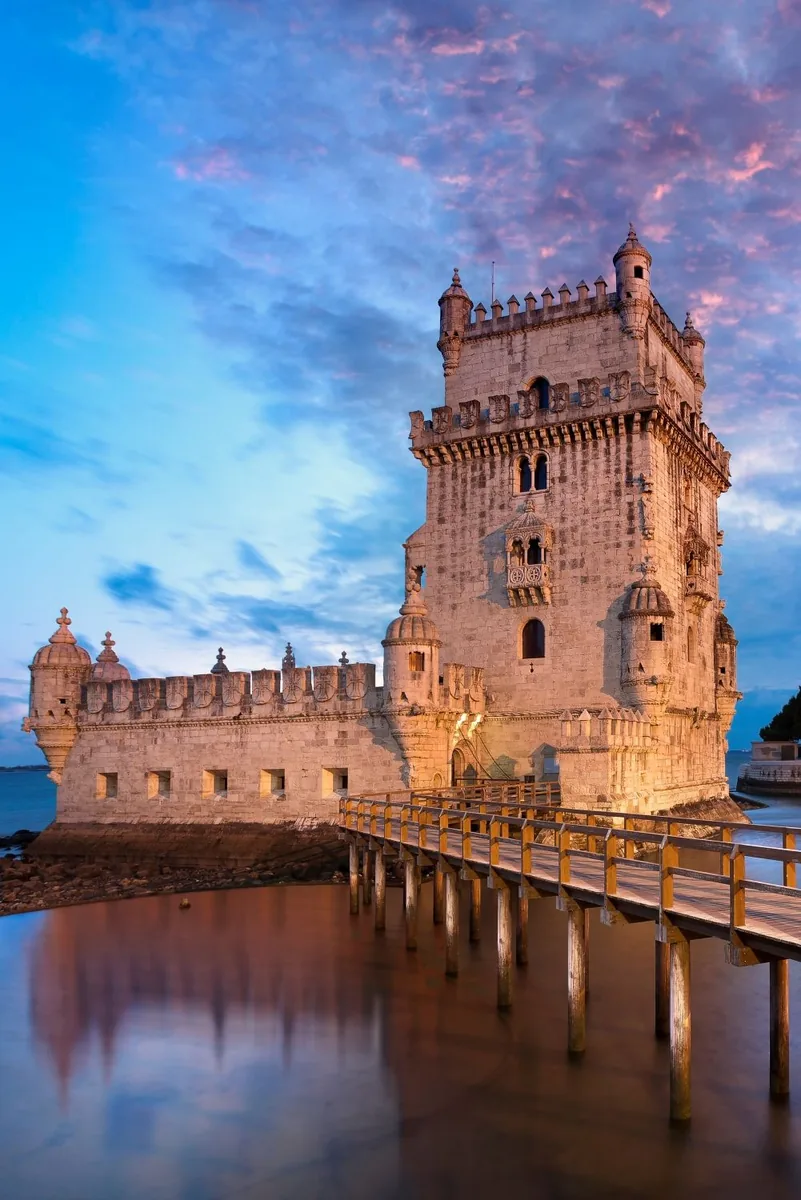
A limestone sentinel rises from the waters of the Tagus, its weathered battlements carved with stone ropes and exotic animals that have watched five centuries of tides. The Torre de Belém is the diminutive but powerful symbol of Lisbon’s maritime identity, once the final piece of land Portuguese explorers saw as they departed for the New World. The environment around the tower is sharp with salt and the constant, restless wind of the Atlantic estuary. You walk across a wooden gangway to reach the bastion. Notice how the architecture blends the defensive grit of a fortress with the delicate ornamentation of the Manueline style. The sound layer is a rhythmic dialogue between the lapping waves against the stone base and the distant cry of gulls circling the watchtowers. It feels like a lighthouse that was built with the soul of a cathedral.
A limestone sentinel rises from the waters of the Tagus, its weathered battlements carved with stone ropes and exotic animals that have watched five centuries of tides.
Commissioned by King Manuel
King Manuel I commissioned the tower in 1514 to serve as a defensive fortress at the mouth of the river and a ceremonial connection to the city. Designed by Francisco de Arruda, who had recently spent time in North Africa, the tower features distinct Moorish influences in its arched windows and ribbed domes. Across centuries, it acted as the first line of defense for Lisbon, housing a battery of cannons that could cross-fire with the fort on the opposite bank. As the city expanded and naval technology changed, the tower’s role shifted from a military bastion to a telegraph station, a lighthouse, and eventually a grim political prison in its lower damp vaults. It survived the 1755 earthquake largely because it was built on a basalt outcrop, and it remains today as a lone survivor of the original riverfront defenses that once lined the Tagus.
Climbing the narrow spiral staircase to the upper battery, The physical constriction of a space designed for soldiers rather than tourists. What hits is the way the light reflects off the water and pours through the arched windows, illuminating the smooth, cream-colored limestone. The smell of the river is omnipresent, a mix of mud, salt, and old stone, that seems to permeate the thick walls of the governor’s room. Something like a sense of history in the open-air terrace, where the stone watchtowers offer a view of the 25 de Abril Bridge and the distant Atlantic horizon. The small, carved rhinoceros on the outer wall, the first depiction of the animal in Europe, sent as a gift to the king from India. The most evocative moment is standing on the bastion at sunset, realizing that this small tower once represented the edge of the known world for every sailor who passed it.
Location and access
The tower is located in the Belém district, about six kilometers west of central Lisbon. It is easily reached via the E15 tram or the train to Belém station, followed by a scenic fifteen-minute walk along the riverfront. Entry is strictly controlled by capacity limits, making online pre-booking essential to avoid long waits on the wooden bridge. Because the interior staircases are extremely narrow and operate on a timed light system to manage traffic, the climb can be challenging for those with limited mobility. Arriving during the golden hour provides the most dramatic light for photography, as the limestone turns a deep, glowing honey color as the sun sinks into the river.
The tower is located in the Belém district, about six kilometers west of central Lisbon.
The Experience
The nature of the Torre de Belém is one of compact, maritime power. What hits is the smell of the river mud and the cold, damp stone of the interior, which holds a chill even in the height of summer. A remnant of the history in the worn stone steps, smoothed by the boots of five hundred years of guards. The light is constantly moving, reflecting off the river and dancing on the ceilings of the vaulted rooms. Immediately, the sound of the wind whistling through the battlements, a sharp, mournful noise that highlights the tower's isolation. The most striking detail is the contrast between the rough, defensive lower walls and the delicate, lace-like carvings of the upper balconies, reflecting a world that was learning to balance war with art.
Why It Matters
The Torre de Belém is a UNESCO World Heritage site and a symbol of the Portuguese Age of Discovery. It represents the height of Manueline art and the strategic importance of Lisbon as a gateway between Europe and the rest of the world. Historically, it is a rare surviving example of a 'bulwark' fortress, bridging the gap between medieval towers and modern coastal defenses.
Why Visit
The pull is that you want to stand on the edge of history. While Lisbon is full of grand monuments, the tower is intimate, tactile, and rooted in the water. You come here to see the rhinoceros in the stone and to imagine the feeling of sailing away into a horizon with no end. It is the only place where the river feels like a doorway.
✦ Insider Tips
- 1
Look for the rhinoceros carving on the northwestern watchtower; it is small and easy to miss but is a vital piece of the tower's history.
- 2
The 'traffic light' system on the spiral stairs is not a suggestion; wait for the green light to avoid a very awkward encounter halfway up.
- 3
Buy a combined ticket with the Jerónimos Monastery to save money and time, but remember that the tower has much lower capacity and should be visited first.
- 4
The best photos are actually taken from the beach at low tide, where you can see the tower's full height and its reflection in the river pools.
- 5
The interior is small and can be skipped if the line is over an hour; the true beauty of the tower is best appreciated from the exterior walkway.