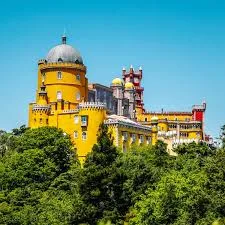
Perched on a mountain peak where the forest meets the clouds, this palace is a wild explosion of yellow and red built by a king who wanted to live inside a fairytale.
About Palácio Nacional da Pena
Ferdinand II was a man of the 19th-century Romantic movement, and Pena was his canvas. He didn't just build a palace; he engineered a landscape, importing exotic trees from all over the world to create the surrounding 200-hectare park. The construction reflected a transition in Portuguese society, where the old monastic ruins were being repurposed for a new, secular era of royal luxury. Throughout the late 1800s, the palace was the setting for the final, bittersweet years of the Portuguese monarchy. It remains one of the best-preserved examples of 19th-century Romanticism in the world, serving as a time capsule of the tastes and eccentricities of a royal family that was soon to disappear from the political stage.
What Palácio Nacional da Pena actually is
Technicolor towers of lemon yellow and brick red pierce the persistent mist of the Sintra hills, looking more like a flamboyant stage set than a royal residence. The Palácio Nacional da Pena is the fever dream of King Ferdinand II, a Romanticist masterpiece that crowns the highest peak above the town. The surroundings here is noticeably cooler than in nearby Lisbon, smelling of damp fern, eucalyptus, and the fresh, mossy breath of the surrounding Atlantic forest. You walk along crenelated battlements that offer views of the ocean on clear days. Notice how the architecture shamelessly borrows from Neo-Gothic, Neo-Manueline, and Islamic styles. The sound is a mix of the wind howling through the rocky crags and the muffled, excited chatter of visitors navigating the narrow, winding corridors. It feels like a place where the logic of the real world has been suspended in favor of a whimsical, architectural fairytale.
Origins
The site began as a quiet, meditative monastery for the Order of Saint Jerome, chosen for its proximity to heaven on the mountain's crest. Along the 1755 earthquake, the monastery fell into ruins until Ferdinand II, the 'King-Artist,' purchased the site in 1838 to create a summer retreat for the royal family. He commissioned Baron Wilhelm Ludwig von Eschwege to build a palace that reflected the Romantic movement's obsession with nature and the exotic. The project integrated the remains of the old monastery, including the chapel and cloister, into a wild new structure of exuberant colors and textures. For decades, it was the preferred sanctuary for the Portuguese royals until the 1910 revolution forced the last queen, Amélia, into exile. It was soon declared a national monument and opened to a public that was both baffled and delighted by its eccentric silhouette.
Entering the palace through the Triton
Gate, The intentional theatricality of the space, as a half-man, half-fish stone carving seems to guard the passage between the forest and the castle. What registers is the way the light changes moving through the rooms, from the bright, reflective tiles of the exterior terraces to the intimate, dimly lit private chambers filled with original royal furniture. The surface of the walls varies from smooth, painted stucco to the rough-hewn granite boulders that the palace was built directly upon. A drop in temperature as the Sintra mist, the 'microclimate', occasionally rolls across the terraces, momentarily obscuring the bright colors in a grey, ghostly veil. First, the intricate stuccowork in the Noble Room, where the detail is so fine it looks like carved ivory. The most evocative moment is standing on the Queen’s Throne terrace, realizing the sheer audacity of building such a colorful monument in such a rugged, primeval landscape.
The palace is located
The palace is located at the top of the Sintra hills, a forty-minute train ride from Lisbon's Rossio station followed by a steep climb. Travelers usually opt for the 434 tourist bus that loops from the Sintra station to the palace gates, as the walk is a grueling uphill trek through the forest. Entry is managed by strictly timed tickets, and it is highly recommended to book the earliest possible slot to avoid the dense midday crowds. After entering the park gates, there is still a ten-minute uphill walk (or a small shuttle bus) to reach the palace itself. Exploring the surrounding Pena Park is just as essential as the palace interior, as the hidden grottoes and lakes were designed to be part of the same Romantic vision.
The Experience
The mood at Pena is one of playful, high-altitude grandeur. What lands is the smell of the damp earth and the salty Atlantic air, a combination that makes the Sintra hills feel like an island in the sky. A physical complexity of the building, with its secret doors, narrow spiral stairs, and unexpected terraces that force you to explore rather than just walk. The light is famously temperamental; one moment the yellow walls are blindingly bright under the sun, and the next they are muted and moody as the clouds settle on the peak. The hum of footsteps on the wooden floors of the royal apartments, a hollow noise that highlights the absence of the people who once lived here. The most striking detail is the way the palace grows out of the natural rock, with massive granite boulders forming part of the interior walls.
Why It Matters
Pena is the crown jewel of the Cultural Landscape of Sintra and a UNESCO World Heritage site. it represents the pinnacle of 19th-century Romanticism in Europe, combining disparate architectural styles into a unified, poetic whole. Culturally, it is the most recognizable symbol of Portugal's royal heritage and a reflection of the King-Artist's vision of harmonizing architecture with the wild natural world.
Why Visit
Why this place matters: you need to see that royalty didn't always have to be serious. While other European palaces are stiff and formal, Pena is a riot of color and imagination. You come here to walk on the battlements of a dream and to see the world from a queen's perspective. It is the only place where the clouds feel like part of the decor.
✦ Photo Gallery
Best Season
🌤 Late spring (May and June) is magical, as the camellias and azaleas in the park are in full bloom and the weather is warm enough to enjoy the open terraces without the summer fog.
Quick Facts
Best time to visit
Late spring (May and June) is magical, as the camellias and azaleas in the park are in full bloom and the weather is warm enough to enjoy the open terraces without the summer fog.
Getting there
In Sintra, Portugal; reach Sintra first, then continue to the site.
Location
Sintra, Portugal
Type
attraction
Insider Tips
- 1
Book the 9:00 AM slot; the palace interior is narrow and becomes claustrophobic once the large groups from Lisbon arrive after 11:00 AM.
- 2
The walk from the Sintra train station to the palace takes about an hour and is very steep; take the 434 bus unless you are looking for a serious hike.
- 3
Don't skip the walk to the High Cross (Cruz Alta); it's the highest point in the park and offers the absolute best panoramic view of the palace's colorful silhouette.
- 4
The palace interior is beautiful, but the exterior terraces are where you can truly appreciate the architectural madness; spend more time there.
- 5
Bring a light jacket even in August; the microclimate in the Sintra hills can be ten degrees cooler than in the center of Lisbon.