“One specific wall in this city bears the inscription 'Portugal was born here,' a claim backed by a thousand years of granite and blood.”
About Centro Histórico de Guimarães
The city’s roots are tied to the 10th-century monastery established by Mumadona Dias, which served as the nucleus for the burgeoning Portuguese identity. It was the seat of the Dukes of Braganza, the family that would eventually rule Portugal for nearly three centuries. The architectural transition from the heavy stone of the Romanesque castle to the more refined, timber-accented Renaissance palaces reflects the city’s shift from a military fortress to a cultural center. Today, it remains a vibrant university city that treats its history as a living foundation rather than a stagnant relic.
Background
Narrow medieval alleys and granite mansions with timber-framed balconies define the city where the Portuguese nation was born. Guimarães is affectionately known as 'The Cradle City,' the site where Afonso Henriques declared himself the first King of Portugal in 1139. The historic center is a masterclass in organic urban evolution, where the rugged stone architecture of the north blends seamlessly into graceful plazas like the Largo da Oliveira. Above the city, the Romanesque castle stands guard on a rocky outcrop, its crenellated towers appearing as if they grew directly out of the granite soil. It is a place of deep national pride, where the history is not just preserved in museums but lives in the laundry hanging over iron railings and the steam rising from local taverns.
Narrow medieval alleys and granite mansions with timber-framed balconies define the city where the Portuguese nation was born.
Guimarães became the first capital
Guimarães became the first capital of the County of Portugal in the 10th century when Countess Mumadona Dias founded a monastery and a castle on this site. The pivotal Battle of São Mamede took place just outside the city walls in 1128, marking the beginning of the kingdom’s independence. Throughout the Middle Ages and the Renaissance, the city expanded southward, developing a unique building style characterized by granite lower floors and overhanging upper stories made of wood and plaster. This 'Guimarães style' was an ingenious solution to the lack of space within the city walls. UNESCO recognized the center in 2001, noting that it perfectly illustrates the transition from a medieval settlement to a modern European city while keeping its soul intact.
Visiting Centro Histórico de Guimarães
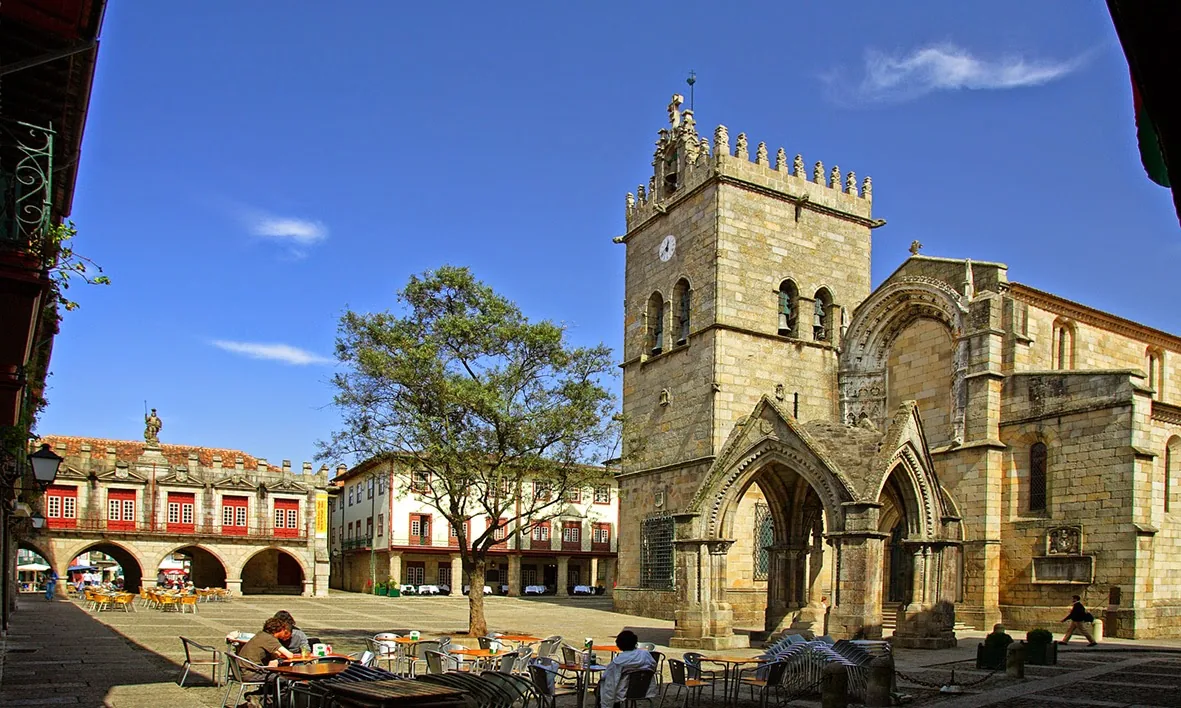
Walking into the Largo da Oliveira, The Gothic canopy of the Padrão do Salado, a monument to a 14th-century victory against the Moors. It smells of roasting chestnuts in the winter or fresh petunias in the spring, mixed with the aroma of strong coffee from the outdoor terraces. The grain of the granite walls, which are often covered in fine, green moss from the northern humidity. The age of the city in the uneven granite slabs of the Rua de Santa Maria, the oldest street in Guimarães. People tend to miss the tiny gargoyles and carvings tucked into the eaves of the 15th-century Palace of the Dukes of Braganza. The bit that stays with you is taking the cable car up to Monte da Penha at dusk, watching the lights of the 'cradle' flicker to life as the bells of a dozen churches begin their evening chorus.
Guimarães is an easy one-hour train journey
Guimarães is an easy one-hour train journey from Porto’s São Bento station, making it one of the most popular day trips in northern Portugal. The historic center is a ten-minute walk from the train station, and once you arrive at the city walls, the area is largely pedestrianized. For those driving from Porto or Braga, the highway connection is excellent, and there are large parking areas located just outside the medieval core, allowing for an easy transition into the timeless world of the old city.
Guimarães is an easy one-hour train journey from Porto’s São Bento station, making it one of the most popular day trips in northern Portugal.
The Experience
What gets you is is the way the dark granite absorbs the morning mist, giving the city a brooding, cinematic atmosphere. Audible: the city is a blend of student life and old-world commerce, the clatter of silverware in the plazas and the ringing of bicycles on stone. A sense of transition from the sunny, open squares to the cool, shadowy depths of the medieval arches. Most visitors miss the Alberto Sampaio Museum, which houses the tunic worn by King João I at the Battle of Aljubarrota. What sticks with you is standing in the castle keep, looking out over the mountains.
Why It Matters
Guimarães is the spiritual and historical home of the Portuguese people. It represents the successful preservation of a medieval urban fabric that has been adapted to modern life without losing its historical integrity. It is the architectural record of the very first moments of the Portuguese kingdom.
Why Visit
Visit Guimarães to see where the story began. While Porto is about wine and commerce, Guimarães is about heritage and the raw materials of nationhood. It offers a more intimate, local experience than the larger cities, providing a sense of 'old' Portugal that feels entirely genuine and unpretentious.
✦ Insider Tips
- 1
The cable car to Monte da Penha offers a refreshing escape from the city heat and the best panoramic views of the Minho region.
- 2
Try the 'Tortas de Guimarães,' a traditional pastry filled with squash jam and eggs, originally created by the city’s nuns.
- 3
Visit the Palace of the Dukes of Braganza late in the afternoon to avoid the tour bus crowds and see the tapestries in the best light.
- 4
Wear shoes with good grip; the medieval granite paving can be incredibly slippery when wet.
- 5
The Rua de Santa Maria is the best place to find authentic local handicrafts that aren't just typical souvenirs.