When the Knights Templar were hunted across Europe, they didn't disappear; they moved to this hill in Tomar and funded the exploration of the world.
About Convento de Cristo
The Convento de Cristo is a palimpsest of eight centuries of Portuguese art and architecture. Its heart is the Charola, a 12th-century Romanesque rotunda where knights were said to have heard mass on horseback, ready for battle. During the 15th and 16th centuries, the site became the laboratory for the Manueline style, most famously expressed in the Chapter House window designed by Diogo de Arruda. This window is a stone catalog of the Age of Discovery, featuring seaweed, coral, and the buckles of the Order of the Garter. The later Renaissance cloisters, commissioned by King John III, introduced a new level of classical harmony to the complex, making it one of the most diverse architectural sites in the world. It was inscribed as a UNESCO World Heritage site in 1983, recognized as a global monument to the military and religious orders that shaped the modern world.
Convento de Cristo
A massive stone fortress-convent crowns the hill above Tomar, its walls containing the secret geometry of the Knights Templar and the most famous window in all of Portugal. The Convento de Cristo is a sprawling, multi-layered complex that was the headquarters for the Order of Christ, the successors to the Templars. This space is dry and carries the scent of wild pine and cold stone, with a silence so thick it feels like it belongs to another century. You walk through a series of seven cloisters. Notice how the architecture shifts from the austere Romanesque of the Charola to the flamboyant Manueline details of the main nave. Audible here is a low hum of wind through the battlements and the distant, rhythmic ticking of a clock in the town below. It feels like standing in the nerve center of a holy crusade, where the line between monk and soldier was carved into the very stone.
“A massive stone fortress-convent crowns the hill above Tomar, its walls containing the secret geometry of the Knights Templar and the most famous window in all of Portugal.”
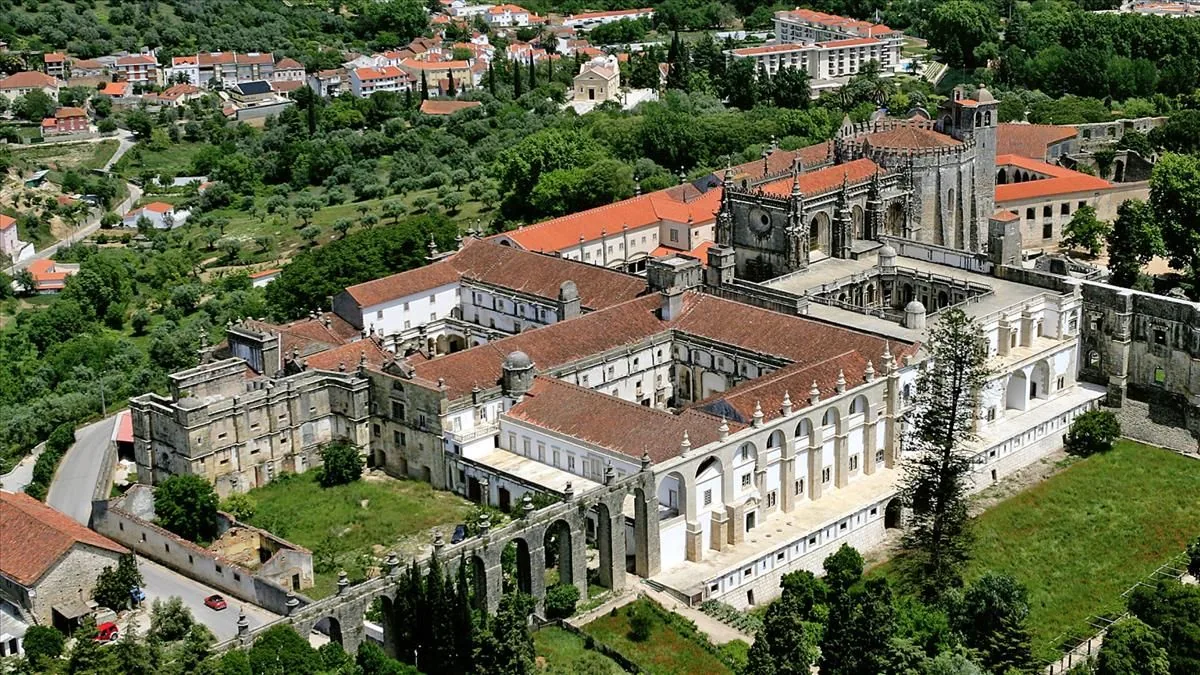
Convento de Cristo, Portugal
on the castle, 1160
Gualdim Pais, the Grand Master of the Templars, began construction on the castle in 1160 as a strategic bastion on the border of the Christian and Moorish territories. When the Templars were suppressed across Europe in the 14th century, King Denis of Portugal cleverly rebranded them as the Order of Christ, allowing them to keep their lands, their wealth, and this massive fortress. Under the leadership of Henry the Navigator, the Order became the financial and spiritual engine behind the Age of Discovery, with the red cross of the Order appearing on the sails of every Portuguese caravel. For over five centuries, the convent was continuously expanded, adding Renaissance cloisters and Gothic halls that created a chronological map of Portuguese history. It remained a religious site until 1834, eventually becoming a national monument that preserves the mysterious legacy of the knight-monks who helped build an empire.
Standing inside the Charola, the octagonal rotunda inspired by the Holy Sepulchre in Jerusalem, the immense spiritual weight of the Templar mysteries. What registers is the way the light hits the gilded statues and the fading frescoes, creating a rich, medieval atmosphere that is unlike any other church in the country. The grain of the stone is rough and ancient in the older corridors, contrasting with the smooth, detailed carvings of the Chapter House window. The cool temperature of the inner cloisters, where the sound of your footsteps on the stone floor is the only thing that interrupts the silence. Immediately, the intricate nautical knots and stone ropes of the Manueline Window, a masterpiece of carving that seems to vibrate with the energy of the sea. The most evocative moment is walking through the dormitory corridors, where the small, identical cells remind you of the ascetic life led by the men who once held the fate of nations in their hands. The convent is located on a hill overlooking the town of Tomar, about a ninety-minute drive or a two-hour train ride north of Lisbon. Travelers usually walk from the town center up the 'Caminho do Castelo,' a scenic but steep path through the forest that takes about fifteen minutes. For those who prefer not to walk, taxis and a small tourist shuttle run regularly to the main gate. The site is massive, and you should allow at least three hours to explore the various cloisters, the church, and the surrounding gardens. Arriving early in the morning ensures you have the Charola to yourself before the day-trippers arrive, allowing the mysterious energy of the space to take hold.
The Experience
The feel of the Convento de Cristo is one of intellectual, military silence. What hits is the smell of the old stone and the dry wood of the ceilings, a scent that hasn't changed for centuries. Part of the physical complexity of the space, with its secret passages and interconnected cloisters that feel like a stone puzzle. The light is soft and filtered in the rotunda, but bright and unforgiving on the upper battlements where you can see for miles across the Ribatejo plains. At first, the sound of the wind through the cypress trees in the gardens, a sharp, rustling noise that adds to the site's sense of isolation. The most striking detail is the contrast between the dark, mysterious Charola and the bright, open Renaissance cloisters, reflecting the shift from the medieval to the modern mind.
Why It Matters
The Convento de Cristo is one of Portugal's most important historical monuments and a UNESCO World Heritage site. It represents the continuity of the Templar legacy through the Order of Christ and their pivotal role in the maritime discoveries. Historically, it is a masterclass in architectural evolution, housing some of the most significant examples of Romanesque, Gothic, Manueline, and Renaissance art in existence.
Why Visit
Why this place matters: you want to solve a stone mystery. While other monuments are straightforward, Tomar is a labyrinth of Templar secrets and maritime riddles. You come here to see the window that represents the soul of an empire and to stand in a room where knights once swore oaths of blood and gold. It is the only place where the Crusades and the Age of Discovery share a roof.
Insider Tips
- 1
The Chapter House window is on the exterior of the church nave; you have to walk through the Cloister of Saint Barbara to see it properly.
- 2
Look for the small 'Templar crosses' carved into the stones throughout the older parts of the castle; these were the masons' marks.
- 3
The convent gardens (Mata dos Sete Montes) offer a beautiful, shaded walk back down to the town that is much easier on the knees than the paved road.
- 4
Bring a torch or use your phone light to see the detail in the darker corners of the Charola, where the fading frescoes are often missed.
- 5
If you are staying in Tomar, visit the convent at opening time (9:00 AM) to experience the Charola in total silence before the tourist buses arrive.