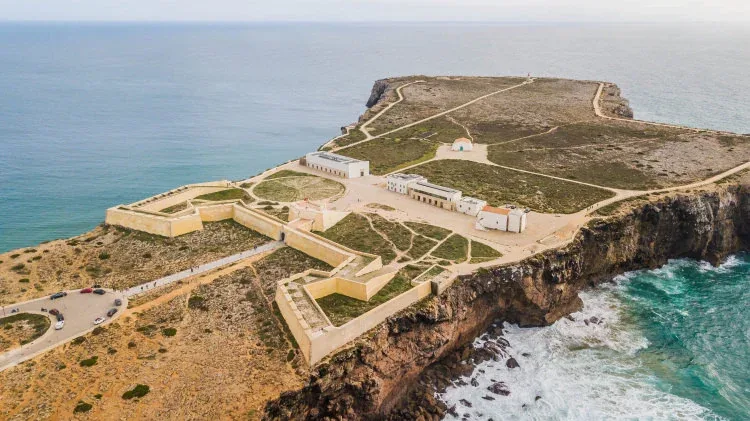
At the literal edge of the European continent, this fortress used 60-meter sheer cliffs as its primary walls to protect the secrets of the world's first great explorers.
About Fortaleza de Sagres
The Sagres promontory has been a sacred site since the Neolithic period, referred to as the 'Sacrum Promontorium' by the Romans who believed the sun hissed as it sank into the ocean here. Prince Henry the Navigator spent much of his time and wealth here in the 1400s, overseeing the development of the caravel. After Sir Francis Drake's raid and the Great Earthquake of 1755, the fortress was largely abandoned as a military site. It was restored in the 1950s and 90s to serve as a national monument to the maritime heritage that changed the map of the world.
On a windswept plateau at the southwestern edge
On a windswept plateau at the southwestern edge of Europe, a single white wall cuts across a peninsula to create a fortress where the primary defense is the ocean itself. The Fortaleza de Sagres is not a traditional castle with high battlements and towers; it is an extension of the 60-meter cliffs that drop vertically into the churning Atlantic. This is the place where the horizon feels endless and the wind never stops. Inside the massive gate, the landscape is barren and scrubby, dominated by a giant wind rose etched into the ground and a small, lonely chapel. It is a site of immense atmospheric power, where the spirit of the Age of Discovery feels like a haunting presence in the salt spray.
Commissioned by Prince Henry
Sagres is inseparable from the myth of Prince Henry the Navigator. In the 15th century, he allegedly founded a school of navigation here, gathering the finest cartographers, astronomers, and shipbuilders to plan the voyages that would eventually chart the coast of Africa and find the sea route to India. While historians debate the existence of a formal 'school,' the promontory was undoubtedly the logistical heart of the early Portuguese expansion. The fortress we see today is a reconstruction; the original 15th-century structures were leveled by the pirate Sir Francis Drake in 1587 and further devastated by the 1755 tsunami. Its current form reflects the austere, military functionalism of the 18th century, designed to withstand both the elements and the cannons of rival empires.
Passing through the massive tunnel of the main
Passing through the massive tunnel of the main gate, The immediate roar of the wind and the sharp, briny scent of the Atlantic. Nearby, the waves is not a gentle lap but a deep, percussive boom that vibrates through the rock. The physical resistance of the wind walking along the perimeter path, where the only thing between you and the drop is a low stone wall. The 'Rosa dos Ventos', a 43-meter diameter wind rose laid out in stone, used by ancient mariners to measure the direction of the gale. People often miss the 'Voz do Mar' (Voice of the Sea), a sound installation inside a small stone labyrinth where The ocean breathing through the fissures in the cliffs. The moment that stays with you is standing at the very tip of the promontory at sunset, realizing that for the explorers who stood here, this was the literal edge of the known world.
Sagres is the end
Sagres is the end of the road in the Algarve, located about 30 kilometers west of Lagos. The drive from Faro takes about an hour and fifteen minutes. Buses run regularly from Lagos, but having a car allows you to explore the nearby Cape Saint Vincent lighthouse as well. The fortress is open daily, but the experience is entirely outdoor; check the wind forecast before you go, as gusts can be powerful enough to make walking difficult. Parking is free at the entrance, and the site is relatively flat, making it accessible for most walkers despite the rugged surroundings.
The Experience
The thing that lands is the way the low-lying vegetation grows horizontal to the ground, a biological a product of the wind's power. Nearby, seagulls screaming as they hang motionless in the updrafts adds to the wild, lonely feel of the plateau. There is a feeling of spray on your skin even though you are sixty meters above the water. Most visitors miss the small 'Cistern' where the early residents collected every drop of rainwater in this desert-like environment. The moment that stays with you is the walk back through the gate, as the silence of the inland hills feels deafening after the roar of the point.
Why It Matters
Sagres is the spiritual home of the Portuguese Age of Discovery. It represents the point where medieval superstition met modern science, leading to the first globalized world. Culturally, it is a site of deep significance, symbolizing the Portuguese 'Saudade', the longing for the sea and the unknown.
Why Visit
Visit Sagres if you want to feel small. Unlike the manicured castles of Sintra or the busy streets of Lisbon, Sagres offers a raw, elemental experience. It is the best place in Portugal to truly feel the power of the Atlantic and to stand in the exact spot where the modern world was envisioned and launched.
✦ Photo Gallery
Best Season
🌤 May and September offer the best balance of clear skies and manageable winds, though a visit in February allows you to see the true, terrifying power of the winter Atlantic swells.
Quick Facts
Best time to visit
May and September offer the best balance of clear skies and manageable winds, though a visit in February allows you to see the true, terrifying power of the winter Atlantic swells.
Getting there
In Sagres, Portugal; reach Sagres first, then continue to the site.
Location
Sagres, Portugal
Type
attraction
Insider Tips
- 1
Bring a windproof jacket even in the middle of summer; the temperature at the point is often 10 degrees cooler than in Lagos.
- 2
Visit the 'Voice of the Sea' installation inside the labyrinth; it’s an acoustic chamber that magnifies the sound of the blowholes.
- 3
The walk around the entire perimeter takes about 45 minutes; stay on the designated paths as the limestone edges can be brittle.
- 4
Check out the small Church of Nossa Senhora da Graça inside; it is surprisingly simple and contains a unique image of Saint Vincent.
- 5
Watch the local fishermen who stand on the very edge of the 60-meter cliffs to cast their lines; it is a terrifying local tradition.