Seven kings poured their wealth into these limestone walls for over a century, yet the most beautiful part of the complex remains entirely roofless.
About Mosteiro de Batalha
The monastery was built to commemorate the 1385 Battle of Aljubarrota, where the Portuguese House of Aviz secured the throne against Spanish claimants. Architecturally, it moved from the sober Gothic of its founding to the extravagant Manueline style of the 1500s. Its construction halted in 1517 when King Manuel I redirected all resources to Lisbon. Despite damage during the 1755 earthquake and the Napoleonic invasions, the monastery was meticulously restored in the 19th century, becoming a national pantheon for the first dynasty of the Age of Discovery.
What Mosteiro de Batalha actually is
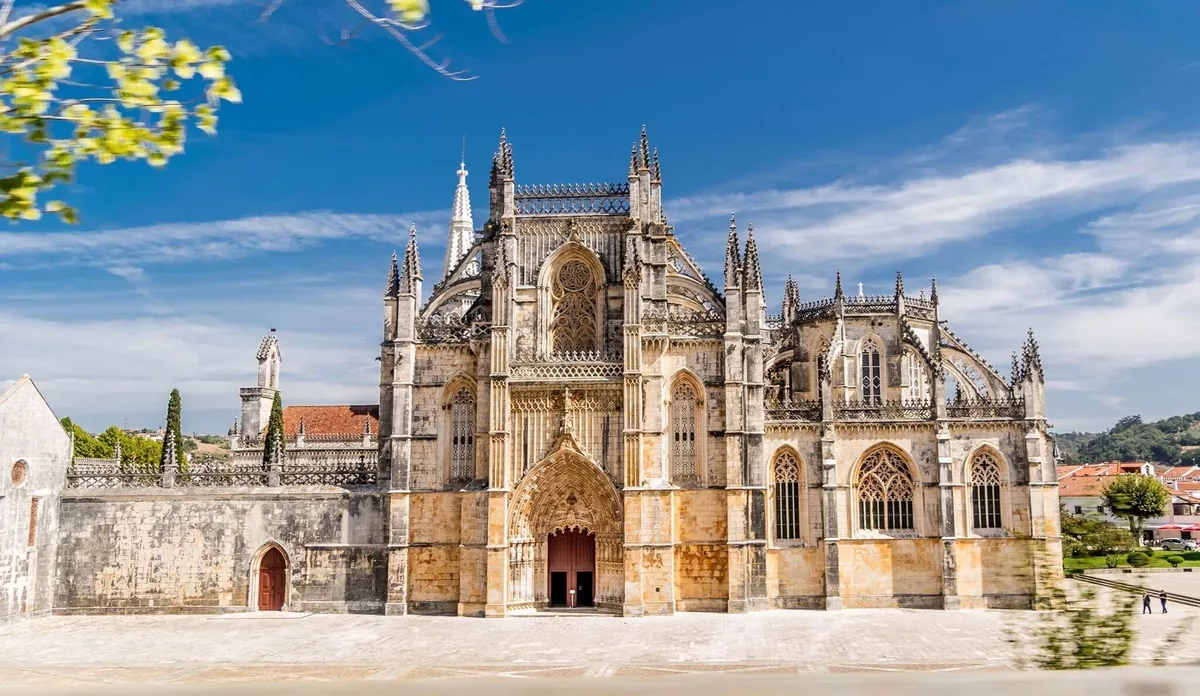
Golden limestone filigree rises from the plains of central Portugal, a limestone prayer that took over a century to carve. The Monastery of Batalha remains a colossal thank-you note from King João I to the Virgin Mary for a military victory that secured Portuguese independence. Its architecture represents the height of the Flamboyant Gothic style, where stone seems to soften into lace and vines. The walk along its exterior, you witness a transition into the Manueline style, where maritime motifs and exotic botanical carvings celebrate the dawn of the Age of Discovery. The complex remains unfinished in parts, providing a haunting glimpse into the architectural ambitions of a kingdom that eventually ran out of time or money.
Battle of Aljubarrota, 1385
King João I made a desperate vow before the Battle of Aljubarrota in 1385, promising a grand monastery if his outnumbered forces defeated the Castilians. The victory was decisive, and construction began in 1386 under the direction of architect Afonso Domingues. For the next seven generations, the project became a laboratory for Portuguese stonemasonry. Master Huguet, who succeeded Domingues, introduced the intricate vaulting and the soaring heights of the Founder's Chapel. However, when King Manuel I shifted royal focus and funding to the Jerónimos Monastery in Lisbon, Batalha’s grandest expansion, the Unfinished Chapels, was left open to the sky. These pillars, thick with stone ivy and snails, remain roofless to this day, a poetic intersection of human craftsmanship and the natural elements.
Stepping into the main nave,
Stepping into the main nave, The temperature drop and the air take on the scent of damp lime and ancient incense. The light filters through massive stained-glass windows, casting vibrant pools of ruby and sapphire onto the cool floor. There is a feeling of transition from the somber, echoing church to the Royal Cloister, where the stone screens between columns are so delicate they look like fossilized sea foam. Audible: a distant bell often punctuates the silence of the Unfinished Chapels, where the lack of a roof allows the sun to hit the intricate carvings directly. Often missed is the tomb of the unknown soldiers in the Chapter House, guarded by silent sentries under a vaulting that once terrified the medieval builders. What lingers with you is standing in the center of the roofless chapels, looking up through stone lace to see the shifting Portuguese clouds.
Reaching Batalha usually involves a two-hour
Reaching Batalha usually involves a two-hour drive north from Lisbon or a shorter hop from the nearby town of Leiria. Regional buses run frequently from both Lisbon’s Sete Rios station and Fátima. While the monastery sits in a modern town, the approach across the square allows the full scale of the flamboyant buttresses to reveal themselves against the sky. Parking is plentiful nearby, but arriving late in the afternoon ensures you avoid the heavy tour groups that stop here between Lisbon and Porto.
The Experience
What catches your eye is is the way the limestone changes color from a pale cream in the morning to a deep, honeyed gold at sunset. Your footsteps on the polished stone of the Founder’s Chapel feels like an intrusion into a royal conversation. A sense of immense verticality of the church, where the pillars stretch upward like petrified trees. Most visitors miss the tiny stone-carved snails and lizards hidden among the Manueline motifs in the cloisters. The piece that stays with you is the silence of the Unfinished Chapels, where the open air makes the stone feel strangely alive.
Why It Matters
Batalha is the definitive monument of Portuguese national identity. It marks the birth of the nation’s independence and showcases the unique Manueline aesthetic that defines the Portuguese Golden Age. It is a rare site where the evolution of European Gothic can be traced through the hands of master masons over 150 years.
Why Visit
Visit Batalha to see stone behave in ways it shouldn't. While other cathedrals feel heavy and imposing, Batalha feels like it was spun from silk. It offers a more intimate and detailed look at Portuguese history than the more crowded monuments in Lisbon, rewarding the traveler who appreciates the beauty of the incomplete.
✦ Photo Gallery
Best Season
🌤 September-October offers the perfect golden hour light for the limestone facade, plus the cooler temperatures make the outdoor Unfinished Chapels much more pleasant to explore.
Quick Facts
Best time to visit
September-October offers the perfect golden hour light for the limestone facade, plus the cooler temperatures make the outdoor Unfinished Chapels much more pleasant to explore.
Getting there
In Batalha, Portugal; reach Batalha first, then continue to the site.
Location
Batalha, Portugal
Type
attraction
Insider Tips
- 1
Wait for the changing of the guard in the Chapter House; it is a solemn, silent ceremony that happens every hour on the hour.
- 2
The stained glass in the chancel is some of the oldest in Portugal, dating back to the 1430s; bring binoculars to see the detail.
- 3
Look for the grave of Prince Henry the Navigator in the Founder's Chapel, marked by the Order of the Garter insignia.
- 4
The Unfinished Chapels require a separate entry ticket, but they are the most photogenic part of the entire complex.
- 5
Dress in layers, as the interior of the main church stays significantly colder than the sun-drenched cloisters and chapels outside.