“Five centuries of Portuguese history are baked into these ceramic squares, including a twenty-three-meter panorama of a Lisbon that no longer exists.”
About Museu Nacional do Azulejo
The origins trace to a Franciscan convent founded by Queen Leonor in 1509, serving as a sanctuary for the Order of Saint Clare. Following the secularization of religious orders in 1834, the building faced various uses before its conversion into a museum in 1965. The collection spans from the Hispano-Moresque 'alicatado' tiles of the 1400s to the golden age of Portuguese tile production in the 18th century. It serves as a rescue mission for the country’s decorative soul, housing thousands of pieces that were literally stripped from the walls of history.
About Museu Nacional do Azulejo
Glazed ceramics in shades of cobalt and eggshell white cover the walls of a former convent, telling the visual history of a nation through fired clay. The Museu Nacional do Azulejo occupies the cavernous, echoing halls of the Madre de Deus Convent, founded in 1509. Through these cloisters offers a sensory journey where the cool touch of porcelain contrasts with the golden opulence of Portuguese baroque altarpieces. This museum protects the craft of the azulejo, an art form inherited from Moorish ancestors that evolved into a uniquely Lusitanian obsession. Every room reveals a different century, from the geometric patterns of the 15th century to the sprawling, narrative blue-and-white panels that became the wallpaper of the Portuguese elite.
Glazed ceramics in shades of cobalt and eggshell white cover the walls of a former convent, telling the visual history of a nation through fired clay.
The past
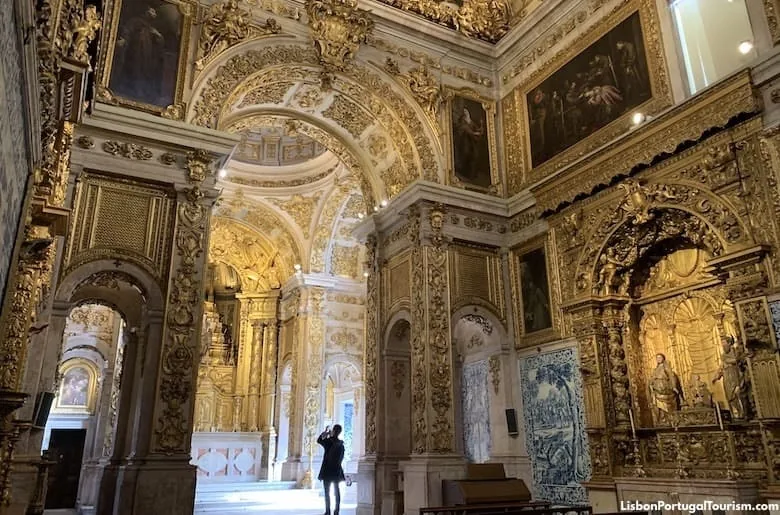
Queen Leonor established the convent on this site in 1509, but the Great Earthquake of 1755 forced a massive reconstruction that integrated the existing Manueline architecture with lavish gold-leaf interiors. The transition from religious house to national museum began in the mid-20th century, specifically curated to preserve tiles salvaged from demolished palaces and churches across the country. One specific masterpiece stands out: a twenty-three-meter-long panoramic view of Lisbon before the earthquake struck. Created in 1738, it remains the most accurate record of a city that was largely erased by fire and tsunami. These tiles were never intended to be museum pieces; they were structural necessities, cooling the interiors of homes while narrating the myths and daily lives of the people who inhabited them.
Inside
Stepping into the main cloister, The sharp drop in temperature as the thick stone walls and glazed surfaces repel the Lisbon sun. The air smells faintly of old wax and damp stone, a lingering ghost of the building’s monastic past. The scale of the collection standing in the center of the Madre de Deus church, where the lower walls are wrapped in blue ceramic narratives while the upper reaches explode in carved gilded wood. The echo of your footsteps on the terracotta floors follows you up to the second level, where the lighting softens to protect the more delicate polychrome glazes. Frequently skipped is the modern section, which proves the azulejo is a living medium still used by contemporary artists. What remains with you is standing before the Great Panorama of Lisbon, realizing you are looking at a phantom city through a window of 1,300 ceramic tiles.
The museum sits slightly east
The museum sits slightly east of the main tourist hubs of Alfama and Baixa. Taking the 728 or 759 bus from Praça do Comércio is the most direct route, dropping you right outside the heavy wooden doors. The walk from Santa Apolónia station takes about twenty minutes along the riverfront, passing through a gritty, industrial edge of the city that makes the sudden beauty of the museum’s interior feel even more rewarding.
The museum sits slightly east of the main tourist hubs of Alfama and Baixa.
The Experience
What gets you is is the way the light reflects off the glaze, creating a shimmering, liquid quality on the walls of the corridors. The silence of the convent is profound, broken only by the chime of a distant clock or the rustle of the garden. Something of rough, hand-painted texture of the older tiles, where the brushstrokes of a 17th-century artisan are still visible. People often miss the tiny cafeteria housed in the former kitchen, which features its own delightful 19th-century tile scenes of game and fish. What lingers with you is the sensory overload of the gold-drenched chapel.
Why It Matters
The Museu Nacional do Azulejo is the only institution in the world dedicated to this specific marriage of ceramics and architecture. It marks the evolution of a Moorish craft into a primary pillar of Portuguese identity. It is not merely an art gallery; it is a repository of the country’s urban memory and aesthetic resilience.
Why Visit
Visit this museum to understand why every building in Portugal looks the way it does. While the Jerónimos Monastery offers scale, this place offers the intimate details of Portuguese life. It is a masterclass in how a single, humble material can define the visual character of an entire nation.
✦ Insider Tips
- 1
Head straight to the top floor to see the Lisbon Panorama first before the school groups arrive.
- 2
The museum app includes an audio tour that explains the specific biblical and mythological stories depicted in the larger panels.
- 3
Look for the 'Chicken's Wedding' panel, a satirical 17th-century piece that mocks the social hierarchies of the time.
- 4
Combine your visit with a walk through the nearby Xabregas neighborhood to see tiles still living on everyday apartment facades.
- 5
Allow at least two hours; the layout is labyrinthine and rewards those who wander into the smaller side-chapels.