Russian Tsars once sent ships halfway across the Atlantic specifically to collect the mineral-rich wine grown within these thousands of black volcanic labyrinths.
About Paisagem da Cultura da Vinha da Ilha do Pico
Viticulture on Pico began shortly after the island’s discovery in 1439, driven by Franciscan and Carmelite friars who recognized the potential of the volcanic soil. The stone walls were built without mortar, stacked precisely to allow wind to pass through while keeping the salt spray out. At its peak, the vineyard culture covered nearly the entire coastline of the island. After the phylloxera blight of the 1850s, the vineyards were largely abandoned until the UNESCO designation in 2004 sparked a massive cultural and economic revival that brought the Verdelho grape back to international prominence.
In brief
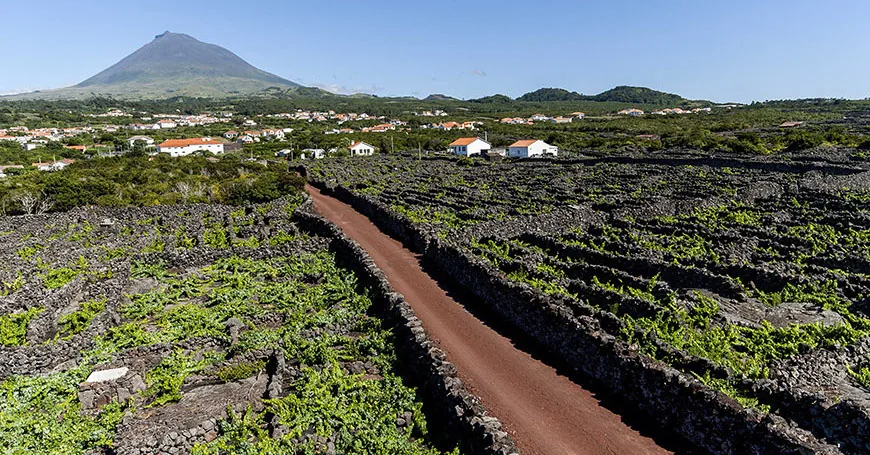
Thousands of small, rectangular plots walled with black volcanic stone stretch toward the Atlantic, protecting vines from the salty spray and relentless winds. The Landscape of the Pico Island Vineyard Culture is a surreal, monochrome mosaic that covers the western shores of the Azorean island of Pico. This is viticulture at its most heroic; the vines are not grown in soil, but in cracks in the basalt lava fields. The stone walls, known as 'currais,' absorb the sun’s heat during the day and radiate it back to the grapes at night, creating a unique microclimate that produces a potent, mineral-heavy wine. It is a landscape that looks more like a geometric art installation than a farm, shaped by five centuries of human stubbornness against an unforgiving volcanic environment.
History
Settlers arrived on Pico in the 15th century and found an island dominated by the massive cone of a volcano and a landscape of frozen lava. Lacking traditional soil, they began to plant Verdelho grapes in the 'biscoitos', the crumbly, biscuit-like volcanic rock. To protect these precious plants, they built a labyrinth of dry-stone walls using the very basalt they cleared from the land. By the 18th century, Pico’s wines were so famous they were found on the tables of Russian Tsars and British royalty. A devastating blight in the 19th century nearly erased the industry, but the stone labyrinths remained. Today, a new generation of winemakers has reclaimed these 'currais,' restoring the walls and the ancient vines to produce some of the most sought-after white wines in the Atlantic.
Walking through the vineyard labyrinths near
Walking through the vineyard labyrinths near Criação Velha, A sharp, metallic scent of volcanic rock mixed with sea salt. The sound of the ocean crashing against the nearby basalt cliffs provides a constant, rhythmic bass note. An impression of heat radiating from the black stones, even on a cloudy day, creating a strange, humid warmth at knee-level where the grapes grow. It becomes clear how the vines crawl along the ground rather than being trellised, hiding from the Atlantic gales. Frequently skipped is the 'rola-pipas', the stone ramps built into the shore where barrels were once rolled directly into the sea to be loaded onto ships. What stays with you is standing on the red-painted windmill at the center of the vineyards, looking out over the endless black grid toward the blue horizon.
Pico is accessible by ferry
Pico is accessible by ferry from the neighboring islands of Faial and São Jorge, or by flight from Lisbon and Ponta Delgada. The best way to see the vineyards is to rent a car or hire a local guide in the town of Madalena. The Criação Velha trail is an easy eight-kilometer walk that takes you through the heart of the protected UNESCO zone. The trail is well-marked and relatively flat, though the black basalt reflects a significant amount of heat, making it essential to carry water even on temperate days.
The Experience
The way the black basalt walls create a flickering visual effect as you drive past them at speed. The feel of the landscape is rough and jagged, a sharp contrast to the liquid smoothness of the wine it produces. A sense of isolation of the island as you look across the channel to the silhouette of Faial. Most visitors miss the 'adegas', small, traditional wine cellars built into the lava rock where the wine is still aged. The element that stays with you is the first sip of a cold Pico white, tasting the exact minerality of the stones you’ve been walking through.
Why It Matters
Pico’s vineyards represent a unique adaptation of human agricultural practices to a hostile volcanic environment. It is one of the few places on earth where the landscape itself is a historical document, recording the labor of generations who literally moved mountains of stone to make the earth give fruit. It is a living heritage site that continues to produce a world-class product.
Why Visit
Visit Pico if you want to see a landscape that feels like it belongs on another planet. It is the antithesis of the lush, rolling vineyards of France or Tuscany. It offers a raw, elemental beauty that connects you directly to the volcanic origins of the Azores and the incredible resilience of the people who call these islands home.
✦ Photo Gallery
Best Season
🌤 August and September are the best months, coinciding with the harvest (vindimas) when the vineyards are full of activity and the weather is reliably dry.
Quick Facts
Best time to visit
August and September are the best months, coinciding with the harvest (vindimas) when the vineyards are full of activity and the weather is reliably dry.
Getting there
In Pico Island, Portugal; reach Pico Island first, then continue to the site.
Location
Pico Island, Portugal
Type
attraction
Insider Tips
- 1
Climb the red windmill (Moinho do Frade) for an elevated view of the geometric 'currais' and the ocean.
- 2
Visit the Wine Museum in Madalena, housed in a former Carmelite convent, to see the giant dragon trees that grow on the grounds.
- 3
Book a tasting at the Cooperativa Vitivinícola da Ilha do Pico to compare different varieties of volcanic wines.
- 4
The stones get incredibly hot; avoid walking through the vineyards in sandals, as the basalt can be sharp and unforgiving.
- 5
Look for the 'manilhas,' small channels carved into the stone to redirect rainwater, which were essential for survival on an island with few springs.