The Atlantic Ocean has spent twenty million years sculpting these golden cliffs into a series of natural cathedrals and sapphire lagoons.
About Ponta da Piedade
Ponta da Piedade has been a silent witness to Portugal’s Age of Discovery, as the caravels of Henry the Navigator sailed past these very cliffs on their way to Africa. The site was once home to a religious hermitage where the families of fishermen would wait for their return. In the early 20th century, the lighthouse was established to guide modern shipping around the treacherous rocky headland. While the geology is ancient, the site only became a major tourist destination in the mid-1900s when local fishermen realized that showing visitors the grottoes was more profitable than the daily catch.
What Ponta da Piedade actually is
Golden limestone cliffs rise from the Atlantic in a surreal architecture of arches, grottoes, and jagged sea stacks. Ponta da Piedade is the Algarve’s most dramatic coastal formation, located just south of the historic port of Lagos. The relentless power of the ocean has carved the soft rock into a labyrinth of hidden beaches and turquoise lagoons that are only accessible by water. From the clifftop, the view stretches across the Bay of Lagos to the distant mountains of Monchique, but the true magic happens at the water’s level. Here, the sea has ground through the stone to create natural cathedrals where the light dances off the yellow walls and the water turns a deep, neon blue.
“Golden limestone cliffs rise from the Atlantic in a surreal architecture of arches, grottoes, and jagged sea stacks.”
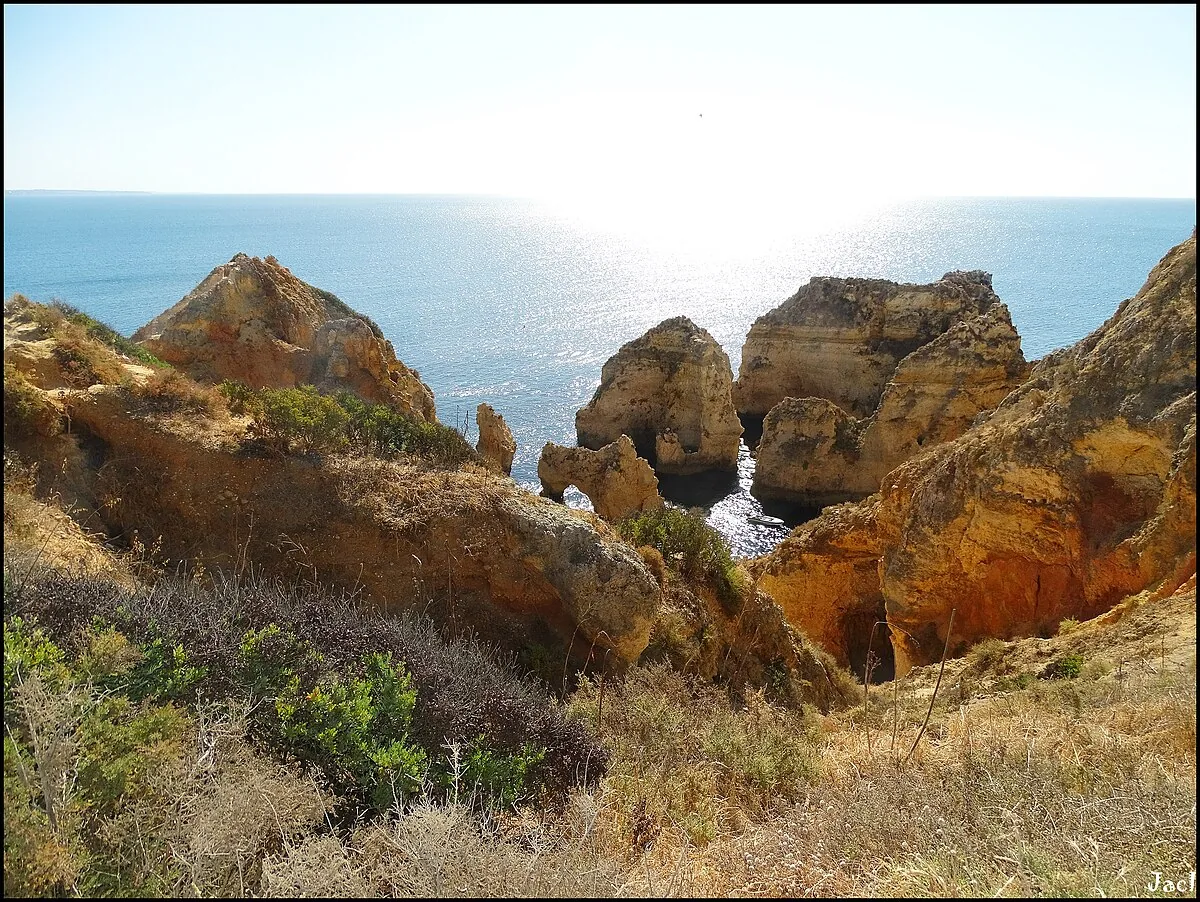
Ponta da Piedade, Portugal
Geologically, these cliffs are composed
Geologically, these cliffs are composed of sedimentary rock formed during the Miocene epoch, roughly twenty million years ago. Over millennia, the hydraulic action of the tides and the chemical erosion of rainwater have exploited the natural fissures in the limestone. While the site is a natural wonder, it has also was a vital maritime landmark for centuries. The lighthouse at the tip of the headland was built in 1913 on the ruins of the Hermitage of Our Lady of Pity, a sanctuary where sailors would pray for protection before venturing into the deep Atlantic. Unlike the sandy stretches of the central Algarve, this headland was never suitable for large-scale development, which allowed its rugged, vertical beauty to remain largely untouched by the concrete sprawl of modern tourism.
On site
Descending the 182 stone steps carved into the cliffside, The sound of the wind is replaced by the booming echo of waves inside the grottoes. The place smells of sea salt and wild thyme that grows along the clifftop paths. Something of spray of the Atlantic on your face as you reach the bottom, where small fishing boats wait to ferry visitors into the deeper caves. The incredible variety of colors in the rock, from pale cream to deep ochre and burnt sienna. Often missed is the tiny fossils embedded in the limestone walls, remnants of the ancient sea creatures that built this place. The piece that stays with you is drifting through a natural stone archway into a lagoon where the water is so clear you can see the white sand on the ocean floor ten meters below.
Ponta da Piedade is located about
Ponta da Piedade is located about three kilometers from the center of Lagos. You can reach the headland by following the coastal boardwalk that starts at Praia do Pinhão, offering a spectacular twenty-minute walk with constant ocean views. For those who prefer to arrive by water, boats leave regularly from the Lagos Marina, navigating through the 'Boneca' and 'Cathedral' grottoes. Taxis and local buses also run from the town center to the lighthouse parking area, making it one of the most accessible natural sites in the region.
“Ponta da Piedade is located about three kilometers from the center of Lagos.”
The Experience
What grabs you is the way the water changes from turquoise to emerald as the boat moves in and out of the shadows. You hear the seagulls nesting in the high crevices creates a wild, lonely soundtrack to the journey. An impression of gentle swell of the ocean beneath the boat, a record of the power that continues to shape the stone. Most visitors miss the 'Kitchen' grotto, where the light filters through a hole in the ceiling to create a spotlight on the water. What lingers with you is the view from the clifftop at sunset, when the yellow rock seems to catch fire.
Why It Matters
Ponta da Piedade is the definitive example of the Algarve’s unique karst coastline. It is a vital habitat for several species of marine birds and a geological archive of the region’s prehistoric past. It represents the raw, unyielding edge of the European continent meeting the vastness of the Atlantic.
Why Visit
Visit Ponta da Piedade to see nature’s most creative sculpture gallery. While the beaches nearby are for relaxing, this headland is for exploring. It is the only place where you can feel like an explorer in a miniature archipelago of gold and blue, all within sight of a historic maritime town.
Insider Tips
- 1
Take a small boat tour rather than a large catamaran; the smaller vessels are the only ones that can navigate the narrowest grottoes.
- 2
The boardwalk is best for sunrise photography when the light hits the eastern face of the cliffs directly.
- 3
Wear sturdy shoes if you plan to walk the clifftop paths, as the limestone is sharp and the terrain is often uneven.
- 4
Look for the 'Camel' and 'Titanic' rock formations; the local boatmen have names for every jagged peak based on their shapes.
- 5
Bring a snorkel; if the sea is calm, the lagoons at the base of the stairs offer some of the best underwater visibility in Portugal.