A simple grazing field was transformed into a plaza larger than the Vatican after three children reported seeing a lady more brilliant than the sun in 1917.
About Santuário de Fátima
Fátima evolved from an unrecognized local phenomenon into a central pillar of 20th-century Catholicism. The three children, two of whom died shortly after the visions, became the youngest non-martyred saints in history. The sanctuary’s development was closely tied to the ‘Secrets of Fátima,’ which were eventually published in parts and included a vision of hell and a prediction of a second world war. The site has been visited by almost every modern Pope, cementing its status as the 'Altar of the World.' In 2007, the addition of the fourth-largest Catholic church in the world marked its latest architectural evolution.
What Santuário de Fátima actually is
A vast, white-paved plaza twice the size of St. Peter’s Square in Rome is the stage for one of the world’s most intense displays of faith. The Sanctuary of Fátima was built on the spot where three shepherd children claimed to see the Virgin Mary in 1917. The complex is anchored by two very different churches: the Neo-Baroque Basilica of Our Lady of the Rosary, with its soaring 65-meter bell tower, and the ultra-modern Basilica of the Most Holy Trinity, a minimalist white disk that can seat nearly 9,000 people. Between them lies the Chapel of the Apparitions, a simple, open-sided structure that marks the exact location of the holmic oak tree where the visions occurred. This is a place that defies traditional tourism, operating on a level of collective devotion that can be felt in the very air.
“Peter’s Square in Rome is the stage for one of the world’s most intense displays of faith.”
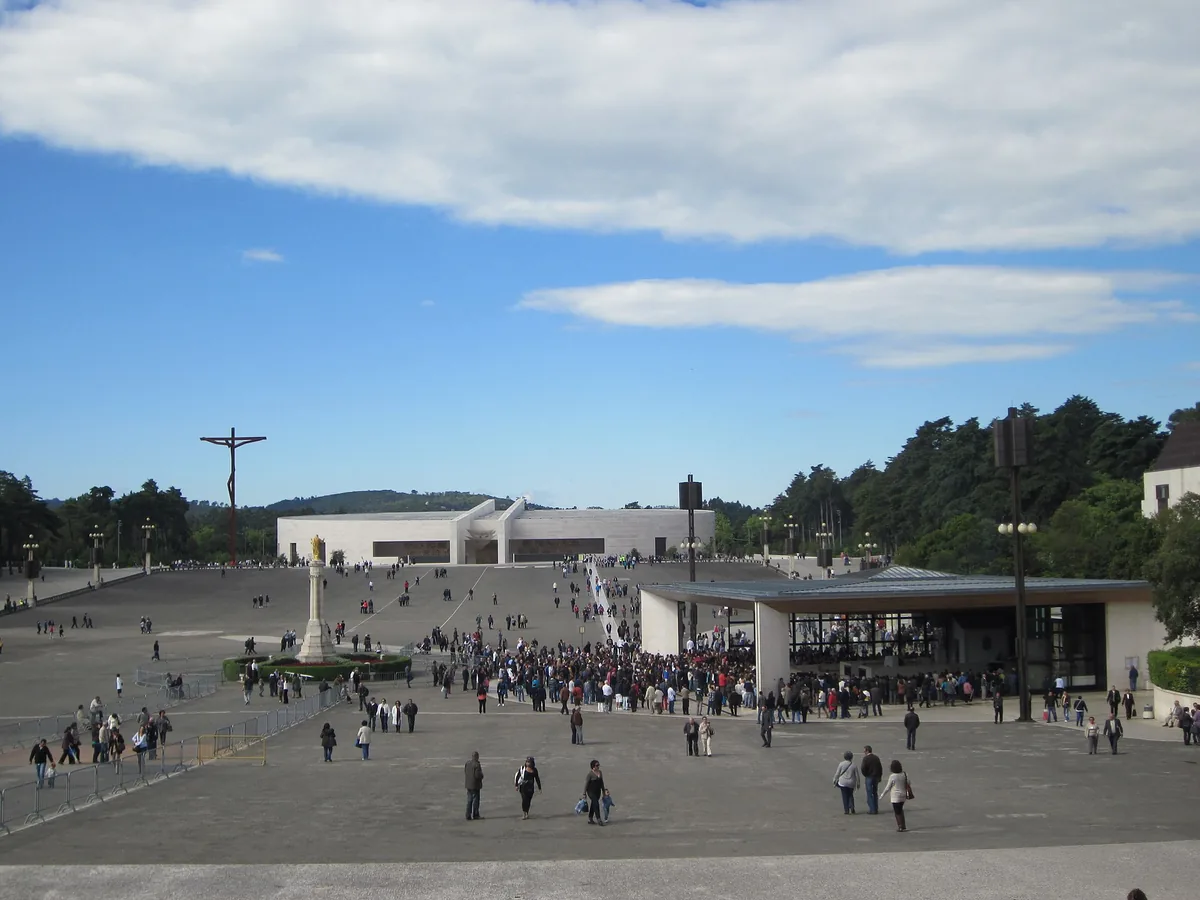
Santuário de Fátima, Portugal
The Fátima story began
The Fátima story began in the middle of World War I, when Lúcia dos Santos and her cousins Francisco and Jacinta Marto reported monthly apparitions of a 'Lady more brilliant than the sun.' The events culminated in October 1917 with the 'Miracle of the Sun,' witnessed by an estimated 70,000 people. From a remote grazing field known as Cova da Iria, the site transformed into a global pilgrimage destination within decades. The Catholic Church officially recognized the visions in 1930, and the first basilica was completed in 1953. The secrets of Fátima, prophecies revealed to Lúcia, fueled decades of mystery and political intrigue, especially regarding the Cold War and the 1981 assassination attempt on Pope John Paul II, who believed the Virgin of Fátima saved his life.
Standing in the center of the vast esplanade
Standing in the center of the vast esplanade, The sound of thousands of voices murmuring prayers in unison, punctuated by the rhythmic crackle of the massive candle offerings. The air often carries the heavy, sweet scent of melting wax and the smoke from the 'Queimador,' where pilgrims toss wax limbs and hearts as symbols of their prayers. The emotional weight of the 'Caminho,' the smooth marble path worn down by pilgrims traversing the length of the square on their knees. how the light reflects off the white limestone, creating a blinding, heavenly glow on bright days. Simple to walk past is the section of the Berlin Wall located at the entrance, a gift to the sanctuary to commemorate the 'Fall of the Iron Curtain' predicted in the secrets. The element that stays with you is the candlelight procession at night, when the square turns into a flickering sea of fire under a silent moon.
Fátima is located about 120 kilometers north
Fátima is located about 120 kilometers north of Lisbon and is most easily reached by car or the 'Rede Expressos' buses that run every hour from Sete Rios station. The journey takes roughly ninety minutes. The town of Fátima has essentially grown around the sanctuary, so once you arrive at the bus station, it is a short, flat five-minute walk to the edge of the esplanade. Most visitors arrive for the 12th and 13th of each month from May to October, but visiting on a quiet weekday offers a much more reflective and less chaotic experience.
“Fátima is located about 120 kilometers north of Lisbon and is most easily reached by car or the 'Rede Expressos' buses that run every hour from Sete Rios station.”
The Experience
It begins with the way the silence in the Chapel of the Apparitions feels more powerful than the shouting of the city outside. You hear the massive bells in the old basilica marks the passage of the day with a deep, melancholy resonance. Something of physical heat from the candle pyre, a literal manifestation of thousands of human hopes and fears. Most visitors miss the 'Path of the Little Shepherds', a quiet walk through the olive groves to the children’s original homes in Aljustrel. What stays with you is the absolute stillness of the crowd during the evening rosary.
Why It Matters
Fátima is more than a religious site; it is a cultural phenomenon that defined 20th-century Portugal. It represents the intersection of folk belief, high theology, and global politics. It is a site of extreme human vulnerability and hope, where the physical act of pilgrimage becomes a tangible expression of faith in the face of suffering.
Why Visit
Visit Fátima even if you are not religious, just to witness the sheer scale of human devotion. It is one of the few places left on earth where you can see thousands of people acting with a single, focused intention. It offers a fascinating look at how a modern myth is constructed and maintained, all within a space of stark, architectural beauty.
Insider Tips
- 1
If you want to witness the candlelight procession, book your hotel months in advance for the 12th of the month.
- 2
The modern Basilica of the Most Holy Trinity contains some of the world's most impressive contemporary religious art; look for the massive bronze crucifix.
- 3
Don't buy the wax candles from the shops outside; the sanctuary provides them for a small donation at the dedicated candle area.
- 4
Walk the 2km 'Way of the Cross' through the Valinhos olive groves for a much more peaceful and natural experience than the main plaza.
- 5
The tombs of Francisco, Jacinta, and Lúcia are located inside the main old basilica and are accessible even during mass.