“These fourteen columns only survived the Middle Ages because they were encased in stone walls and used as a municipal slaughterhouse for centuries.”
About Templo Romano de Évora
Built in the early 1st century AD, the temple was the centerpiece of a Roman forum during a period of massive expansion under Augustus. It underwent significant alterations during the Moorish occupation and the subsequent Christian Reconquista. By the 14th century, it was incorporated into the city's defensive walls. The 1871 restoration by Italian architect Giuseppe Cinatti was a turning point, as he recognized the columns were not just old stone but a vital link to the Mediterranean's classical past. Today, it stands as the crown jewel of Évora’s UNESCO World Heritage status.
Commissioned by Emperor Augustus
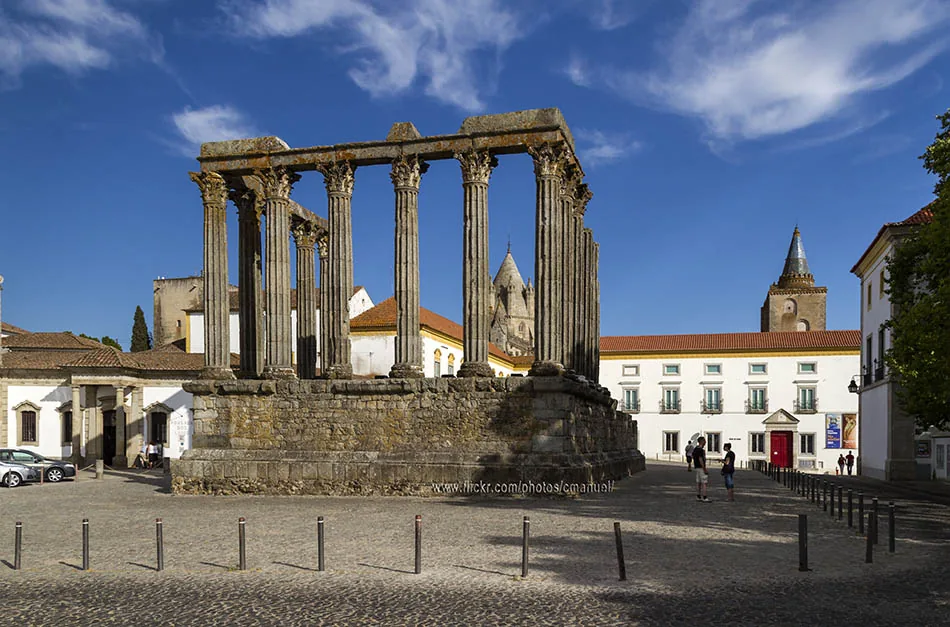
Fourteen Corinthian columns rise from a granite podium in the center of Évora, standing as the most significant Roman ruin on the Iberian Peninsula. Often misnamed the Temple of Diana, this structure was likely built to honor the Emperor Augustus in the first century. The ruin dominates the Largo do Conde de Vila Flor, surrounded by the whitewashed walls of the Inquisition Palace and the Gothic towers of the city’s cathedral. Unlike the crumbling ruins of Rome, these columns feel strangely intact, their fluted shafts and marble capitals carved with a precision that has survived two millennia of Alentejo sun. It is a monument that bridges the gap between the pagan foundations of the Roman Empire and the medieval heart of Portugal.
Fourteen Corinthian columns rise from a granite podium in the center of Évora, standing as the most significant Roman ruin on the Iberian Peninsula.
Constructed during the heyday of Liberalitas Julia
Constructed during the heyday of Liberalitas Julia, the Roman name for Évora, the temple was part of a grand forum that was the city’s social and religious pulse. When the Roman Empire collapsed, the temple found a grim new purpose. During the Middle Ages, the spaces between the columns were bricked up to transform the structure into a fortress and later a slaughterhouse. This unusual second life actually saved the temple from being quarried for stone, as happened to so many other Roman monuments. It wasn't until 1871 that the medieval masonry was cleared away, revealing the elegant skeleton of the original Roman design. This restoration marked one of the first major heritage conservation projects in Portugal, stripping away centuries of utilitarian grime to find the classical beauty beneath.
Walking across the sun-baked square,
Walking across the sun-baked square, The striking contrast between the grey granite of the columns and the white marble of the capitals and bases. The area is dry and warm, often smelling of rosemary from the nearby gardens and the sound of bells from the cathedral. First, the rough texture of the Estremoz marble, which has weathered into a soft, porous surface over twenty centuries. There is a weight of the heat in the afternoon, which makes the shade of the nearby trees a necessity for observation. What most skip is the small drainage holes in the podium that once cleared rainwater from the temple floor. What sticks with you is seeing the columns illuminated at night, when the shadows stretch across the square and the stone seems to glow with an inner, ancient warmth.
Évora is a ninety-minute drive or Évora is a ninety-minute drive or train ride from Lisbon, making it a popular getaway for those looking to escape the capital’s bustle. The temple sits at the highest point of the city’s historic center, which is entirely pedestrian-friendly. From the Évora train station, a twenty-minute uphill walk through the labyrinthine streets leads you directly to the Largo. Many travelers choose to stay in the Pousada de Évora, located in a former convent just across from the temple, allowing them to see the ruins in the quiet stillness of dawn.
Évora is a ninety-minute drive or Évora is a ninety-minute drive or train ride from Lisbon, making it a popular getaway for those looking to escape the capital’s bustle.
The Experience
The thing that grabs you is is the way the light casts long, rhythmic shadows across the podium during the golden hour. You hear the city is muted here, filtered through the narrow alleys that lead up to the square. A strange sense of scale; while the temple is modest compared to the Parthenon, its presence in this small Portuguese town feels gargantuan. Most visitors miss the subtle carvings of acanthus leaves on the Corinthian capitals, some of which are still remarkably sharp. What stays with you is standing on the cathedral roof nearby and looking down at the temple's footprint.
Why It Matters
The Templo Romano is the most well-preserved Roman temple in Portugal. It represents the profound influence of Roman urbanism on the Iberian Peninsula and serves as a physical timeline of Évora’s history, from imperial outpost to medieval stronghold to modern heritage site.
Why Visit
Visit this temple to experience the raw power of Roman engineering without the overwhelming crowds of Italy. It offers a rare opportunity to stand in a space that has been continuously used for 2,000 years. It is the only place where you can see a Roman ruin framed by a Gothic cathedral and a 16th-century palace in a single glance.
✦ Insider Tips
- 1
Visit at sunset when the granite columns take on a deep golden hue that matches the surrounding historic buildings.
- 2
The nearby Cadaval Palace often hosts art exhibitions and is worth the small entrance fee for its private gardens.
- 3
Check the ground near the base of the podium for the remains of the original Roman forum pavement.
- 4
Avoid the midday sun between June and August, as the open square offers very little shade.
- 5
The cathedral roof across the square offers the absolute best vantage point for seeing the temple’s layout from above.