Every August, as the sun rises over the Moldavian plains, the mountain casts a shadow so precise it forms a perfect, three-dimensional pyramid, a trick of light that has been called divine for centuries.
About Ceahlău National Park
Ceahlău National Park is the setting for more Romanian legends than perhaps any other peak. It was the favored retreat of Prince Stephen the Great, who built monasteries in its foothills. During the 19th century, it became a focal point for the Romanian Romantic movement, with poets and painters flocking to its cliffs to capture the rugged beauty of the Eastern Carpathians. The scientific study of the park began in earnest in the early 1900s, identifying over 1,100 species of plants. The establishment of the national park was a response to the threat of logging, ensuring that the 'sacred mountain' remained a wild enclave even as the surrounding valleys were industrialized during the communist era.
Ceahlău National Park in short
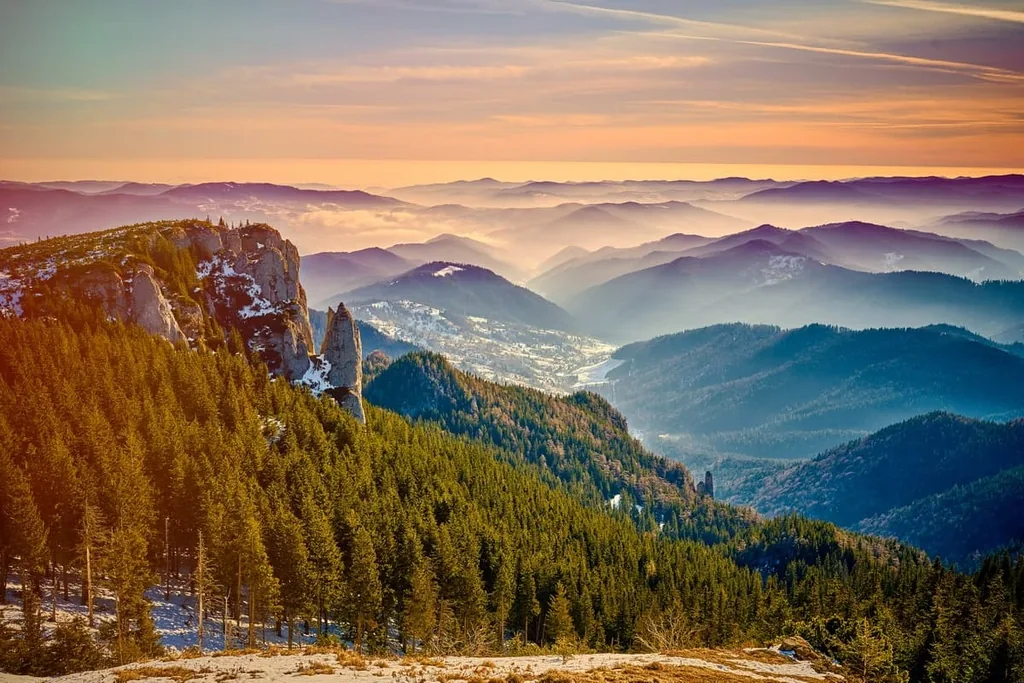
Ceahlău is often called the 'Olympus of Romania,' a lone massif that rises abruptly from the Moldavian plateau like a limestone fortress. Located in the Neamț County, this national park is a geological playground of jagged towers, deep gorges, and high-altitude meadows. Unlike the sprawling Făgăraș, Ceahlău is compact and vertical, making its peaks, Toaca and Ocolașul Mare, accessible but demanding. The mountain is wrapped in a thick blanket of fir and spruce forests, and its upper reaches are defined by bizarre rock formations that have inspired local legends for millennia. The fog often clings to the cliffs, creating a sense of isolation that has drawn hermits and monks to its slopes since the Middle Ages.
The mountain has been considered sacred
The mountain has been considered sacred since the time of the Dacians, who reportedly dedicated it to their primary god, Zalmoxis. In the 14th and 15th centuries, it became a sanctuary for Eastern Orthodox monks, leading to the construction of small hermitages and monasteries, some of which still operate today near the summit. The park was officially established in 1955 to protect its unique biodiversity, including the rare edelweiss and the Carpathian chamois. Geologically, Ceahlău is a 'horst,' a raised block of the earth's crust, which accounts for its sheer walls and the dramatic contrast with the surrounding lower hills. Every year on August 6th, thousands of pilgrims and hikers climb to the summit to witness the 'Shadow Pyramid,' an optical phenomenon where the mountain's shadow forms a perfect pyramid during sunrise.
The hike begins in the shadow of massive evergreens, the trail often crossing small, ice-cold streams. As you climb, the forest thins out, replaced by alpine junipers and the sound of the wind whipping against the limestone crags. The ascent to Toaca Peak involves a series of steep, metal stairs, over 500 of them, that feel like they are leading directly into the clouds. At the top, the view opens up to the Bicaz reservoir, a vast blue eye in the distance. The silence is occasionally broken by the sharp whistle of a marmot or the bells of a mountain chapel. Here, the air is incredibly clean, smelling of resin and wet stone. Resting at the Dochia Chalet, The camaraderie of the trail, where hikers share hot tea and stories of the ascent. The main entry point to the park is the village of Durău, which hosts a variety of guesthouses and the historic Durău Monastery. To reach Durău, most visitors drive from the city of Piatra Neamț or Târgu Neamț, a journey of about 60 to 90 minutes through scenic mountain roads. You get no direct rail access to the park entrance, though buses run from the larger nearby towns. The trails are well-marked with colored symbols, but the weather can change with terrifying speed, so starting the hike early in the morning is the standard rule for anyone aiming for the summit.
The Experience
First, the way the light changes as you pass through the 'Gates of the Mountain' rock formation; the world below disappears, replaced by a kingdom of stone and sky. The climb is physical, but the reward is the sensation of standing on a natural pedestal. The grit of the limestone under your boots and the sudden chill of the mist as it rolls over the plateau. One of the most striking sights is the lonely weather station at the top, a small human outpost in an environment that feels indifferent to civilization. In the evening, if you stay at the chalet, the stars are so bright and numerous they seem to press down on the mountain. It is a place that makes you feel both small and intensely alive.
Why It Matters
Ceahlău is the spiritual heart of the Moldavia region. It represents the intersection of pre-Christian mythology and Orthodox monasticism, serving as a 'Holy Mountain' for the Romanian people. Ecologically, it is a vital refuge for large carnivores like lynx and wolves, acting as a northern anchor for the biodiversity of the entire Carpathian chain.
Why Visit
You visit Ceahlău because it is a mountain with a personality. It isn't just a physical challenge; it is a cultural walk through the myths and history of Romania. The peculiar rock formations like 'Dochia and Trajan' or 'The Panaghia' give the landscape a narrative quality you won't find on more generic peaks.
✦ Photo Gallery
Best Season
🌤 Late September offers the best visibility and the most stable weather, with the added bonus of the forest turning into a patchwork of vibrant autumn colors.
Quick Facts
Best time to visit
Late September offers the best visibility and the most stable weather, with the added bonus of the forest turning into a patchwork of vibrant autumn colors.
Getting there
In Ceahlău, Romania; reach Ceahlău first, then continue to the site.
Location
Ceahlău, Romania
Type
attraction
Insider Tips
- 1
Pack a pair of light gloves for the metal stairs leading to Toaca Peak; the rails can be freezing cold or blistering hot depending on the hour.
- 2
Bring cash for the Dochia Chalet, as they don't accept cards and their blueberry tea is the essential summit reward.
- 3
Stop at the Duruitoarea Waterfall on your way up or down; the sound of the 25-meter drop is a perfect natural soundtrack for a break.
- 4
The park entry fee is small and payable at the Durău mountain rescue (Salvamont) post, keep the ticket handy.
- 5
Check the weather forecast specifically for 'Toaca Peak' rather than Durău, as the summit conditions are often wildly different from the base.