“While the rest of the world’s royals were still lighting candles, this mountain retreat became the first castle in Europe to have its own electricity and central heating.”
About Peleș Castle
The construction of Peleș was a massive international effort, directed by architects Wilhelm von Dodel and Johannes Schultz. It was built during a pivotal era when Romania was forging its modern identity as an independent kingdom. The King’s insistence on using only the finest materials meant that the project lasted until 1914, the year of his death. After being seized by the communist regime, the castle was closed to the public for years, eventually being returned to King Michael I in 2007. It now serves as a national museum, miraculously intact after decades of political upheaval, housing one of the finest collections of art and weaponry in Eastern Europe.
Commissioned by King Carol
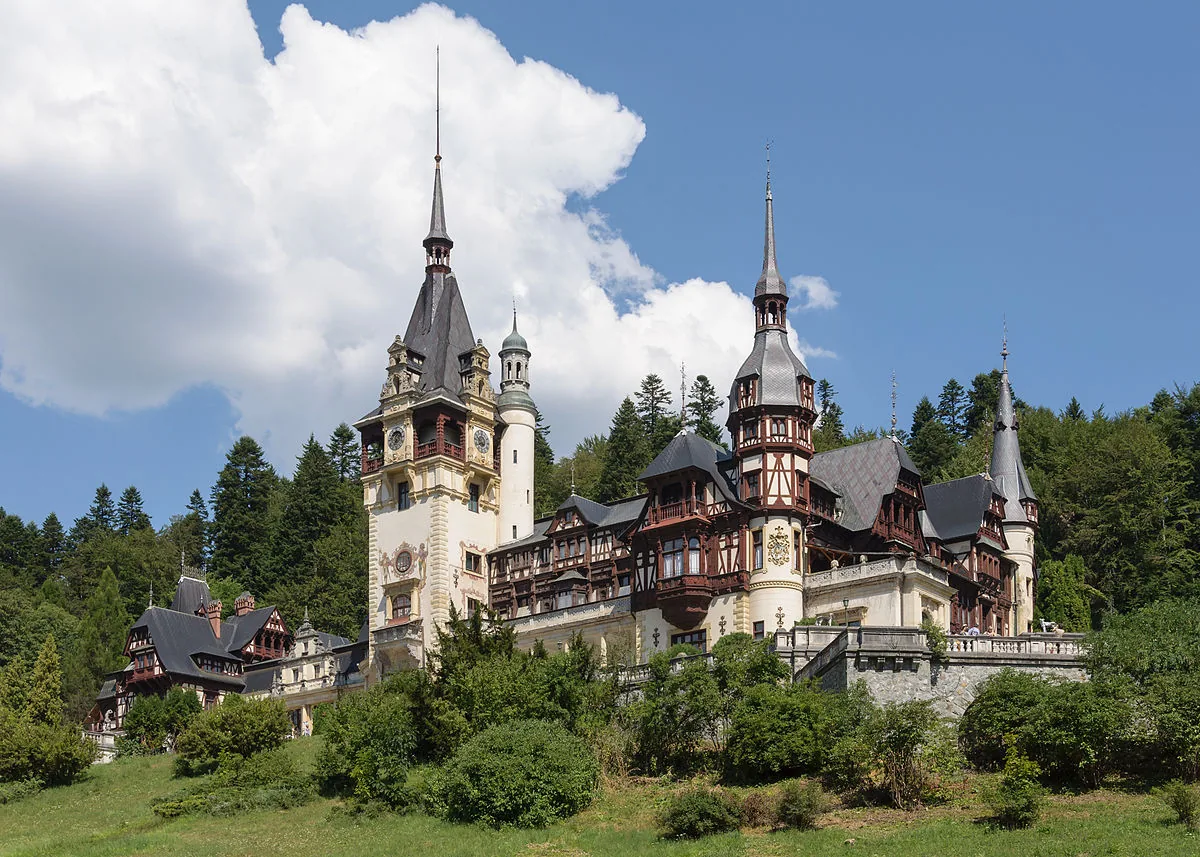
Sharp mountain air carries the scent of resin and damp earth through the Neo-Renaissance spires of a palace that seems more at home in a Germanic fairy tale than the rugged Carpathian wilderness. Peleș Castle functions as a monument to royal obsession, a summer retreat where King Carol I spared no expense to create a sanctuary of technical and artistic perfection. The walk across stone terraces adorned with Carrara marble statues. Notice how the dark timber framing contrasts with the pale stone walls. The interior air feels dense and fragrant with the scent of hand-carved walnut and old leather, a world away from the sun-dappled lawns outside. Light filters through stained glass to dance upon silk-covered walls and intricate marquetry floors. This place functions as a visual mix of the 19th century, where the industrial revolution met the height of romanticism in a valley of impressive verticality.
Sharp mountain air carries the scent of resin and damp earth through the Neo-Renaissance spires of a palace that seems more at home in a Germanic fairy tale than the rugged Carpathian wilderness.
Commissioned by King Carol
King Carol I fell in love with the mountain scenery of Sinaia in 1866, seeing in these peaks a resemblance to his native Germany. Construction began in 1873, but the king rejected three separate architectural plans before settling on a design that satisfied his exacting European tastes. Thousands of craftsmen from across the continent labored here, speaking a dozen languages as they installed the world’s first castle central heating system and a private electricity plant. The palace was inaugurated in 1883, serving as the summer seat of the Romanian royal family until the forced abdication of King Michael in 1947. During the communist years, Nicolae Ceaușescu famously avoided the castle because he believed the woodwork was infested with a fungus that would harm his health, an irony that inadvertently preserved the delicate interiors from modern tampering.
Stepping into the Honor Hall, There is a sense of overwhelming verticality as the three-story space reveals walls lined with walnut carvings and movable glass ceilings. The first thing you register is the way the light catches the cold steel of the armory, home to over four thousand pieces of weaponry that shimmer with a lethal grace. The smell of the library is intoxicating, a mix of vanillin from aging paper and the heavy, waxy scent of polished floorboards. An echo of the plushness of the Persian rugs beneath your feet as you transition from the Moorish salon to the Florentine room, each door opening into a different corner of the world. What registers is the silence of the surrounding forest pressing against the thick windows, a quiet that amplifies the ticking of the castle’s many clocks. What lingers is standing on the balcony, watching the mist roll off the Bucegi Mountains while the fountain below hums a steady, liquid tune.
Sinaia sits about two hours north of Bucharest by train, a journey that climbs steadily into the mountains along the Prahova Valley. From the Sinaia railway station, a steep but beautiful walk through the forest park leads you to the castle gates. Taxis and local buses are available for those who prefer to skip the climb. Tickets must be purchased for specific tours, as the upper floors are only accessible with a guide. Arriving for the first tour of the morning is the best way to see the Honor Hall without the midday crowds that arrive from the capital. Because the castle is tucked into a valley, the temperature is often significantly lower than in Bucharest, so an extra layer is essential even in the height of July.
Sinaia sits about two hours north of Bucharest by train, a journey that climbs steadily into the mountains along the Prahova Valley.
The Experience
The character of Peleș is one of dense, scholarly luxury. What hits is the smell of the pine forest outside mingling with the scent of lemon oil used on the massive walnut doors. The shift in era as you move from the technological marvels of the royal theater to the hushed, spiritual quiet of the private chapel. The light is soft and golden, diffused by thick stained glass that casts ruby and sapphire patterns on the parquetry. The intricate detail of the door handles and the delicate carving of the ceiling beams, which show no signs of age. The most striking detail is the glass ceiling in the Honor Hall; it still retracts perfectly, allowing you to see the mountain stars from the comfort of the palace floor.
Why It Matters
Peleș Castle is a masterpiece of Neo-Renaissance architecture and a symbol of Romania’s royal past. It represents the successful merging of traditional European craftsmanship with the cutting-edge technology of the late 19th century. Culturally, it serves as the heart of Romanian national pride, demonstrating the country’s historic ties to Western European artistic movements.
Why Visit
Why this place matters: you need to see what happens when a king has unlimited resources and a perfect mountain view. While other castles are cold and defensive, Peleș is warm, lived-in, and obsessively beautiful. You come here to walk through a house where every square inch was designed to be a work of art. It is the only place where the industrial age feels truly romantic.
✦ Insider Tips
- 1
Buy the 'extended tour' ticket; the ground floor is impressive, but the private royal apartments on the upper levels hold the most intimate and surprising details.
- 2
Bring a pair of thick socks; you will be asked to wear oversized felt slippers over your shoes to protect the priceless marquetry floors.
- 3
Walk the forest path from Sinaia town rather than driving; the gradual reveal of the spires through the trees is part of the intended royal experience.
- 4
Look for the hidden door in the library behind a fake shelf of books; it leads to the king's private study.
- 5
Check the schedule for the 'mechanical' ceiling demonstration; seeing the 19th-century motor slide the glass roof open is a rare treat.